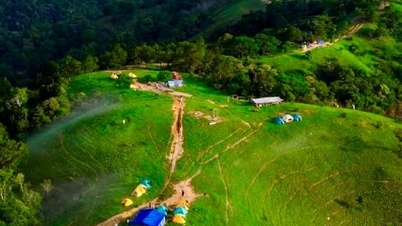
Nam Tra village (Gia Phu commune) is considered the most remote and mountainous village in Bao Thang district. The village has 120 households, all of whom are Dao ethnic people and are classified as poor, receiving government assistance. Village head Chao Lao Lo said: "This is the easiest time to travel on the roads. But if it rains, landslides block the road. The ground becomes slippery, and no vehicle dares to pass through here." The road to Nam Tra has just been leveled, the wind whipping up dust that stings our eyes. We trudged up each steep slope, and finally, we reached the teachers and students of Gia Phu No. 5 Primary School. There is one main school and three branches: Nam Tra 2, Nam Ket, and the furthest, Nam Phang, 8km from the main school. Just a few years ago, the road to Nam Tra was just a narrow path; the only way to reach this school was on foot. Many newly married teachers would cry upon arriving. To get home, they would walk down to Ta Thang and then ask someone going to Pho Lu for a ride. On the day they had to go to teach, their families would drop them off at the foot of Ta Thang, say goodbye, and then they would walk back up to each branch. Principal Le Thanh Bang said that the school has 18 teachers in total, half of whom are young women. Many of these women are newly married with young children, yet they voluntarily choose to stay here as a decision deeply rooted in their hearts. Nam Tra is dotted with houses spaced far apart, and occasionally we'd see Dao girls embroidering by the roadside. What caught our eye was the sight of children going to school in the morning and returning to the fields in the afternoon to plant rice or look after their younger siblings, their bare feet and worn clothes filling the air as they happily ran to class in the morning chill. The voices of teachers Huong and Yen teaching the children to spell, echoing from the four walls made of wooden planks, seemed to dispel the scarcity, gloom, and boredom of this place. Teacher Yen said, "When I first started teaching, seeing a scene like this..." "There were times I wanted to move somewhere else. But now I'm used to it, and I want to stay to help the children learn to read and write." The small school nestled in the Ngoi Giang valley. Beside the slanted classroom, built of wooden planks, stood the teachers' quarters. Most of the teachers here were people from various places, having climbed mountains and crossed streams to reach this remote land to spread literacy. The barefoot students, with their reddish hair and thin, dust-stained cloth clothes, innocently played in the biting cold wind.
You may also like  When knowledge extends beyond the laboratory.The value of scientific research lies not only in academic publications, but more importantly, in how knowledge is transferred from the lab to solve real-world problems. At Phenikaa University, research and application are closely linked in a continuous transformation chain from laboratory to commercialization. From dioxin remediation projects and health products to robotic systems and autonomous drones, all focus on solving a core problem: How to ensure science doesn't remain on paper, but truly enters real life.  Dozens of schools in Ho Chi Minh City are likely to have low 10th grade entrance exam cutoff scores in 2026.Based on the exam results in 2026 and recent enrollment trends, many schools in Ho Chi Minh City will continue to have low admission scores for 10th grade.  Which business couple once donated 100 taels of gold to the government?Besides donating 100 taels of gold to the government, this business couple also made many important contributions to the revolution and the resistance. What do you know about this extraordinary family? Arriving at the Nam Ket branch, which the teachers here call the saddest branch, I felt as if the branches of Gia Phu No. 5 Primary School were struggling to "keep up" with the houses of the Dao people here. Looking around the Nam Ket branch school, there are only a dozen or so houses. Nam Ket also holds records that few schools in the country can match: the entire branch school has only two teachers in charge of two combined classes. Ms. Hien is in charge of the combined class of grades 2, 4, and 5; Ms. Mao is in charge of the combined class of grades 1, 3, and kindergarten. Ms. Hien's combined class also has the fewest students I've ever seen, with only six students in total across the three classes. Teaching methods from the lowlands like group work or discussion are practically useless in such special classes. The teachers' only option is to rotate classes from one to the other. When we arrived, the class had already ended, but the chalk lines dividing the blackboard into three sections were still there: one side with addition problems, and the other side with... The sounds and rhymes are poorly combined… At 11:30 AM, the sun was directly overhead. Standing at the Nậm Phảng branch school, nearly 1500 meters above sea level, we felt as if the sun were closer. The wind was abundant, a raging, swirling gust that echoed through the mountain valleys, mimicking the roar of the Ngòi Giàng stream on the rocks. What was special about the Nậm Phảng branch school was that all four teachers were male. They lived in a dilapidated house, less than 20 square meters, with four walls covered in tarpaulin, like a construction worker's shack. Teacher Bùi Văn Thiện, one of the longest-serving teachers at this school, confided: "When I first arrived here, the further I went, the more isolated it seemed. I almost turned back, but seeing how poor and eager the students were to learn, I couldn't bring myself to abandon them." Getting students here to attend school is very difficult. Most of the children come from disadvantaged backgrounds and are used to working in the fields every day. Therefore, teachers have to go door-to-door to bring them to school. Sometimes, in the middle of school or during the harvest season, many children drop out and go home to help their parents. Teachers then have to travel back and forth to persuade them to return to school. The lack of classrooms is also a major obstacle to teaching and learning in this highland area. Principal Le Thanh Bang said that two years ago, there was a project to rebuild the school, but the construction unit came, demolished the old classrooms, leveled the ground, and then... left without a trace. Fortunately, they were able to borrow the village's cultural center to build two temporary classrooms. On the way from the Nam Phang branch school to the main school, Ms. Yen pointed down into the valley – where a flag was raised amidst the trees, indicating the location of the Nam Tra 2 branch school. In the late afternoon, the mist descended, and it was the dry season. The makeshift generators lacked sufficient water to run, causing the light bulbs to flicker in the dim light. The computers provided by the education department were also left in the cupboard because there wasn't enough electricity to power them. Teacher Bang said: "The main school is lucky to have some electricity. But at the Nam Ket and Nam Phang branches, throughout the dry season, the teachers can only prepare their lessons by lamplight. That's why many teachers sit and prepare their lessons until it's pitch dark and they can no longer see the letters, only then do they start cooking." The road from Nam Tra down to Ta Thang is full of hairpin bends, like invisible traps hidden in the thick mist and clouds. Leaving Nam Tra, I could still hear the children's songs echoing through the green valley, amidst the vast mountain and cloud-covered landscape. I yearn for peace everywhere I go. Life becomes more beautiful. Let the younger ones run around, dancing and singing. The spring sunshine beautifies every home.  Vietnam encourages US businesses to expand investment in high technology.On the morning of June 26th, at the Government Headquarters, Deputy Prime Minister Ho Quoc Dung received Mr. Jeff Place, Supply Chain Director of Coherent Group (USA). During the meeting, the Deputy Prime Minister affirmed that Vietnam encourages US businesses to expand investment, especially in high-tech, innovation, and semiconductor industries.  Encourage U.S. businesses to expand investment in high-tech sectors.Deputy Prime Minister Ho Quoc Dung said that Vietnam welcomes US businesses to continue expanding their operations in Vietnam, especially in high-tech industries and sectors with high added value.  Vietnam and the United States strengthen cooperation in addressing the consequences of war.VTV.vn - On June 22, General Secretary and President To Lam received Acting Secretary of the US Navy Hung Cao. | ||
Manh Dung |

Source: http://laocai.edu.vn/tin-noi-bo/day-chu-o-thung-lung-ngoi-giang-142720

![[Photo] "Hanoi Lotus Festival" honors the lotus flower that has been associated with Vietnam for thousands of years.](https://vphoto.vietnam.vn/thumb/1200x675/vietnam/resource/IMAGE/2026/06/27/1782516943048_sen-ha-noi-2026-minh-duy-1-jpg.webp)