Promoting excellence
As someone who loves exploring traditional cultural values, Mr. Dinh Cong Thanh (35 years old, Hoa Xa commune) often chooses destinations with strong cultural identity when he has the opportunity to travel . One of the journeys that left a lasting impression on him was the night tour at Van Mieu - Quoc Tu Giam.

According to Mr. Thanh, the appeal of this tourism product lies not only in the ancient historical site but also in how cultural values are "retold" in a modern language. During the approximately 90-minute journey, visitors can explore the ancient scholarly atmosphere, learn about the Imperial Examinations, the tradition of studiousness, and the nation's spirit of respecting teachers through various experiential activities such as classes with traditional teachers, folk games, and 3D mapping applications.
"Technology helps make historical stories more accessible and vivid. Tourists not only hear introductions but also get to directly experience and feel the cultural space in a new way," Mr. Thanh shared.
From specific experiences like the night tour of the Temple of Literature – National University, it's clear that digital transformation is contributing to changing the way Hanoi exploits, promotes, and develops its tourism products. With its rich resources including historical relics, cultural destinations, traditional craft villages, spiritual tourism, ecological tourism, and resort tourism, the capital city is gradually applying technology to enhance the attractiveness of its tourism products.
Reportedly, with the support of the Vietnam National Tourism Administration, Hanoi has implemented an "Online - Interconnected - Multimodal" electronic ticketing system at several destinations such as the Temple of Literature, the Vietnam Fine Arts Museum, and the National History Museum. In addition, many night tourism products associated with historical and cultural relics such as Hoa Lo Prison and Thang Long Imperial Citadel, as well as medical tourism, agricultural tourism, and ecotourism linked to rural development, are also being prioritized for development.
Not only major destinations, but many localities in Hanoi are also proactively incorporating technology into tourism promotion and exploitation, especially in traditional craft villages – places that preserve the unique cultural essence of the capital.
Among them, Bat Trang pottery village is one of the bright spots in leveraging digital platforms to expand its market. From a production and business space primarily based on direct operations within the craft village, production facilities in Bat Trang have gradually brought their products onto e-commerce platforms and social networks to promote and connect with customers both domestically and internationally.
According to artisan Nguyen Tuan Minh, one of the businesses effectively applying digital platforms in developing Bat Trang ceramic products, building online sales channels on Facebook, Zalo, and e-commerce platforms has helped his business's products reach a large number of customers in many provinces and cities.
In reality, digital transformation is not just a promotional tool, but is becoming the "key" to more effectively exploiting cultural, historical values and unique products. When technology is combined with the unique identity of each destination, Hanoi tourism has more opportunities to create new experiences, increase its attractiveness, and develop sustainably in the digital age.



Elevating tourism
Not only in major destinations, but also in many localities of Hanoi, which possess a system of historical relics, traditional craft villages, and unique cultural values, digital transformation is considered an important direction to improve the effectiveness of tourism preservation, promotion, and exploitation.

Hoai Duc commune is one of the localities making significant strides in this endeavor. With the goal of promoting heritage values in conjunction with tourism development, the locality is gradually building a digital tourism ecosystem, applying technology to bring destinations, cultural stories, and unique products closer to locals and tourists.
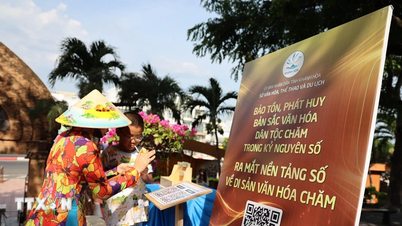
Through the consultation of the Culture and Social Affairs Department of the commune, Hoai Duc is implementing the digitization of data on historical relics, building a QR code system, digital tourist maps, smart digital explanatory texts, and integrating them into the "Hoai Duc Digital Tourism" section. With just a tap on a smartphone, tourists can easily access information about the history, culture, architecture, and value of each destination in a visual and vivid way.
Ms. Dong Thi Nga (Member of the Standing Committee of the Party Committee, Vice Chairman of the People's Committee of Hoai Duc Commune) stated that Hoai Duc is a land rich in historical and cultural traditions, marking the life and career of Emperor Ly Nam De. The commune currently has 53 historical and cultural relics, including 31 classified at the national and city levels, along with 11 intangible cultural heritage sites, numerous traditional craft villages, and unique traditional festivals.
In the context of rapid digital transformation, the application of digital technology and artificial intelligence to preserve and promote traditional cultural values is essential. Therefore, the "Hoai Duc Digital Tourism" section was created. This is not only a modern information and communication channel but also a step towards building a digital database on the local culture and tourism.
According to the leaders of Hoai Duc commune, the "digitization" of cultural values not only helps tourists more easily learn about and experience the destination, but also opens up a new way for the locality to promote the image of its homeland, people, and distinctive products in the online space.
Along with applying technology, Hoai Duc also focuses on building a safe and friendly tourism environment. The local government has implemented comprehensive solutions to ensure security, order, and traffic safety in areas where festivals and crowded tourist attractions take place; strengthened inspections of fire prevention and fighting at accommodation establishments; and coordinated efforts to raise awareness of food safety and hygiene at food service businesses.

Not only in Hoai Duc, but many localities and units throughout Hanoi are also striving to use technology as a "digital bridge" connecting the past with the present, helping historical and cultural values to spread more widely.



In Son Tay, the Army Officer Training School 1, in coordination with the Party Committee, local government, and Youth Union of Son Tay ward, is implementing the "digitization" of the national historical site where President Ho Chi Minh presented the flag bearing the inscription "Loyal to the country, filial to the people" at Son Tay Bus Station. Through the digitalized historical site information website at ditichtraoco.com, along with a QR code system integrated at the site, residents and tourists can easily access historical documents using smartphones or computers anytime, anywhere.
The approaches from Hoai Duc and Son Tay demonstrate that when technology is combined with traditional cultural values, heritage sites are not only preserved but also given new life. Each QR code, each digital platform, becomes a "door" opening up historical narratives, helping today's visitors access heritage in a more accessible and modern way.
Looking at the broader picture, with the proactive application of technology by localities and the orientation towards developing smart tourism, Hanoi is gradually forming a modern tourism ecosystem where the past is preserved through technology, cultural values are disseminated through new methods, contributing to the further development of the capital's tourism in the digital age.
Source: Hanoi New Newspaper
Source: http://sodulich.hanoi.gov.vn/day-manh-so-hoa-de-nang-tam-du-lich.html