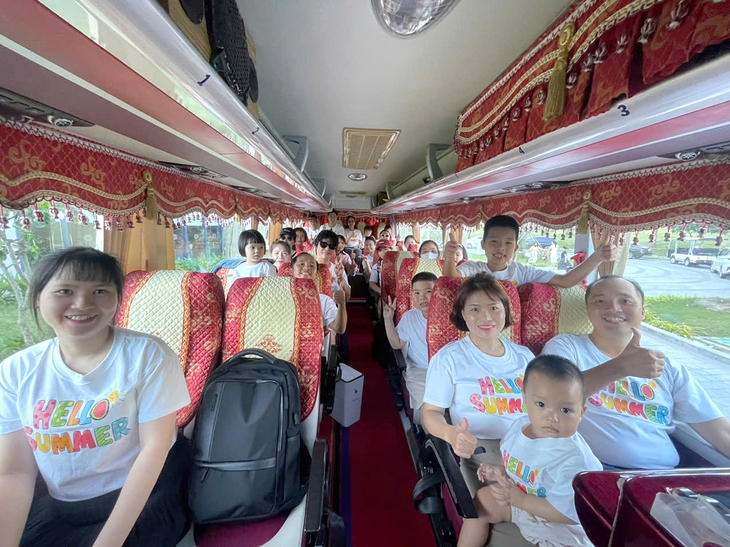
The driver was calm and careful to ensure the tourists had a pleasant journey - Photo: TNV
For a safe and enjoyable journey, there are some things that drivers, especially family drivers who don't often drive long distances, need to keep in mind.
Sad journeys and happy journeys
Almost every driver has some regrettable experiences they don't want to remember but can't forget.
Nguyen Thanh Dong, a former driver for Saigon Petro, is still haunted by the scene of his 7-seater car being crushed and six people losing their lives on National Highway 1. The man was transporting Vietnamese expatriates on a cross-country tour , but he fell asleep at the wheel at night, losing control and crashing head-on into an oncoming truck.
Meanwhile, Le Thanh, a driver with over 30 years of experience in Ho Chi Minh City, still regrets handing the wheel over to his wife during a summer vacation in the Mekong Delta. In an inexperienced overtaking maneuver, she crashed her car straight into the back of a truck in front of them.
Of the three people in the car, only Thanh survived. His wife and child were not so lucky! The tragic event is over, but Thanh still feels belated regret when recalling it: "My wife had only gotten her driver's license a few months ago. If only I hadn't handed the wheel over that day so I could have taken a nap!"
But those are just a few of the risks; summer still offers many safe journeys if the drivers are experienced and careful.
During the summer months of June, the staff and teachers of the Vietnam-Japan Vocational Education Center went on a 3-day tour to Cam Ranh (Khanh Hoa) to strengthen team spirit and recharge their positive energy.
What most driving instructors appreciated during their three-day trip as passengers on the 30-seater bus was the friendly demeanor of the elderly driver. He was mature, cheerful, and experienced, driving safely both ways.
More than half of the passengers were women and teenagers, but no one experienced motion sickness or vomiting. Despite the unpredictable weather (rain and sunshine) and heavy traffic in many areas, the tourist bus remained smooth as it ascended and descended the Phuong Hoang pass and traveled along the Nha Trang - Khanh Hoa expressway, allowing passengers to rest and sleep peacefully.
No one felt unsafe because throughout the journey, even during unexpected stops, the driver didn't make any sharp turns or brake suddenly. Except when sleeping, the children played games and sang together, and the mothers joined in, filling the entire bus with joy.
"Driver, how do you manage to drive such a large vehicle for hundreds of kilometers so smoothly?" - someone asked.
The driver smiled and shared, "I'm driving tourists for sightseeing and relaxation, not transporting emergency patients, so there's no need to rush. I focus on driving smoothly and safely so everyone can relax and enjoy themselves."
Ms. Lien and her husband, Mr. Thang, a teacher from Buon Ma Thuot, recently drove back to their hometown in the midland region of Phu Tho in their four-seater car with their two children. Mr. Thang, Ms. Lien's husband, has been a long-distance truck driver for many years and is now a driving instructor.
He said: "Every year, during the summer break, my wife and I plan a trip back to our hometown for our children. First, it's to let them know their homeland, grandparents, and relatives, and second, to let them see the rice fields, the rice plants, the buffaloes..."



Mr. Thang added: "I made sure to prepare the vehicle for safety, taking it to the service center for a thorough inspection, changing the oil and coolant. My wife prepared luggage, food, and even a backup stove in case of unexpected situations like traffic jams or vehicle breakdowns far from populated areas."
Throughout the round trip, Mr. Thang was mostly the driver. He only handed over the route information to his wife, choosing routes that were scenic and avoiding rush hour traffic, so that he could recline and rest.
Tips for a safe trip
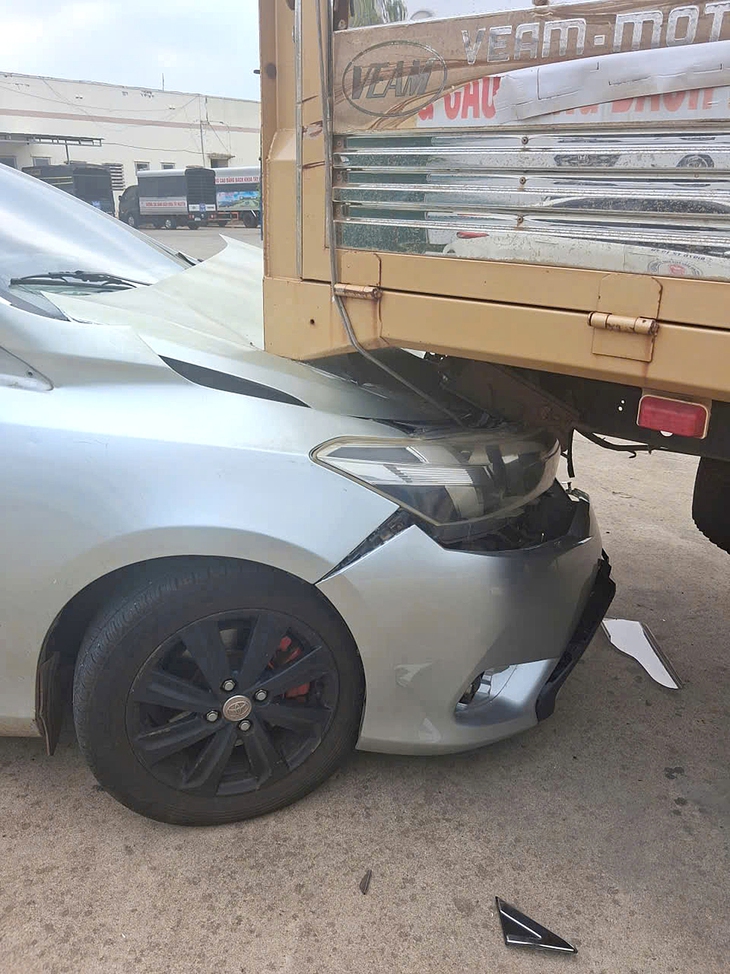
Car rear-ends truck due to failure to maintain safe distance - Photo: TNV
Having been a long-distance truck driver for many years but now teaching driving, Thang learned many valuable lessons from his recent summer road trip with his wife and children back to their hometown.
The first and most crucial piece of advice that Mr. Thang shared was the importance of preparing the vehicle for a safe long journey.
Besides things the driver can visually check, such as worn tires or a weak battery, procedures like checking wheel alignment and balancing to reduce vibration during long journeys require taking the vehicle to a reputable repair center.
Next, you need to learn how to navigate using directions from Google Maps and the vehicle tracking system.
Mr. Thang shared: "This was my first time taking my driving students to Phu Yen, east of Dak Lak province. On the way there, following Google Maps, we arrived at our destination without any problems. But on the return trip, my students and I were stranded in the middle of the night because Google Maps only showed the highway, as the highway to Buon Ma Thuot wasn't yet open."
The teacher and students had to turn the car around, only to find out later that Google Maps indicated they were only 600 meters away from turning right. They had only driven about 300-400 meters when they saw the turn-off, and they turned right prematurely, thus getting lost and ending up on the highway. Family drivers often make this mistake.
One small detail that new drivers often get confused about is: At roundabouts, Google Maps often directs you to the first, second, or third turn. You need to know that the first turn is the first and closest turn on the right, in order to steer your vehicle onto the correct road as indicated.
In particular, drivers who are unfamiliar with the routes or don't frequently travel long distances should regularly check their vehicle tracking devices for early warnings to avoid speeding violations and subsequent fines.
In addition to complying with traffic laws, drivers must operate their vehicles in the correct lane and section of the road as prescribed. They should only drive in one lane, maintain a steady, straight path, and keep a safe distance from the vehicle in front.
When encountering obstacles or a vehicle suddenly stopping ahead, drivers should downshift, reduce speed, and, if necessary, come to a complete stop, and turn on their hazard lights. When changing direction, lanes, or making a U-turn, drivers should remember to downshift, reduce speed, and carefully observe to ensure safety before changing direction or making a U-turn.
In reality, most vehicles on the road comply well with the Road Traffic Law, but drivers still need to constantly observe (looking up close, looking far away, glancing left and right) to maintain control of the space around their vehicle, ready to yield to or avoid drivers who overtake recklessly, cut in front of them, or swerve.
Drivers should also remember to minimize anger, arguments, or fights in the event of a collision. Drivers transporting their wives and children on long journeys back to their hometowns should also note down emergency numbers, rescue services, or local police numbers in the areas they pass through so they can ask for assistance if needed.
Having safe and enjoyable summer trips isn't difficult; just remember the principle of thoroughly preparing your vehicle and driving carefully. Because behind you is the life of your family, and in front of you is the life of others.




It's still the same problem: tailgating and not maintaining a safe distance.
Be careful when handing over the co-driver position.
According to experienced drivers, family drivers rarely drive long distances, so they need to pay attention to their health. Even if it's a trip, they shouldn't party excessively the night before driving to maintain good health and a clear mind for driving.
Long journeys and prolonged driving can easily lead to drowsiness. Drivers need to remember the principle of never continuing to drive when feeling sleepy, as this is extremely dangerous. This is the cause of many tragic accidents.
In particular, careful consideration is needed when handing the wheel over to someone else, such as your spouse, children, or friends, so you can rest. New drivers or those unfamiliar with highways and mountain roads may encounter unsafe situations.
Source: https://tuoitre.vn/de-nhung-chuyen-choi-he-an-vui-10026062210530462.htm


![[Photo] "Hanoi Lotus Festival" honors the lotus flower that has been associated with Vietnam for thousands of years.](https://vphoto.vietnam.vn/thumb/1200x675/vietnam/resource/IMAGE/2026/06/27/1782516943048_sen-ha-noi-2026-minh-duy-1-jpg.webp)