

Large-scale cultivation areas, but a tendency towards dispersion.
With an area of over 1,000 hectares and an annual production of approximately 14,000 tons of fruit, Quang Ninh is currently one of the top 5 provinces producing custard apples in the country. It is also the fruit tree with the largest cultivated area among the province's main fruit crops, concentrated in localities such as An Sinh, Binh Khe, and Quang Yen. To date, custard apples have achieved an average yield of over 12 tons/ha, with an annual production of approximately 14,000 tons.

Currently, the entire province has over 1,000 hectares planted with custard apple trees, making it the fruit tree with the largest planted area among the province's key fruit crops.
In concentrated production areas, custard apple trees have proven to be significantly more economically viable than many other crops. For the firm-fleshed variety, the average yield reaches over 12 tons/ha, with prices ranging from 20,000-30,000 VND/kg, generating revenue of 240-300 million VND/ha. For the soft-fleshed variety, although the yield is lower, only about 8-10 tons/ha, the selling price is higher, averaging 30,000-40,000 VND/kg, and can even reach 80,000-100,000 VND/kg at the beginning of the season, helping many models achieve revenue exceeding 300 million VND/ha/year.
Mr. Bui Xuan Hanh (Binh Khe ward) happily shared: "Currently, my family owns a custard apple orchard with native varieties. Thanks to mastering the techniques of care and propagation, by 2025, each tree will yield an average of 20-30kg of fruit, mostly first-grade with about 3 fruits per kilogram; the selling price ranges from 90,000-100,000 VND/kg, with an average income of over 2 million VND per tree."

Mr. Bui Xuan Hanh (Binh Khe ward) grows a local variety of custard apple with high economic value.
Due to the high economic benefits, some farmers have proactively switched from firm-fleshed to soft-fleshed custard apples, applying technical measures such as supplementary pollination and staggered harvesting, thereby stabilizing yields and increasing product value. Several growing areas have been certified VietGAP with an area of over 350 hectares, accounting for approximately 40% of the custard apple growing area in Dong Trieu City (before the merger). The Department of Agriculture and Environment has requested the Department of Crop Production and Plant Protection (Ministry of Agriculture and Environment) to grant special approval for the circulation of the two custard apple varieties from Dong Trieu. The Provincial Agricultural Extension and Forest Management and Development Center (Ministry of Agriculture and Environment) has self-declared one custard apple variety, QN-D1. Many people in localities have also proactively approached new custard apple varieties of imported origin for cultivation (Queen custard apple, Durian custard apple, etc.).
However, there are still significant differences in economic efficiency between growing regions. In newly developed areas like Dam Ha commune, people mainly cultivate based on experience, with little investment in technology, leading to unstable yields and quality. This shows that the economic advantages of custard apple trees have not been exploited evenly across the province. Mr. Pham Van Vien (Tan Luong village, Dam Ha commune) said: Custard apples are popular with consumers, but due to family-scale production, expanding the area, accessing new techniques, transportation, and consumption are also difficult.

Officials from the Farmers' Association and Mr. Ninh Van Toan (on the right) (Tan Tien village, Dam Ha commune) exchange experiences on growing custard apples.
Overall, during the period 2018-2025, the area of fruit trees in general and custard apple trees in particular tended to fluctuate, even decreasing at certain times due to land reclamation for development projects, the aging of many orchards, declining productivity, or the impact of natural disasters. According to statistics from the Department of Agriculture and Environment, the area of custard apple trees decreased from over 1,200 hectares in 2018 to approximately 1,008 hectares in 2023, before recovering to over 1,100 hectares in 2025.
One notable issue is that custard apple growing areas are still scattered, interspersed with residential areas and other crops. This makes it difficult to invest in synchronized infrastructure, apply mechanization, and establish planting area codes—requirements that are increasingly mandatory in modern agricultural production.
In addition, the custard apple growing areas in the province are facing many difficulties such as: limited infrastructure serving production in many areas; poor soil nutrients and steep terrain making mechanization difficult; seed quality not strictly controlled because most of the area is planted from seeds; weak production-consumption linkages; lack of post-harvest processing, preservation, and processing facilities; short shelf life and high seasonal pressure.

Thanks to custard apple cultivation, revenue from many farming models has exceeded 300 million VND/hectare/year. (Photo: Off-season custard apple cultivation has helped Mr. Tran Van Co, Xich Tho village, Thong Nhat commune, achieve a revenue of approximately 500 million VND/year).
Regarding sales, localities producing custard apples on a large scale have covered collection points with ample space, allowing orchard owners to gather, sort, weigh, and package their produce, facilitating selection and transportation by traders to consumption points. Besides traditional distribution channels, some models have begun to approach e-commerce platforms, OCOP (One Commune One Product) channels, and social media for direct sales, but the scale remains modest, especially in a province that attracts over 12 million tourists annually. Clearly, Quang Ninh has a huge potential market for local agricultural products, including custard apples; however, the connection between custard apple production and tourism and services remains weak. The majority of products still depend on private traders, with prices influenced by short-term market fluctuations, posing the risk of "bumper harvest, low prices," especially given that the main harvesting season only lasts about a month.
Restructuring growing areas and value chains
Developing sustainable custard apple growing areas is not just a matter for individual farmers, but a comprehensive issue encompassing planning, production organization, application of science and technology, and market development. The reality demands that Quang Ninh province shift from a mindset of "producing what we have" to "producing what the market needs," linking growing area development with the restructuring of the value chain.
One fundamental solution is to review and adjust the planning of custard apple growing areas towards concentration, selecting areas with clear advantages in soil and climate. A systematic assessment and analysis of the land is necessary to identify suitable ecological zones, thereby providing appropriate technical recommendations for each sub-region. Alongside planning, investment in integrated infrastructure is needed, including internal field transportation, water-saving irrigation systems, electricity for production, and processing and packaging facilities.

The family of Mr. Le Hong Thang (Dinh village, Thong Nhat commune) is tending to their off-season custard apple orchard.
Mr. Nguyen Van Phu, Vice Chairman of the People's Committee of Thong Nhat commune, said: The province's identification of custard apple as one of the main forestry tree species opens up a direction for restructuring crop patterns in some areas of production forest with suitable conditions, thereby expanding the sustainable development of custard apple cultivation. Currently, the commune has over 45 hectares of custard apple cultivation with 42 participating households. It is expected that in 2026, the commune will continue to expand by another 100 hectares, making custard apple a key fruit crop of the locality.
Science and technology have also been identified as the "key" to improving the productivity, quality, and stability of custard apple products. The province aims to promote grafting and renovation of old custard apple orchards, using new high-yielding varieties with good cold tolerance and staggered harvesting such as QN-D1 custard apple, Taiwanese soft custard apple, pineapple custard apple, etc., in order to extend the supply period and reduce seasonal pressure. Along with this, it emphasizes strengthening the application of mechanization, water-saving irrigation systems, biological products, integrated pest management (IPM), and moving towards organic production and circular agriculture. However, according to many farmers, the transfer of technology needs to be more substantive, linking training with direct guidance in the fields, helping farmers master the production process, especially in newly planted areas such as Thong Nhat and Dam Ha.
Sharing his experience in sales, Mr. Hoang Van Huong, Director of Nghia Phuong custard apple cooperative (Bac Ninh province), said: Currently, the cooperative is a major buyer in the northern region, supplying custard apples to Hanoi and other major cities. The scale, area, and production of custard apples in Quang Ninh province are not a major issue in sales, however, in reality, to have a stable market and good selling price, sustainable development of custard apple growing areas cannot do without production and consumption linkage models. Organizing production through cooperatives, partnerships, and multi-party linkages will help concentrate resources, standardize processes, enhance competitiveness, and reduce risks for producers. Most importantly, people must produce high-quality products with uniform size and quality, and high stability.
Many businesses and custard apple growers also stated that, along with consolidating traditional markets, the province needs to promote trade, connect with supermarket systems, clean agricultural product chains, and e-commerce. At the same time, it should effectively exploit the tourism market through agricultural tourism models and custard apple orchard experiences, thereby increasing the value and brand recognition of the product – a promising new direction in rural areas today.

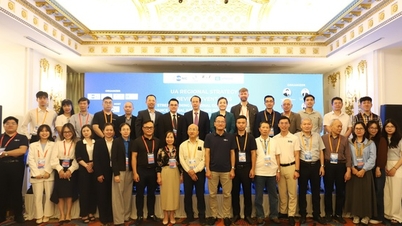
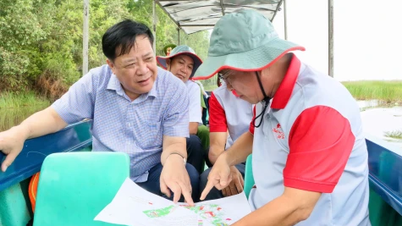
As part of the seminar "Developing a Sustainable Custard Apple Production Area in Quang Ninh" to be held in December 2025, delegates visited a model custard apple production facility in Dam Ha commune.
Mr. Nguyen Khac Dung, Director of the Center for Agricultural Extension and Forest Protection and Development Management, stated: "Sustainable development of custard apple growing areas is an essential task for our unit and the agricultural sector. In December 2025, at Dam Ha commune, the Center organized a seminar on 'Sustainable Custard Apple Production Area Development in Quang Ninh'. Through this seminar, managers, experts, and farmers identified challenges and sought solutions to make custard apple a key agricultural product of the locality. Three strategic solutions for custard apple cultivation were also outlined: standardizing cultivation processes, focusing on rejuvenating custard apple orchards, applying advanced techniques, and expanding production areas according to VietGAP and organic standards; building brands and planting area codes; and strengthening the supply chain. In the future, we will continue to review the planning and advise the province on implementing practical support policies regarding capital, technology, and trade promotion."
Overall, custard apple cultivation has been and continues to bring significant economic value. However, for sustainable development, a long-term, synchronized strategy is needed, encompassing planning, infrastructure, science and technology, and market access. Once these bottlenecks are addressed, the custard apple growing region of Quang Ninh will not only focus on raw material production but can also make a practical contribution to the province's goals of developing ecological agriculture, modern rural areas, and civilized farmers in the coming period.
Hoang Nga
Source: https://baoquangninh.vn/de-phat-trien-vung-trong-na-ben-vung-3392460.html













































































Comment (0)