In reality, waste collection and management in many areas still face shortcomings. In some residential areas, streets, and small business districts, waste sometimes accumulates for extended periods before being transported, causing foul odors, detracting from urban aesthetics, and affecting residents' lives. In some places, household waste is mixed with plastic packaging, paper, leftover food, or even left haphazardly on sidewalks in busy areas.
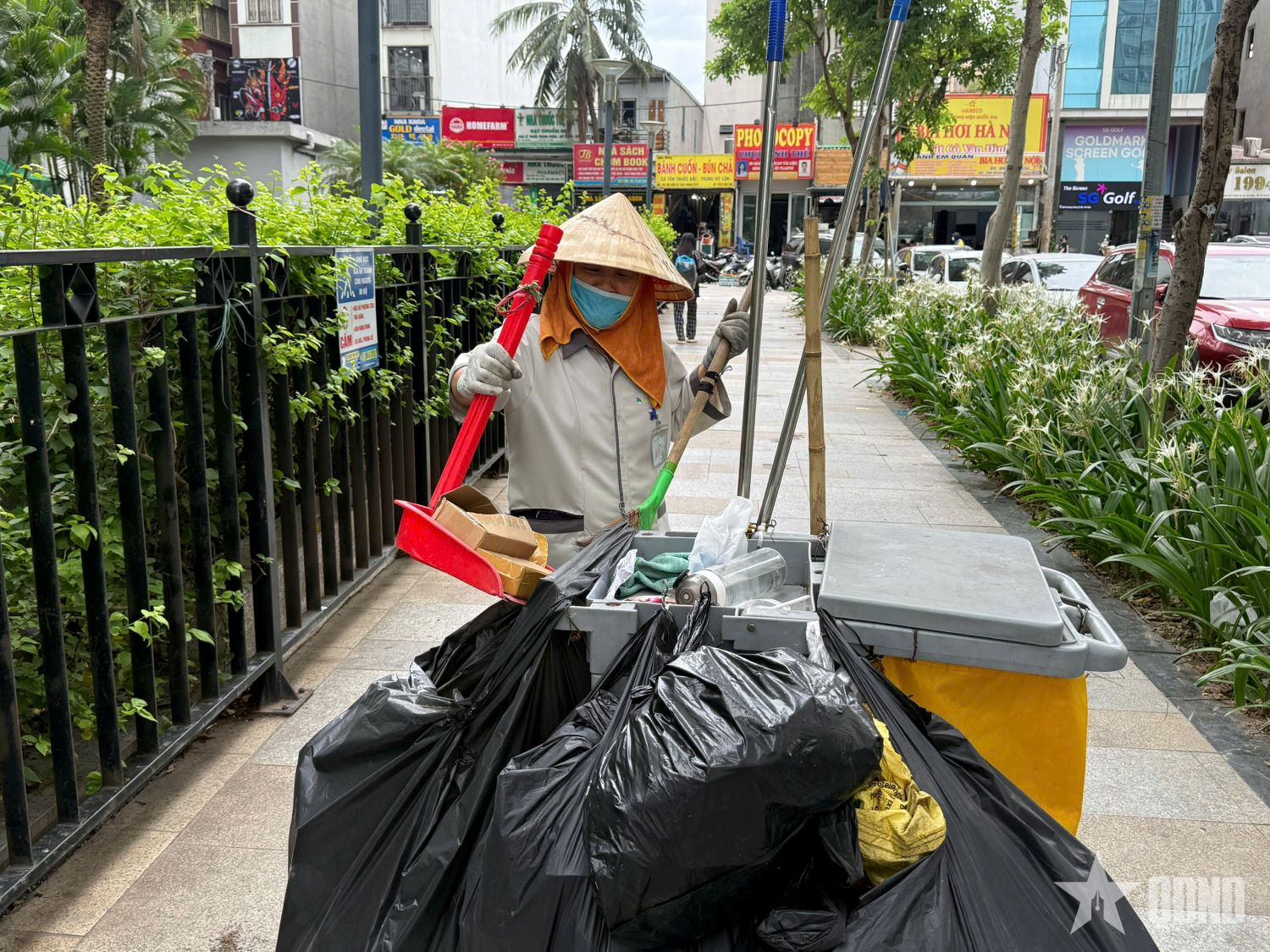 |
Garbage collection activities at Goldmark City apartment complex ( Hanoi ). |
Currently, public and sorting bins do not meet practical needs. In some streets and public areas such as Ba Trieu Street, Nguyen Dinh Chieu Street, Le Duan Street, and the area around Thien Quang Lake, public bins have been placed to serve the needs of residents and tourists. However, the practice of discarding household waste outside the bins still occurs, indicating a low level of compliance among some people and highlighting the need for stricter management.



Notably, separate bins for organic, inorganic, and recyclable waste are still not widespread. The majority of household waste is mixed together, from leftover food, leaves, paper, plastic, and metal to non-biodegradable packaging. When organic and inorganic waste are mixed, recycling and reuse become much more difficult. Without sorting at the source, subsequent processing steps will be more costly and less efficient. Therefore, residents hope that authorities will continue to review the placement of waste bins, provide specific guidance on sorting, and maintain stable collection to create a cleaner and more civilized living environment.
Mr. Ngo The Anh, Director of the Investment and Infrastructure Project Management Board of Hai Ba Trung Ward (Hanoi), said: “In the ward, public and enclosed trash bins have been installed to collect household waste according to a set schedule; at the same time, specialized pushcarts are used for collection in residential areas and narrow alleys. However, currently, waste sorting at source still faces difficulties due to the lack of a synchronized post-sorting processing system, especially the absence of a separate facility for processing organic waste.”
To address this situation, it is necessary to review the waste collection network, collection points, and public trash can system; appropriately place trash cans in residential areas, schools, markets, parks, and busy streets. In addition, collection schedules need to be publicly announced and stable so that people can follow them consistently; illegal waste disposal must be inspected and strictly dealt with. Waste sorting at source can only be effective when accompanied by separate collection, transportation, and appropriate processing mechanisms, avoiding the situation where people sort their waste but it is still collected together.
Waste management is a problem directly linked to people's lives and the quality of the urban environment. To create a green, clean, and beautiful living space, in addition to the efforts of the government and relevant agencies, the consensus and cooperation of each citizen is essential in disposing of waste in designated areas and at the right time, and gradually forming the habit of sorting waste at the source. When solutions are implemented synchronously, regularly, and appropriately to reality, waste management will be more effective.



Source: https://www.qdnd.vn/xa-hoi/cac-van-de/de-rac-thai-khong-con-la-noi-lo-do-thi-1045912