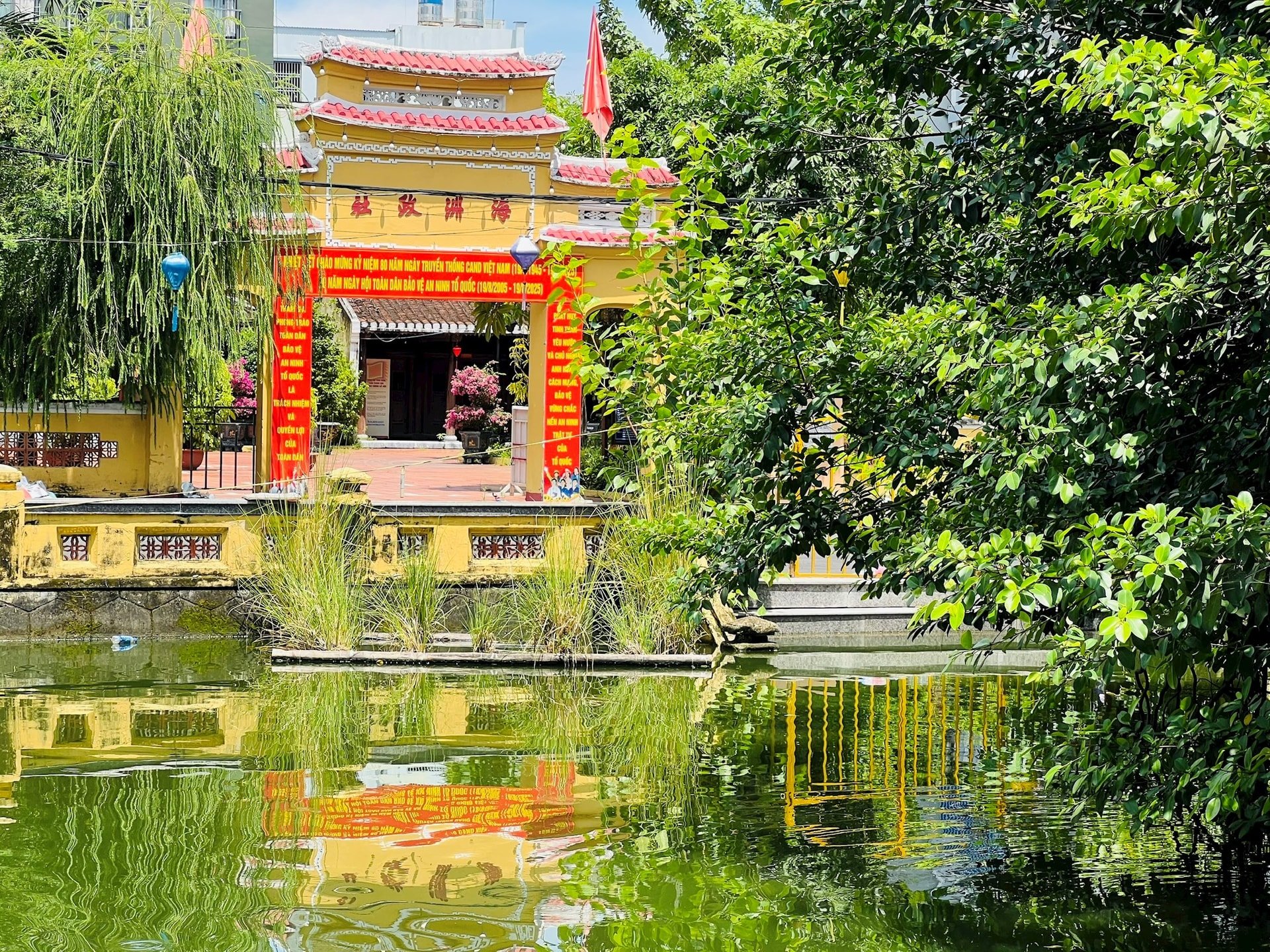
The triple-arched gate casts its reflection on the emerald green lake. Photo: Nhat Minh
A century-old landmark in the heart of the city.
When people think of Da Nang, they picture a dynamic city with well-maintained roads, bustling streets, and bridges connecting the shores. However, even in the heart of this vibrant metropolis, there remains a quiet space that preserves the essence of a traditional village.
 Báo Đà Nẵng•29/09/2025
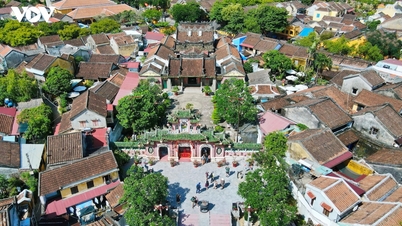
The location mentioned here is nestled in alley number 48 on Phan Chau Trinh Street, Hai Chau Ward, where the Hai Chau village communal house stands serenely amidst the hustle and bustle of modern life.
Stepping inside, the sight of the five-colored flags fluttering in the wind evokes the spirit of the old village. The further you go in, the more the space opens up, and the familiar symbols of Vietnamese rural life become clearer.
There's the majestic triple-arched gate inscribed with the four Chinese characters "Hai Chau Chinh Xa," the ancient banyan tree casting its shade, the lake, and the spacious courtyard serving as a center for cultural and religious activities.
You may also like

Binh Thuy: A century of the soul of the island land.Returning to Binh Thuy islet, Binh My commune, during the fifth lunar month, I was able to enjoy the unique festive atmosphere of this land. It's not just a folk religious activity, but also a beautiful cultural tradition of this islet that has existed for hundreds of years.

Heritage 'awakens' at night.GD&TĐ - At night, the museum space becomes a cultural meeting point, where the public can enjoy art and experience heritage in an intimate and vibrant way.

Citizen launches a new quartet of Promaster Marine models: Upgraded Eco-Drive movements and bio-compatible straps.Citizen's new Promaster Marine diving watch line stands out with its versatile 40.6mm size and the Eco-Drive Caliber E118 movement, which boasts double the power reserve of its predecessor. The collection also incorporates the sustainable BENEBiOL material, reflecting a commitment to environmentally friendly manufacturing practices.
Everything blends together in a harmonious setting, with the village communal house symbolizing humanity, the banyan tree reaching towards the sky symbolizing the masculine principle, and its reflection shimmering on the lake's surface symbolizing the feminine principle, evoking a sense of peace and tranquility.
Hai Chau village communal house, a national historical and cultural relic, is one of the earliest village communal houses built in Da Nang .
According to historical records, the temple was built in 1806 in Nghia Loi area, on the eastern bank of the Han River, to worship the village's tutelary deity and the ancestors of 42 clans from Tinh Gia district ( Thanh Hoa province ) who followed King Le Thanh Tong south to develop the land in 1471.
Despite enduring numerous historical upheavals and three restoration and renovation projects, the temple still retains its ancient charm, serving as a symbol of the resilience and determination of the people of Da Nang.
The temple complex includes the Ancestor Worship Temple, the Temple of the 43 Clans - Kinh Ai Temple, the City God Temple, and the Lady's Shrine.
Inside the temple, many horizontal and vertical couplets inscribed with Chinese characters, painted in red and gold, dating back several hundred years, are preserved. Among them is a horizontal plaque with four Chinese characters "Vạn cổ anh linh" (Eternal Heroic Spirit) created in the 17th year of Gia Long (1818), along with some precious artifacts such as a 1.3m high bronze bell, 3 marble inscriptions... which have great historical and cultural value. The decorative reliefs inside the main hall are also outstanding works of art, showcasing the essence of traditional Vietnamese sculpture.
Every year on the tenth day of the third lunar month, this place bustles with preparations for the festival. The Hai Chau Village Temple Festival consists of two parts: the ceremonial part and the festive part. The ceremonial part includes the preliminary ceremony, the main sacrificial ceremony, and incense offerings, all conducted solemnly to express respect and gratitude to the ancestors who contributed to settling the village, developing the community, and leaving a legacy for future generations.

Vietnam encourages US businesses to expand investment in high technology.On the morning of June 26th, at the Government Headquarters, Deputy Prime Minister Ho Quoc Dung received Mr. Jeff Place, Supply Chain Director of Coherent Group (USA). During the meeting, the Deputy Prime Minister affirmed that Vietnam encourages US businesses to expand investment, especially in high-tech, innovation, and semiconductor industries.

Encourage U.S. businesses to expand investment in high-tech sectors.Deputy Prime Minister Ho Quoc Dung said that Vietnam welcomes US businesses to continue expanding their operations in Vietnam, especially in high-tech industries and sectors with high added value.

Vietnam and the United States strengthen cooperation in addressing the consequences of war.VTV.vn - On June 22, General Secretary and President To Lam received Acting Secretary of the US Navy Hung Cao.
Meanwhile, the festival part is lively and joyful with cultural and artistic activities, competitions, and folk games such as tug-of-war, stick pushing, sack race relay… creating a vibrant, enthusiastic atmosphere that strengthens community bonds.
Today, Hai Chau village communal house is not only a cultural and spiritual institution but also a tourist destination for those seeking peace amidst the bustling city. As a symbol of the connection between the past and the present, between tradition and modernity, Hai Chau village communal house will continue to shine as a part of the city's soul, regardless of the vicissitudes of time.
Source: https://baodanang.vn/di-tich-tram-nam-giua-long-do-thi-3304878.html
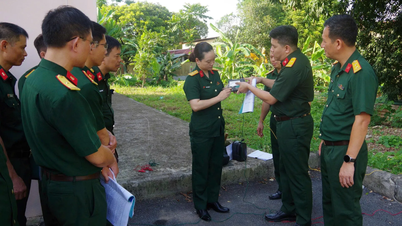
![[Photo] Strengthening character and expertise: Intense training for artillery soldiers.](https://vphoto.vietnam.vn/thumb/1200x675/vietnam/resource/IMAGE/2026/06/30/1782815602541_lu-368-1875-4571-jpg.webp)























































































Finish line

The soul of craftsmanship