

Local specialties are still struggling to find their footing.
For generations, agricultural production in Nam Son commune, Hai Phong city, has been closely linked to onions and garlic, a traditional occupation established and passed down through many generations. On familiar farmlands, thanks to suitable soil and accumulated farming experience, Nam Son onions and garlic possess a distinctive spicy and aromatic flavor, earning the trust of local consumers.

Famous winter onion fields in Hai Phong City. Photo: Tung Dinh.
However, amidst those bountiful winter fields, a persistent paradox exists. As the locality's main agricultural product, Nam Son onions and garlic should easily follow the path of commercial production and expand their market. Yet, behind this pride lie the unspoken worries of the growers. The application of science and technology in the production of clean onions and garlic is limited, product outlets are unstable, and the cycle of "good harvest, low prices; high prices, poor harvest" continues to repeat itself. Agricultural products are mainly sold through traditional, spontaneous channels, lacking the strong linkages necessary to stand firm in the larger market.
The struggle to find markets isn't limited to onions and garlic; it's also evident in Bang La salted apples, another specialty of the coastal region of Hai Phong. Mr. Tran Quang Tuyen, from Nam Do Son ward, shared that Bang La apples are grown on long-standing salt-rich land, where the unique soil conditions create a very distinctive flavor, a perfect blend of sour, salty, sweet, and astringent tastes.
Each year, apple production reaches approximately 30,000 tons, but the path to larger markets remains limited. The majority of the produce is only sold in traditional markets in a few northern provinces, unable to access more promising markets. What apple growers hope for is nothing less than improved connectivity and trade promotion so that their local specialty can have the opportunity to reach further afield.

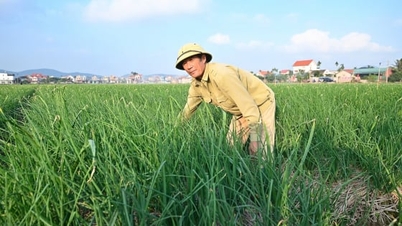
The locals have a long tradition of growing onions. Photo: Tung Dinh.
From a local management perspective, Ms. Nguyen Thi Thanh Nhan, Vice Chairman of Nam An Phu commune, Hai Phong city, stated that as a purely agricultural commune, the lives of local people are closely tied to two rice crops and one winter crop each year, with onions and garlic being the main crops. Although these crops bring high economic value, current production lacks sustainability due to traditional farming methods that do not prioritize soil health and long-term standards.
“The local government's goal is to gradually introduce agricultural products, primarily onions and garlic, into major supermarket chains, and eventually export them. For the people here, 'every inch of land is worth its weight in gold,' so everyone hopes that successful models will help establish a registered growing area, create a brand for Nam An Phu onions and garlic, and thereby elevate the value of local agricultural products,” Ms. Nhan shared.
Controlling pesticide residue is fundamental to building a strong agricultural brand.
Looking at the overall picture, Ms. Luong Thi Kiem, Deputy Director of the Department of Agriculture and Environment of Hai Phong City, said that the city currently possesses a large area of winter crops, with onions and garlic alone reaching approximately 7,000 hectares.
Farming practices in many localities are maintained quite stably according to the model of intercropping: 2 rice crops - 1 onion crop. In these fields, 100% of the straw after the harvest is used by farmers to cover the onion rows, which both reduces weeds, retains soil moisture, and returns natural organic matter, helping to prevent the soil from becoming "exhausted" after many years of intensive cultivation.

Ms. Luong Thi Kiem shared this at the Forum on Connecting Agricultural Products in the Red River Delta, aiming towards the Tet market, held on December 23rd. Photo: Tung Dinh.
In the Nam An Phu area and many communes of the former Kinh Mon town, agricultural land is utilized to the maximum extent. From the main fields to the field boundaries, there is almost no empty space left, clearly reflecting the farmers' spirit of staying rooted in their land.
However, behind this diligence, there are still gaps in the methods used. Currently, onion and garlic cultivation is still primarily based on traditional experience, with the same crop varieties used repeatedly, and product branding has not been systematically developed.
Notably, due to a lack of comprehensive assessments of soil nutrient residue and balance, many households tend to apply large amounts of phosphorus fertilizer over extended periods, posing a risk of nutrient imbalance and directly affecting the "health" of cultivated land.
According to Ms. Luong Thi Kiem, in the context of increasingly demanding quality and safety standards in commodity production, assessing soil health in each region and for each crop type, and then adjusting cultivation processes accordingly, is an unavoidable requirement.
"In addition, producers must be more aware of controlling pesticide residues. This is not only a matter of the health of growers and consumers, but also a decisive factor in the reputation of agricultural products, brand image, and market access," emphasized the leader of the Department of Agriculture and Environment of Hai Phong City.
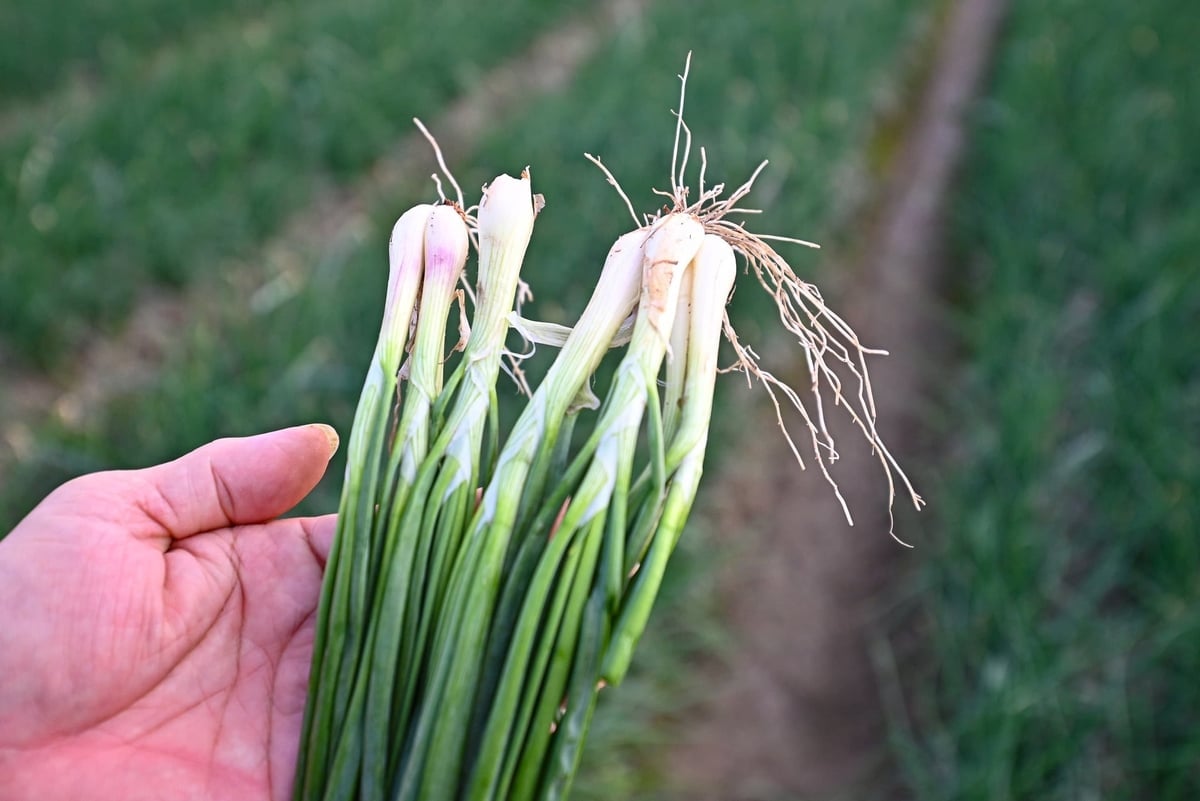
Reorganizing production is identified as a shared responsibility of the people, businesses, and local authorities. Photo: Tung Dinh.
Besides onions and garlic, carrots, another key export item of Hai Phong, despite having relatively high production volume and a favorable market, are still facing the challenge of controlling input materials and residue levels. In reality, if the production process isn't handled well, all efforts at promotion and trade facilitation will struggle to achieve the expected results.
According to Ms. Kiem, reorganizing production is identified as a shared responsibility of the people, businesses, and local authorities. The industry calls on businesses to participate in investment and linkages with farmers, while also coordinating closely with specialized agencies in planning growing areas that meet export standards. In the context of the South Korean market tightening controls, requiring 100% of export shipments to undergo residue testing, early monitoring of growing areas, at least 1 to 2 months before harvest, has become a mandatory requirement.
"Raising awareness of production and building high-quality products right from the start is the foundation for the sustainable development of Hai Phong's agricultural products, increasing their value and achieving truly bountiful harvests," affirmed Ms. Luong Thi Kiem.
Source: https://nongnghiepmoitruong.vn/di-tim-loi-giai-cho-nghich-ly-tren-nhung-canh-dong-vu-dong-d791023.html
![[Image] First UAV flight test in medical transport](/_next/image?url=https%3A%2F%2Fvphoto.vietnam.vn%2Fthumb%2F1200x675%2Fvietnam%2Fresource%2FIMAGE%2F2025%2F12%2F24%2F1766560655977_thunghiembay-3551-jpg.webp&w=3840&q=75)

![[Image] First Congress of the Vietnam Science and Technology Trade Union](/_next/image?url=https%3A%2F%2Fvphoto.vietnam.vn%2Fthumb%2F1200x675%2Fvietnam%2Fresource%2FIMAGE%2F2025%2F12%2F24%2F1766552551054_ndo_tr_img-1801-jpg.webp&w=3840&q=75)











!['Ho Giao' 4.0 or reflections on the dairy industry: [Part 2] Essential investment, no 'showmanship'](https://vphoto.vietnam.vn/thumb/402x226/vietnam/resource/IMAGE/2025/12/24/1766538762427_13-nongnghiep-105131.jpeg)























































Comment (0)