|
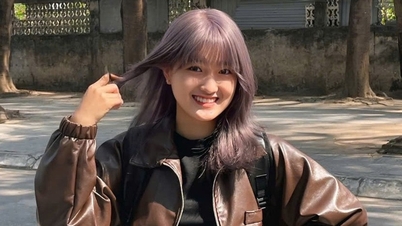
| The young authors of the book "The Image of Vietnam Through the Crossroads of Time". (Source: YMATE Books) |
The book brings together 12 young writers, but instead of forming a "chorus," each retains their own voice, sometimes out of sync, sometimes overlapping. In Xó, Thòong Dành Kể Chuyện, Thảo Nguyên, Mochi ở đây, Phan Quốc Dũng, Nguyễn Khánh Toàn, Vũ Ngọc Ngân Giang, Dương Hạnh, Nguyễn Việt Anh, Trinh Nguyễn, Phạm Thị Thuỷ Tiên, and Nguyễn Tuấn Nam, they enter the story of Vietnam from very different paths. They don't share the same profession or journey, but they meet with a desire to better understand the connection between themselves and the country they live in.
Therefore, this book does not attempt to construct a "standard" image of Vietnam; there are no predefined definitions of patriotism or national identity. Instead, it offers glimpses, sometimes soft, sometimes sharp, reflecting how a generation is observing and engaging with reality.
Some articles lean towards memories and growing up, where the past emerges through everyday details, without ostentation. Others touch upon folklore, as an attempt to preserve what is easily forgotten in the rhythm of modern life. But there are also pages that directly address contemporary issues such as artificial intelligence, digital life, gender equality, the environment, or personal choices amidst the myriad possibilities of the open age.



However, these seemingly "global" themes are not detached from the foundation of Vietnamese culture. They are placed within a specific context, where each issue is interwoven with layers of history, society, and personal experience. As a result, readers not only receive information but are also encouraged to view an issue from an individual, a community, and, more broadly, a national perspective.
As can be seen, the book has softened concepts that could easily become rigid. Patriotism is no longer limited to symbolic emotions, but is manifested in choosing to study seriously, work responsibly, tell the story of Vietnam in a new language, behave kindly online, or simply not lose the ability to think independently amidst conflicting information.
With its three-part structure—past, present, and future—the book forms a clear yet unconstrained line of thought. In the past section, the authors question how memories are preserved and transmitted. In the present section, traditional values are put to the test by technology, integration, and social transformation. And in the future section, the book doesn't offer predictions, but rather explores the possibilities of how young people will continue to write the story of Vietnam.
As the first publication in YMATE Books' "Youthful Perspectives" series, "The Image of Vietnam Through the Crossroads of Time" encourages questioning and critical thinking. Social issues are not presented in a one-sided manner, but are viewed from multiple perspectives and the personal experiences of young people themselves.
According to Mr. Nguyen Manh Tuan, CEO of YMATE Books, the value of the book lies not in offering a single perspective or answer about national identity, but in creating a space for diverse viewpoints to coexist. Whether similar or different, these perspectives all stem from concern, reflection, and a sense of responsibility towards Vietnamese cultural, historical, and identity values.



For students, this book can be a useful resource when approaching contemporary issues, and it helps readers realize that understanding one's country is a continuous process of dialogue with the past, present, and future.
Source: https://baoquocte.vn/di-tim-minh-trong-dang-hinh-dat-nuoc-400797.html


![[Photo] "Hanoi Lotus Festival" honors the lotus flower that has been associated with Vietnam for thousands of years.](https://vphoto.vietnam.vn/thumb/1200x675/vietnam/resource/IMAGE/2026/06/27/1782516943048_sen-ha-noi-2026-minh-duy-1-jpg.webp)