

Wave of interest rate increases
Monitoring the money market since the beginning of the fourth quarter, especially in the last three weeks, interest rates have fluctuated sharply. In the first half of December, the overnight lending rate in the interbank market at one point rose to 7.5% per annum.
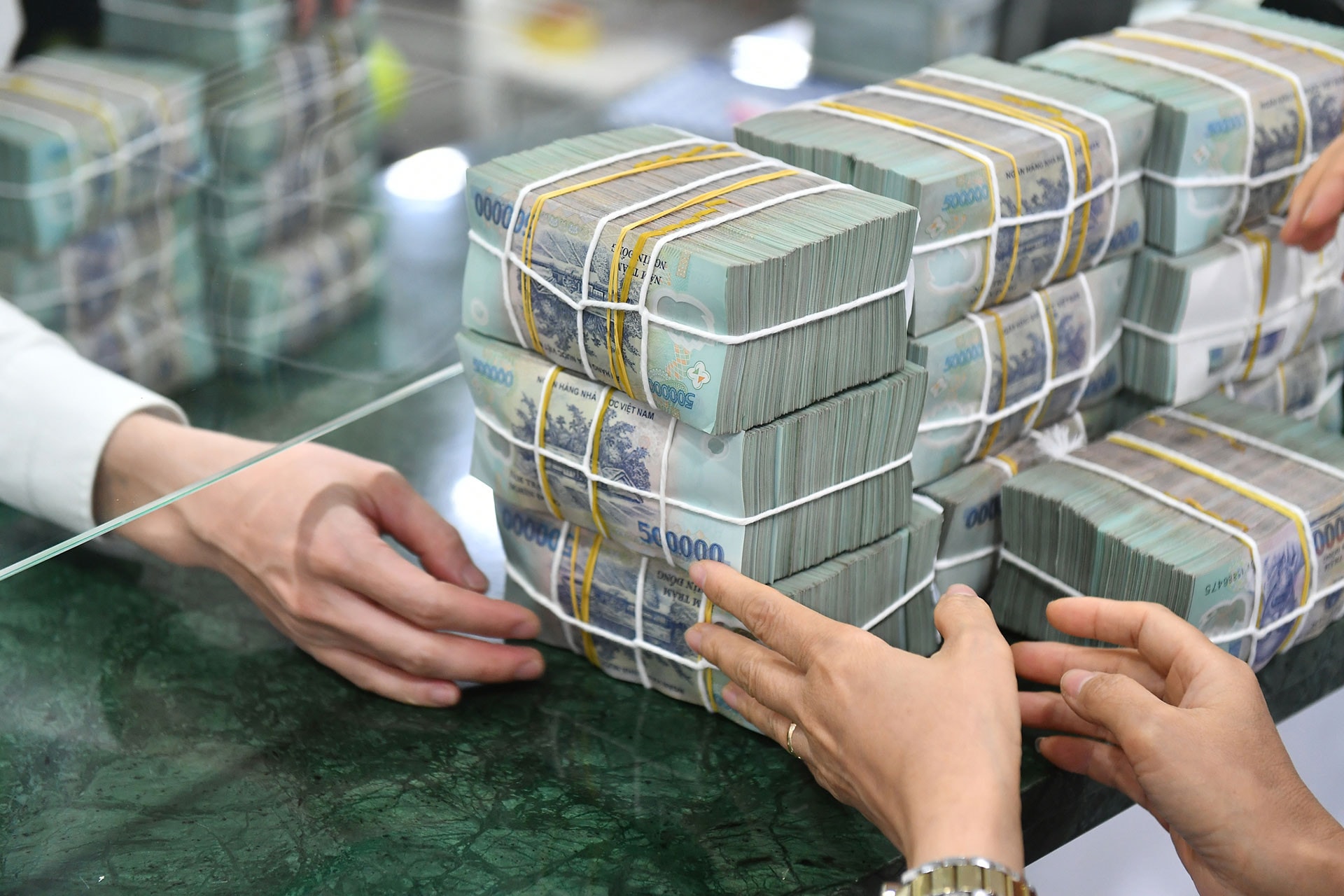
By December 22nd, at least 25 banks had adjusted their deposit interest rates upwards compared to the beginning of the month. Some banks even increased savings interest rates twice in a single week.
Leading the wave of interest rate increases are smaller banks, with a series of promotional programs for individual customers. For example, An Binh Commercial Joint Stock Bank (ABBank) added 1.2% to the listed interest rate for 6- and 12-month terms, bringing the interest rate for these terms to 6.7–6.8%/year.
From December 17th to mid-January 2026, Viet Capital Commercial Bank (BVBank) is offering an additional 0.5% on the listed interest rate for deposits made at the counter or online for terms of 6 to 18 months, raising the actual interest rate to 6.8% per year. Similarly, National Commercial Bank (NCB) is adding up to 1.4% per year to the interest rate for online savings deposits of one month or more, without requiring a large deposit amount or being a large customer.
Thus, deposit interest rates for terms under 6 months at small and medium-sized commercial banks have been pushed up to the ceiling of 4.75%/year. Meanwhile, interest rates for medium and long-term terms (6-12 months) are commonly in the range of 6-7%/year. Depending on the term, the average deposit interest rate at commercial banks has increased by 0.5-1.4% compared to the beginning of the year.
Unlike before, the "big 4" banks, including the Vietnam Agricultural and Rural Development Bank ( Agribank ), the Vietnam Investment and Development Bank (BIDV), the Vietnam Foreign Trade Bank (Vietcombank), and the Vietnam Joint Stock Commercial Bank for Industry and Trade (VietinBank), also increased deposit interest rates by 0.5% per year across various maturities. However, the increase in interest rates by these large banks helped to "cool down" the open market, bringing the deposit interest rate in this market down to 4.6% per year.
Specifically, for the 1-month term, VietinBank, Vietcombank, and BIDV all raised interest rates from 1.6% to 2.1%/year (an increase of 0.5%), while Agribank increased from 2.1% to 2.4%/year. For the 3-month term, VietinBank, Vietcombank, and BIDV increased from 1.9% to 2.4%/year; Agribank, however, increased from 2.4% to 2.7%/year.
For the 6-month term, savings interest rates at the three major banks (VietinBank, Vietcombank , BIDV) all increased from approximately 2.9–3% to 3.5% per year; Agribank continued to lead with 3.8% per year. The 9-month term saw similar trends, with the top three banks increasing from 2.9–3% to 3.5% per year, while Agribank raised from 3.5% to 3.8% per year. The listed interest rates for the 12-month term at the big four banks increased from 4.6–4.7% to 5.2% per year.
The pressure to increase deposit interest rates is quite significant, resulting in higher deposit interest rates compared to mid-year. This increase in deposit interest rates has led to a sharp rise in lending interest rates as well. Several commercial banks have reported that personal loan interest rates for consumer loans have reached 14.5% per year, while secured loans such as real estate loans have exceeded 10% per year. This level of lending interest rates has caused businesses to worry about the possibility that interest rates will not stop rising in 2026.
What will happen to interest rates?
According to experts, the main reason for the rapid increase in interest rates is the strong and sustained growth in credit, while deposit growth has been slower. In 2025 alone, credit could increase by around 20%, while deposits are expected to increase by only about 15%. This situation has led to record high loan-to-deposit ratios (LDR) for many banks.
Furthermore, the low deposit interest rates maintained from 2023 to the present have caused many people to shift from savings to other investment channels, resulting in a large outflow of money from the system and impacting liquidity.
According to Vietcap Securities Joint Stock Company's assessment, the interest rate hike by the Big 4 banks is not surprising, as private banks had already done so and the State Bank of Vietnam had also raised the OMO interest rate by 0.5%. Vietcap's experts also believe that the current interest rate level remains supportive of the economy and predict that liquidity pressure in the system will gradually ease from March 2026, after the Lunar New Year holiday, thanks to additional capital sources such as public investment disbursements and funds returning to the banking system.
Answering the question of what interest rates will be like in the near future, economist Dr. Nguyen Duc Huong believes that Vietnam, aiming for high growth, cannot rely solely on bank capital but needs to strongly develop its capital market. Efforts to upgrade the stock market and the national credit rating will open up more favorable opportunities for businesses to raise international capital, thereby helping to bring interest rates back to a balanced level.
Many also predict that deposit interest rates may continue to rise in the first few months of 2026 due to increased capital demand before and after the Lunar New Year 2026. However, after that, interest rates may cool down, and it is predicted that the overall interest rate level in 2026 will increase by about 0.5-1%.
Although interest rates are showing signs of rising, system liquidity will improve. At the same time, bank deposits may face less competition as asset classes like gold, stocks, and real estate are all at high prices, prompting people to consider returning to savings accounts.
Source: https://hanoimoi.vn/dien-bien-lai-suat-se-the-nao-728119.html
![[Photo] Mrs. Ngo Phuong Ly meets and exchanges views with Mrs. Peng Li Yuan](https://vphoto.vietnam.vn/thumb/1200x675/vietnam/resource/IMAGE/2026/04/16/1776277858080_phu-nhan-1-jpg.webp)

![[Photo] National Assembly Chairman Tran Thanh Man attends the opening session of IPU-152](https://vphoto.vietnam.vn/thumb/1200x675/vietnam/resource/IMAGE/2026/04/16/1776277863731_ctqh5-jpg.webp)
![[Photo] My Son at night: A thousand-year-old heritage site amidst the Milky Way](https://vphoto.vietnam.vn/thumb/1200x675/vietnam/resource/IMAGE/2026/04/15/1776261039184_ndo_br_chon6-jpg.webp)
![[Photo] The General Secretary, President and his wife meet with Vietnamese-Chinese friendship leaders.](https://vphoto.vietnam.vn/thumb/1200x675/vietnam/resource/IMAGE/2026/04/15/1776264829725_vna-potal-tong-bi-thu-chu-tich-nuoc-to-lam-gap-mat-nhan-sy-huu-nghi-viet-nam-trung-quoc-8703641-3130-jpg.webp)








































































Comment (0)