

 |
The dilapidated buildings, interspersed with tangled electrical wires, reflect Manila's chaotic infrastructure. Photo: Zachary Angeles/Pexels . |
While Southeast Asian tourism is entering a strong recovery phase, the Philippines is showing a slower pace compared to its neighbors, according to SCMP.
Short of breath
Figures from the Philippine government show that the country welcomed 5.6 million tourists in 2025, about 2% lower than the 5.95 million of the previous year. Although the Department of Tourism later updated the figure to 6.48 million, this number is still modest compared to Vietnam and Thailand – two countries that welcomed 21.5 million and 32.9 million tourists respectively during the same period.
One key reason for this situation is that Chinese tourists are not yet enthusiastic about visiting the Philippines.
Over 1.4 million mainland Chinese tourists visited Malaysia in the first four months of 2025 alone. In Vietnam, Chinese tourists accounted for approximately one-quarter of the total international visitors, with 5.28 million arrivals. Cambodia also recorded 1.2 million Chinese tourists out of a total of 5.5 million foreign visitors.
However, in the Philippines, the number of Chinese tourists decreased by 16.55%, to approximately 250,000 by November 2025.
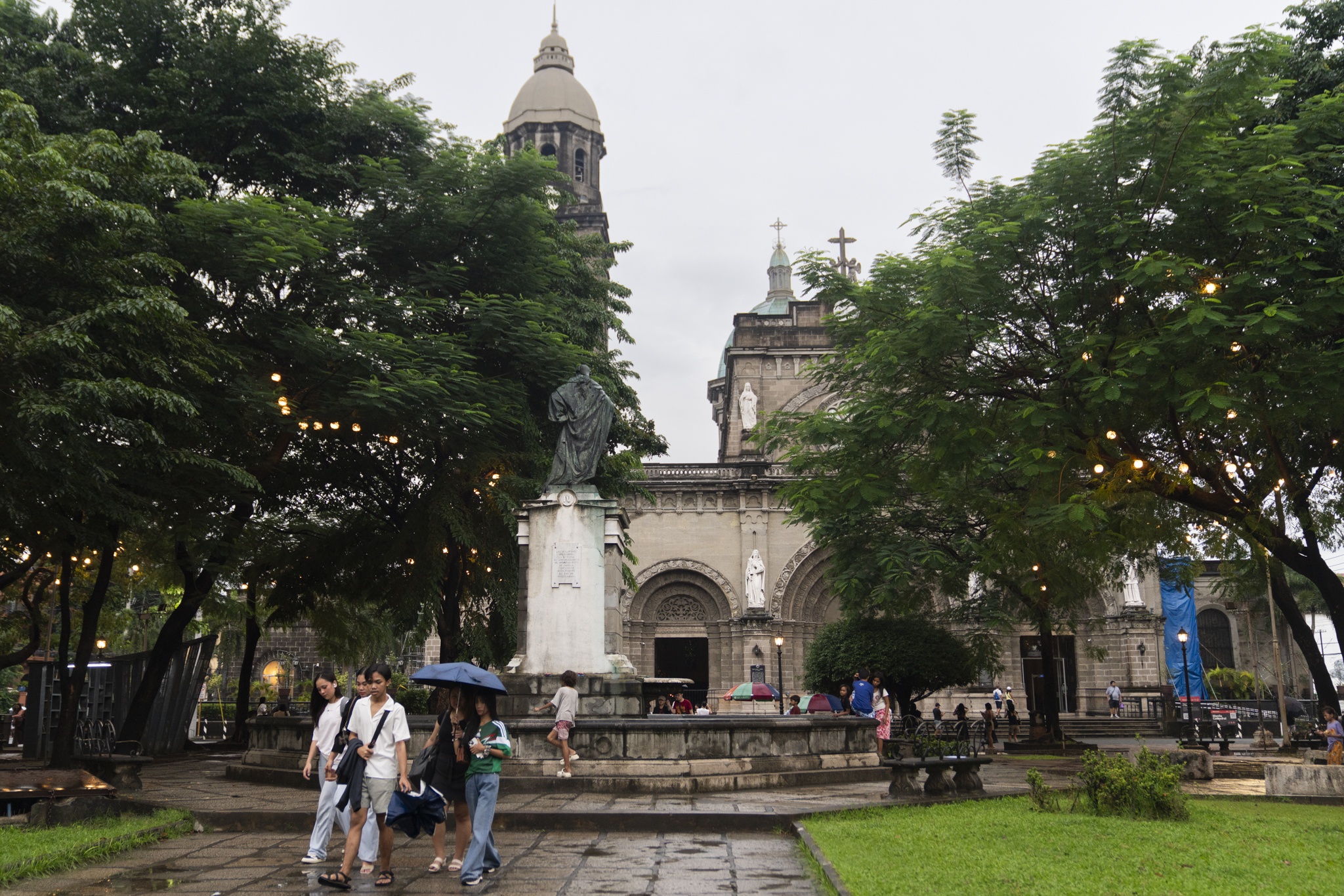 |
Tourists at the ancient city of Intramuros, Malina, Philippines, November 2025. Photo: Linh Huynh. |
Jayant Menon, a senior research fellow at the ISEAS-Yusof Ishak Institute (a regional research center for Southeast Asia based in Singapore), suggests that this decline is related to tensions between Manila and Beijing, which have impacted the Philippines' recovery more severely than other countries. Manila recently implemented a 14-day visa waiver program for Chinese citizens to improve the situation.
Furthermore, geographical differences and connectivity are also decisive factors. Countries like Thailand, Malaysia, Vietnam, and Indonesia have the advantage of dense air networks and numerous transit hubs.
Meanwhile, the Philippines, with its strengths in island and coastal destinations, relies heavily on complex domestic and connecting flights. This is a structural limitation, not a lack of attractiveness, and partly explains why its recovery has been uneven.
 |
Tourists relax on Malay Beach, Philippines. Photo: Ren Dell/Pexels. |
General visa expectations
During discussions at the 63rd ASEAN National Tourism Organizations Meeting held in Cebu (January 28-30), many observers noted that a common tourism visa mechanism for the entire bloc, coupled with a synchronized digital connectivity system, could become a lever to balance growth and support slow-recovering destinations like the Philippines, according to SCMP.
The conference brought together tourism leaders from the region along with representatives from Japan, China, and South Korea, important source markets for ASEAN. In 2024, 20 million Chinese tourists, 9 million South Korean tourists, and 3 million Japanese tourists visited Southeast Asia, and this growth is projected to continue this year.
 |
Chinese actress Fan Bingbing enjoys durian in Melaka, Malaysia. Photo: @bingbing_fan. |
In her opening remarks, Philippine Undersecretary of Tourism Verna Buensuceso emphasized that coordinated regional policies will directly impact the visitor experience, destination competitiveness, and community livelihoods. She called for the development of interconnected tourism corridors by 2030, thereby promoting nature-based destinations and strengthening ASEAN's position as a shared destination.
However, analysts note that competition among member states is always a barrier. Jayant Menon from the ISEAS-Yusof Ishak Institute analyzes that deep cooperation in tourism is not easy to achieve when countries all want to capture a larger share of tourists in a volatile market.
Nevertheless, he believes that a regional visa across ASEAN is a win-win option that could operate similarly to Europe's Schengen model, thereby encouraging multinational travel and increasing the integration of Southeast Asian destinations.
Meanwhile, Joanne Lin, an expert at the ASEAN Research Centre at ISEAS - Yusof Ishak, believes that the idea of a common visa is positive, but its implementation will be uneven due to differences in immigration control capabilities and the level of readiness of each country.
According to her, ASEAN needs a phased approach, starting with pilot programs or small groups instead of a single, all-encompassing solution.
Source: https://znews.vn/dieu-philippines-trong-doi-post1623893.html


![[Photo] Memorable moments at the 10th Vietnam-China Border Defense Friendship Exchange](https://vphoto.vietnam.vn/thumb/1200x675/vietnam/resource/IMAGE/2026/03/20/1773986226876_giao-luu-bien-gioi-vntq-lan-10-ben-tq-9737-4225-jpg.webp)













































































Comment (0)