

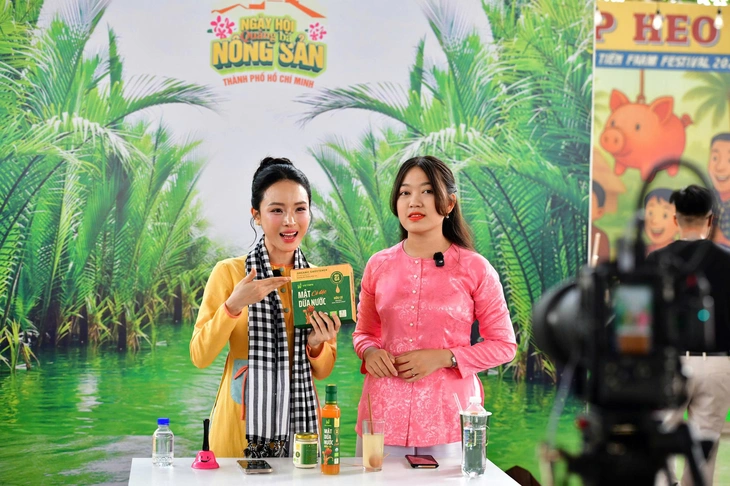
A live stream selling agricultural products on the TikTok Shop platform, featuring famous KOLs and KOCs - Photo: DUYEN PHAN
Livestream selling is booming in Vietnam across platforms like Facebook, TikTok, Shopee, Lazada, and YouTube.
Consumers can easily buy goods, but when problems arise, they don't know who to turn to... Especially when they buy counterfeit or fake goods, buyers are no different from victims of fraud... and all they can do is cry out in despair.
Buying goods via livestream is easy, but holding people accountable is difficult.
Having been a victim of livestream shopping scams, Nguyen Bich Tram (25 years old, Ho Chi Minh City) recounted that the dress she received was completely different from the image in the livestream, so she requested a return, but the seller reported to the e-commerce platform that she had sent rags.
Because she didn't record a video when handing the package to the delivery person, Ms. Tram had to "grin and bear it." On another occasion, Ms. Tram bought a thermos flask for over 400,000 VND, advertised as being made of 304 stainless steel, but it rusted after only a short time.
"I knew I'd been scammed, but I had no way to get compensation and didn't know who to contact," Ms. Tram said.
Meanwhile, KL (33 years old, Ho Chi Minh City), who has a large following and has conducted numerous livestream sessions generating sales ranging from several billion to tens of billions of VND, admits that this profession is full of temptations.
"My teeth are white and healthy because I take good care of them and regularly visit the dentist for checkups. But once, several companies offered me the opportunity to advertise their electric toothbrushes, which were of very poor quality. If I agreed to praise them, they were willing to pay 50 million VND immediately, without any sales commitment," she recounted.
According to Ms. KL, many online sellers lack product knowledge and only advertise according to contracts. She even once received a whole box of counterfeit and substandard cosmetics delivered to her door, along with an advertising offer promising high commissions.
Although livestreaming can generate substantial income, many KOLs/Influencers tend to shirk responsibility, while consumers often fall prey to FOMO (fear of missing out), hastily placing orders only to receive counterfeit or low-quality goods, making it difficult to claim their rights.
Risks are not only present on e-commerce platforms but also spread across social networks such as Facebook, Instagram, and YouTube.
In many cases, after receiving complaints about poor-quality products, sellers immediately block customer communication. Therefore, when buying goods through livestreaming sessions, whether from regular sellers or KOLs/Influencers, users face many risks.
The case of Chi Em Rot Group Joint Stock Company (CER) is a typical example of exploiting its popularity to repeatedly make deceptive advertisements, leaving buyers with no choice but to complain.
Protecting consumer rights and strengthening market confidence.
Speaking to Tuoi Tre newspaper , Mr. Doan Trong Khoi, General Director of Vimarket Vietnam JSC, the company that owns and operates the MasOffer affiliate marketing network, said that the proposal to verify and identify businesses and individuals selling goods, including livestreamers, as proposed in the draft E-commerce Law recently reviewed by the National Assembly Standing Committee, is very necessary and completely reasonable.
According to Mr. Khoi, the LiveCommerce wave (selling goods via livestream on e-commerce platforms) and the strong rise of TikTok over the past three years, strongly supported by major e-commerce platforms (TikTok, Shopee, etc.), means that businesses and content creators in Vietnam do not want to miss out on this trend.
Users watching livestreams as a form of entertainment and making purchasing decisions while relaxing has become commonplace. At their peak, it was not uncommon for Live and Mega Live sessions to generate hundreds of billions of dong in sales.
However, there are still many loopholes in monitoring and managing streamers and sellers/brands who use livestreaming to sell products. Are the origin and quality of goods as advertised? Who will be responsible if problems or incidents occur after the sale?
Therefore, according to Mr. Khoi, identification and verification will help improve state management capacity, enhance the transparency of the model, ensure the rights of buyers, and at the same time force individuals and organizations selling goods to comply with the "rules of the game" more seriously.
Mr. Nguyen Pham Hoang Huy - Head of the Digital Marketing Department (FPT Polytechnic) - also believes that identifying sellers through livestreaming not only helps authorities collect taxes effectively, but also clearly identifies those responsible for business activities in e-commerce.
"When disputes arise, authorities can quickly identify who directly sold the goods, thereby assigning responsibility instead of allowing multiple parties to deny responsibility or prolonging the tracing process," Mr. Huy said.
According to Mr. Huy, in reality, there are quite a few cases where brands release batches of products that meet quality standards, but during livestreams, some sellers mix in counterfeit goods to make a profit.
Suppose a brand collaborates with 10 TikTokers for distribution. If two of them mix in counterfeit goods, identifying them will help authorities quickly determine who is in violation, instead of allowing everyone to evade responsibility.
"If identification and verification are done from the outset, tracing the origin and identifying the offending individual will be done more quickly, transparently, and effectively," Mr. Huy affirmed.

More and more tools are available to support livestreaming activities - Photo: D. THIEN
Clean up the market, prevent counterfeit goods.
According to NielsenIQ's forecast, Vietnam's e-commerce market will reach $45 billion by 2025, accounting for approximately 10% of total national retail sales. Livestreaming has become a major trend, but it also brings significant challenges regarding identity verification, information transparency, and the legal responsibility of sellers.
However, the reality shows that trust in social media advertising is becoming increasingly fragile. According to Vietnam Report, over 79% of users encounter new F&B products through online advertising, with 31% being directly influenced by celebrities.
However, the lack of expertise among many KOLs, leading them to easily promote low-quality products, has resulted in a crisis of trust and numerous boycotts.
Therefore, according to Ms. Nguyen Thi Anh Hong - e-commerce director of the 24hStore retail system, introducing VNeID identification into e-commerce will help purify the market and limit counterfeit and substandard goods that are rampant on livestreaming.
"With a legitimate sales system like 24hStore, this serves as a legal 'foundation' to affirm credibility and differentiate ourselves from sales channels lacking transparency," Ms. Hong shared.
The platform supports the identification of sellers and livestreamers.
Speaking to Tuổi Trẻ newspaper , Mr. Phan Mạnh Hà, Director of External Relations at Shopee Vietnam, said that the platform had planned to identify all sellers on its platform since 2024, before the Ministry of Industry and Trade released the draft law, because "identifying sellers is considered a necessary measure to protect users and provide the best experience for buyers on Shopee."
"We support the need for this requirement in the E-commerce Law to enhance the transparency and security of online transactions, and to develop a healthy and sustainable e-commerce industry in the future," Mr. Ha said.
A representative from Lazada Vietnam also stated that regulations on electronic identity verification for sellers and livestreamers are necessary, creating a legal framework for managing transactions and participants on e-commerce platforms.
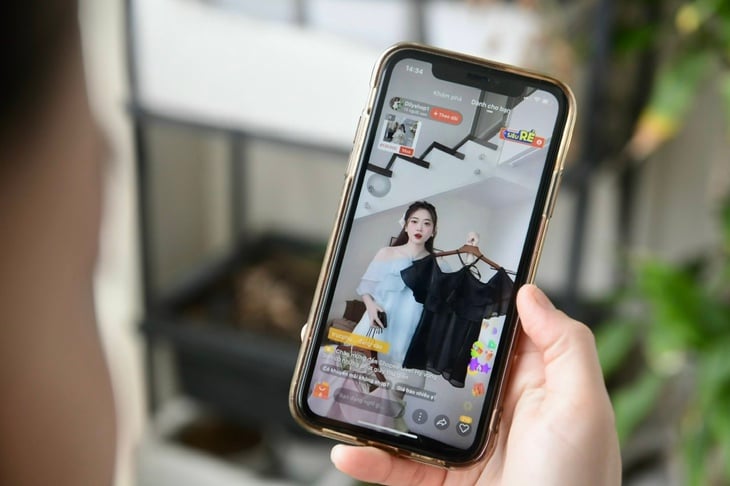
Buying and selling goods via livestream is booming in Vietnam - Photo: QUANG DINH
Livestreamers must be provided with complete legal documentation.
In addition to stipulating that e-commerce platform owners are responsible for identifying domestic sellers via VNeID and identifying foreign sellers through legal documentation, the draft E-commerce Law also includes many regulations related to livestreaming activities.
Accordingly, the platform owner must verify the identity of the livestreamer, publicly disclose and implement real-time control mechanisms and measures for livestream sales content. Sellers must provide livestreamers with legal documents proving they meet the requirements.
Livestreamers are prohibited from providing false or misleading information regarding the uses, origin, quality, price, promotions, warranty policies, and other related content of goods and services. They must adhere strictly to the advertising content approved by the competent authority for goods and services where legal requirements necessitate such approval.
Many regulations are not technically feasible?
Ms. Bui Thi Viet Lam, representative of the US-ASEAN Business Council, stated that using VNeID to identify sellers is an inevitable and necessary trend as Vietnam is building a database for many economic and commercial activities, with the national database system as its foundation.
However, according to Ms. Lam, policies should encourage the development of e-commerce, because small households and small traders still play a significant role in the household economy, ensuring their livelihoods and economic activities. When integrated into e-commerce activities managed by large platforms, they will have the power to decide on the operations of millions of these small businesses.
According to Ms. Lam, the regulations for livestreaming are "too burdensome," because proactively monitoring all content before and during livestreams is technically impractical. "Furthermore, the mandatory requirement to retain images of all livestreaming activities is unnecessary; instead, focus should be placed on retaining only specific content," Ms. Lam stated.
Are there still loopholes for livestreaming?
According to Mr. Nguyen Pham Hoang Huy, the advantage of the draft Law on E-commerce is that it separates the selling groups to control responsibility, but loopholes still exist because it does not cover everything comprehensively.
Livestreaming for entertainment, interaction, personal sharing, teaching, etc., is not subject to identity verification, allowing for loopholes to incorporate advertising, sales, or false information. Therefore, consideration should be given to expanding the scope of regulation while tightening control over false advertising content. Furthermore, the identity verification process should be simple, quick, and avoid unnecessary complications.
"Identification is a necessary step to ensure transparency, traceability, and protect consumer rights, but it must be designed to be concise and robust enough to prevent fraud from the outset," Mr. Huy shared.
Source: https://tuoitre.vn/dinh-danh-nguoi-ban-hang-online-tuan-thu-luat-choi-20250924224321221.htm



















































![[Video] Sunset at Lap An Lagoon – Where the sun sets over the fishing nets](https://vphoto.vietnam.vn/thumb/1200x675/vietnam/resource/IMAGE/2026/05/31/1780192137701_beach-landscape-sea-water-nature-grass-745871-pxhere-com.jpeg)





























Comment (0)