



Phu Khe communal house, Hoang Phu commune.
Legend has it that at that time, there was a man named Chu from Guangde (China) who married a woman from the same village, surnamed Huang. Mr. Chu's family was wealthy and engaged in trade, traveling by boat. Four years after their marriage, his wife fell seriously ill and passed away. When he was over 30 years old, the country was engulfed in war and conflict... Mr. Chu had to seek refuge in Vietnam, a foreign land.
Upon arriving in Son Nam, he found the land fertile and bought it to establish a livelihood. A year later, he fell in love with and married a woman named Khoan from the Pham family. They lived happily together and were loved by the local people for their kind nature. However, after many years of marriage, they still had no children. They visited many temples to pray for offspring but were unsuccessful. Hearing about the sacred Bao Phuc Temple in Phu Trung Trang (now Phu Khe village), he packed his bags and set off to perform rituals and seek blessings. Upon arriving there, he felt an indescribable elation and a strong sense of faith. He donated all his money and, together with the local people, contributed to the village's charitable work. From then on, he and his wife always devoted themselves to Bao Phuc Temple.
Two years later, she dreamt that two angels appeared, lifted her onto a cloud, and then disappeared. She found herself in a strange place, surrounded by lush greenery, birdsong, and the sound of a babbling stream. Beside her stood a garden of ripe, unusual fruit trees. She reached out and picked some fruit to try, but suddenly, an overwhelming thirst tormented her. Startled, she awoke, realizing it was only a dream. Three months later, she felt strange and became pregnant, giving birth to a bundle containing two handsome sons. The Chu family then named the eldest son Chu Ming and the younger son Chu Jun.
As Chu Minh and Chu Tuan grew older, they became increasingly intelligent and talented. At the age of 13, their father took them south by boat to visit Bao Phuc Temple. Just as the boat docked near Phu Truong Trang, a sudden, great flood arose in the middle of summer, sinking the vessel. The two sons drowned, but their father was fortunate enough to be swept ashore by the rising tide, escaping the disaster. Standing on the shore, he watched the waves, his heart aching at the sight of his sons. Strangely, after the flood, the people of Phu Truong Trang saw two men floating on the water, their postures resembling Buddhas, drifting towards Bao Phuc Temple. When the water receded, the villagers found two mounds of earth formed by termites. Intrigued, the villagers performed a ritual and erected a mausoleum there.
In 1039, the southern part of Dai Viet was harassed by Laotian invaders. The royal army fought many battles, but neither side could gain the upper hand. The king had to personally lead the army, advancing to Thanh Hoa province, Ha Trung prefecture. Hearing that Phu Truong Trang was a large, populous place with ample land suitable for recruiting soldiers, the king proceeded there to set up camp. That very night, in his sleep, the king suddenly saw two handsome young men appear, bowing and saying: “We are sons of the Chu family from the North, who wandered to the South. After a journey of sightseeing and business, we encountered misfortune and drifted ashore here. The local people have cared for us in our final resting place. Now, seeing you go to battle, we vow to provide divine assistance, hoping for your swift and victorious return.” Before they finished speaking, the king awoke, realizing this was a sacred sign. During a battle, while the king was still unsure how to proceed, dark clouds suddenly gathered, and a storm raged towards the enemy, causing them to scatter in panic. Taking advantage of this, our army advanced and recaptured all the territory. After returning victorious, the king performed a thanksgiving ceremony and renovated and erected a mausoleum.
In the mid-19th century, during the reign of Emperor Tự Đức, Phú Khê village rebuilt the communal house on its sacred old foundation, and since then, the people have consistently cared for and protected it. The communal house is designed in the shape of the Chinese character "二" (two), consisting of two main halls and a rear sanctuary. Currently, the communal house still preserves many valuable artifacts dating back several centuries, such as couplets, horizontal plaques, dragon thrones, and ancestral tablets.
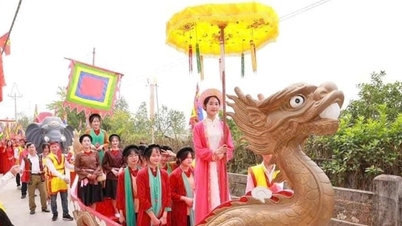
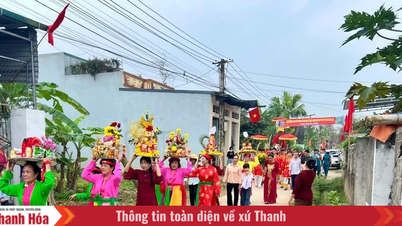
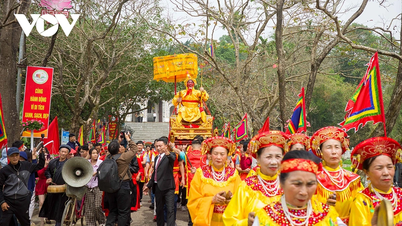
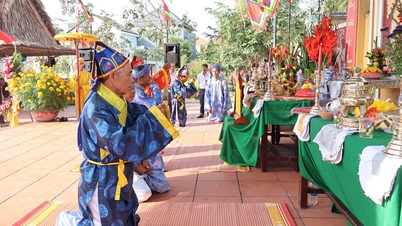
Through countless ups and downs, and the harshness of time, the temple's appearance is no longer intact. However, the reverence for the two deities remains undiminished in the spiritual life of the people of Phu Khe. With its unique historical, cultural, and architectural values, Phu Khe Temple was recognized as a national historical and cultural relic in 1993. Every year, on the 16th day of the 2nd lunar month, the people of the commune solemnly organize the spring festival to worship the village's tutelary deity, expressing their respect and gratitude to their ancestors who built and preserved peace in the land, and praying for favorable weather and bountiful harvests.
Text and photos: Khac Cong
(This article uses source material from the book "Historical and Cultural Relics of Phu Khe Temple").
Source: https://baothanhhoa.vn/dinh-phu-khe-279548.htm
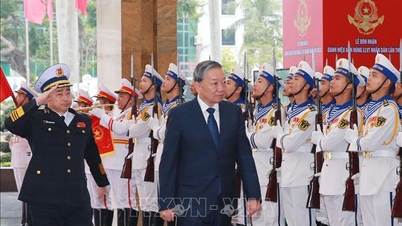
![[Photo] The General Secretary presents the title of Hero of the People's Armed Forces to the Navy.](https://vphoto.vietnam.vn/thumb/1200x675/vietnam/resource/IMAGE/2026/02/28/1772251730336_vna-potal-tong-bi-thu-to-lam-du-va-trao-danh-hieu-anh-hung-llvt-nhan-dan-cho-quan-chung-hai-quan-8612073-jpg.webp)

















































Comment (0)