

Appreciating art in general, and poetry in particular, depends on many factors: level of understanding, circumstances, age, perspective, etc. In Do Thanh Dong's poetry collection "Mother's Six-Eight Verse," there are quite a few beautiful verses (of course, beautiful according to my own criteria).
Reading all 42 poems in the collection "Mother's Six-Eight Verse," one can easily recognize two basic themes: admiration for the mother's patience and self-sacrifice, and the author's unending longing and remembrance of his mother. Many poems have already addressed the patience and self-sacrifice of mothers. In turn, Do Thanh Dong adds a few new expressions: "Bearing rain and wind from dawn till dusk / At forty, my mother's hair has turned gray" (Repentance).
Speaking of premature graying of hair, perhaps Nguyen Du has the most impressive line of poetry: "The white-haired warrior grieves, looking towards the sky." This line was written by Nguyen Du when he was not yet 30 years old. Using premature graying of hair to express the hardships and worries of a mother isn't necessarily new. The novelty in the poem "Repentance" lies in the six-line stanza: "Bearing the rain and carrying the wind morning and evening." "Bearing the rain" has already appeared in the poetry of the child prodigy Tran Dang Khoa: "My father came home from plowing / bearing thunder / bearing lightning / bearing the whole rain." But "carrying the wind" is something I've never heard before. In poetry, even a small bit of creativity is valuable and worthy of respect.
 |
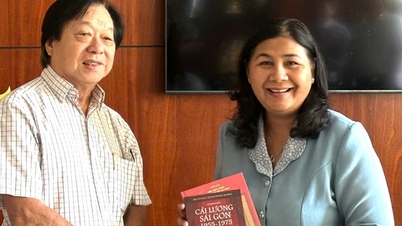
| The poetry collection "Mother's Six-Eight Verse" by Do Thanh Dong - Photo: MVH |
Speaking of his mother's patience and sacrifice, Do Thanh Dong also wrote a realistic line: "Heaven gave her a little lipstick/Mother dried it in the sun for a full can of rice" (Mother's Beauty). This line not only speaks of the hardships and sacrifices of poor mothers but also contains the author's profound reflections on human nature and the ways of the world. Sometimes, people have to trade beauty to survive. Everywhere and at every time, there are people who have to make such painful and silent sacrifices. Understanding his mother's hardships and sacrifices, Do Thanh Dong feels even more love and longing for her.
Among countless memories, there's the longing for my mother to pick lice from my fingers every day. I also had my mother pick lice from my fingers like you, so I deeply empathize with your unique "craving": "I crave the handful of fingers / my mother picks lice from my fingers every day" (I Crave). Usually, people crave delicious and exotic foods. But for Do Thanh Dong, craving the handful of fingers his mother used to pick lice from every day is truly unusual. "Poets" often have such unconventional tastes and ideas. Association is one of the indispensable qualities of a poet. Do Thanh Dong, because he deeply understands his mother's hardships and struggles, when he says: "Silently gazing at the crescent moon at the end of the sky / I suddenly feel so much affection for my mother's bent figure" (Mother's Moon). Looking at the crescent moon and feeling affection for his mother's bent figure shows that maternal love is always present in the author's consciousness. When we are young, we don't truly understand the hardships and sacrifices of our parents. Only when we grow up do we truly understand the labor and sacrifices of our parents. Only when we grow up do we realize the merits of our mothers and teachers. Do Thanh Dong exclaimed, as if offering a sincere apology to his mother: "I cry out in pain, Mother / You, in pain, can only grit your teeth and endure it your whole life" (Night's Sorrow). Both suffer pain, but the son and mother express it in two different ways. The son has his mother as a support to share his pain with. The mother, however, can only grit her teeth and endure it her whole life. I consider this a rather surprising discovery about maternal love.
Do Thanh Dong is one of the writers trying to revitalize the six-eight verse form. If we consider the form as the vessel and the content as the wine, then even if the wine is changed a hundred thousand times, the vessel may not necessarily be changed. That's why people often say "old vessel, new wine." The six-eight verse form has existed for nearly three centuries. It has always been used quite flexibly, not rigidly, rhythmically, and smoothly as many people mistakenly believe. If asked which poem in the collection "Six-Eight Verse of Mother" you like best, I would not hesitate to choose "Mother's Abstinence." For me, the poem "Mother's Abstinence" almost fully embodies the collection's theme. The author has chosen a powerful and moving poetic idea. Do Thanh Dong acknowledges that "Mother gives me poetic ideas / So that I can live fully with my dreams" is not without basis. His mother's life, her personality, and her feelings are the "material" that enabled him to write thousands of lines of "Six-Eight Verse of Mother." Talent and life experience are two inseparable elements for writers in general and poets in particular. His life experience with his poor, hardworking, and self-sacrificing mother helped Do Thanh Dong complete his long-held dream of writing the six-line poem "Mother's Six-Line Verse." His mother's image is vividly portrayed through each line, each verse, each stanza, and is encapsulated in the poem "Mother's Abstinence." "Mother's Abstinence" is a poem that is beautiful upon reading, requiring no further analysis. "Mother's Abstinence" is like a short story told in poetry with a simple, profound tone: "In March, fresh green herring/Standing and watching for a while, mother had to go home empty-handed/The village market sells cheap hats/Mother worries about daily expenses/Pitying her child who has been hungry for fish for so long/Mother bravely clenches her finger and asks/Borrows money to buy a dozen fresh fish/For the meal, mother says one fish is enough for everyone/A dozen for father and son/How can mother only have stewed fish left?/Mother laughs, 'Don't worry, son/I abstain from eating herring because it makes you sick/So the child remains carefree/So mother's worries disappear/So father remains pensive/This illness of mother's is partly father's fault/Mother, it's still March now/The village market is a dazzling white with herring by the riverbank/I don't worry about money/I only hear the waves lapping, my heart aches for the past."
The circumstances, personality, and fate of his mother played a crucial role in Do Thanh Dong's revitalization of the poetry collection "Mother's Six-Eight Verse." His mother's cracked heels from wading through mud inspired the poem "Mother's Heels" ; her slightly hunched back from years of toiling in the fields inspired the poem "Mother's Moon"; her sun-tanned complexion inspired the poem "Mother's Beauty." And if his mother hadn't lied about avoiding herring because "eating it would make you sick," he could hardly have written the moving poem "Mother's Restrictions." No matter how high a kite flies, it must have a string connecting it to the ground. Parents, homeland, and country are the roots of literature. If literature loses its connection to its roots, it will forever float in the air, gradually dissolving into smoke and dust like "a game without a trace."
Mai Van Hoan
Source: https://baoquangtri.vn/van-hoa/202601/do-thanh-dong-voi-luc-bat-me-2c60aa9/























































































Comment (0)