

High prices and limited supply are making the townhouse and villa segment in Ho Chi Minh City highly competitive with projects in neighboring cities.
Savills Vietnam's Q2 2024 data indicates a shortage of townhouses and villas in Ho Chi Minh City, with high prices and declining sales rates. Over 77% of the total primary supply is priced above VND 30 billion per unit. Furthermore, the absorption rate is low at only 6%. These high prices far exceed the affordability of the majority of the population.
Forecasts indicate that by 2026, Ho Chi Minh City will no longer have low-rise properties priced under 5 billion VND/unit, and only 10% of the primary supply will be priced under 10 billion VND/unit. Meanwhile, properties in this price range will account for 70-85% of the supply in Long An, Binh Duong, and Dong Nai provinces .
 |
According to Ms. Giang Huynh, Director of Research and S22M at Savills Vietnam, townhouses and villas in Ho Chi Minh City are facing competition from more affordable options in neighboring areas. High prices are driving homebuyers looking for a place to live or for investment purposes to move to urban areas adjacent to Ho Chi Minh City, where there are more suitable choices.
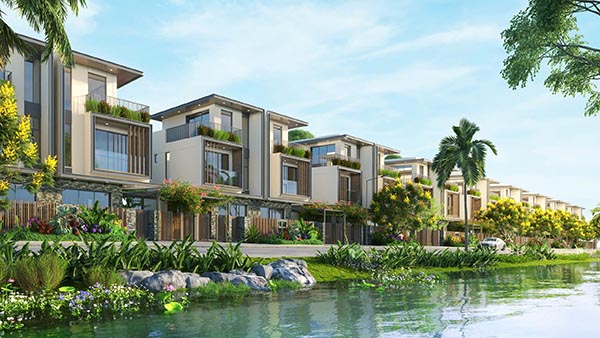
Accordingly, Ben Luc – an “expanded district” bordering Ho Chi Minh City, with rapidly developing infrastructure – has been a positively received option recently. Several urban development projects recently launched on the market, priced from 3-5 billion VND per unit, with well-planned and invested amenities, have received positive attention from the market.
"Easy access, close proximity" – infrastructure provides a solid foundation for urban areas adjacent to Ho Chi Minh City.
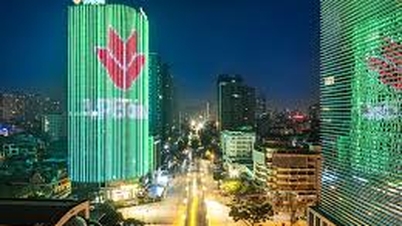
Over the years, Long An has seen a surge in brightly lit urban areas thanks to its infrastructure development. Besides the improved transportation infrastructure bringing the area closer to Ho Chi Minh City, the demand for both residential and investment properties has become a consistent preference in these large-scale urban developments. Furthermore, reasonable prices and diverse product offerings continue to be a major draw, driving significant demand from other regions towards Long An.
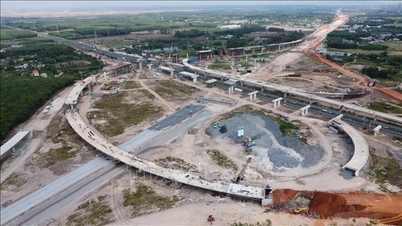
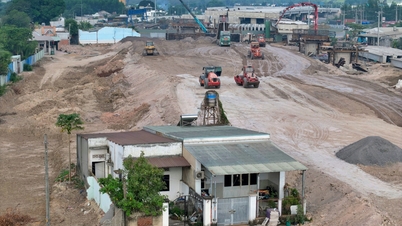
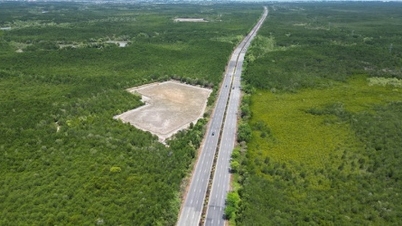
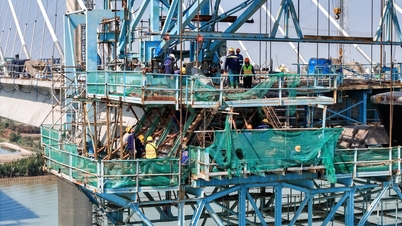
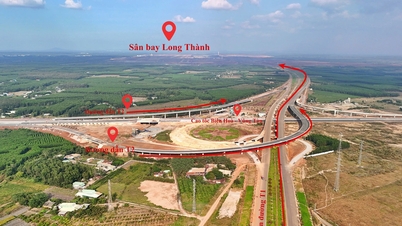
Recently, major transportation routes in Long An have seen significant investment, giving a boost to the real estate market. Notably, the 58km Ben Luc – Long Thanh expressway, traversing Long An, Ho Chi Minh City, and Dong Nai, is being constructed at an accelerated pace. It is expected that the 21km section from Ho Chi Minh City to Long An will be open to traffic in the first quarter of 2025. Once completed, along with the completion of Ho Chi Minh City's Ring Road 3, this route will significantly reduce travel time from Long An to Ho Chi Minh City, Dong Nai, and other southeastern provinces, creating a complete regional connectivity axis for the western region.
Most recently, the Luong Hoa – Binh Chanh arterial road has officially commenced construction, along with a series of regional connectivity projects such as Ring Road 3, Ring Road 4, National Highway 50B, National Highway N1… which are being promoted for investment and upgrading. All of these create a complete "two-sided" connection point, serving as a foundation for urban areas adjacent to Ho Chi Minh City. In particular, some urban areas in Ben Luc (Long An) directly benefit due to their gateway location between Ho Chi Minh City and the Mekong Delta region.
Clearly, thanks to improved infrastructure, people can "travel easily and return quickly," and consequently, the perception of owning real estate adjacent to Ho Chi Minh City is gradually changing. For today's homebuyers, administrative boundaries are no longer a psychological barrier. They have redefined the concept of a city center. It is now the center of satellite cities, offering convenient access to work, daily life, and amenities that ensure a high quality of life, all at an affordable price and easy to own.
A determination to keep the lights on and an eco-friendly model that anticipates future trends.
Eco-urban models, with their diverse amenities, abundant green spaces, and comprehensive living experiences, combined with adjacent eco-industrial zones, are contributing to the attractiveness of real estate in the western part of Ho Chi Minh City. There, residents can enjoy a life in a refreshing green environment with numerous job, business, and long-term investment opportunities.
In a recent announcement, a representative from the investor Prodezi stated that the 400-hectare Prodezi eco-industrial park, located opposite the 100-hectare LA Home eco-urban area, is being urgently developed and will be operational in 2025. This will be a magnet attracting thousands of high-income professionals and engineers, along with tens of thousands of workers, providing homeowners at LA Home with peace of mind regarding a sustainable and profitable future.
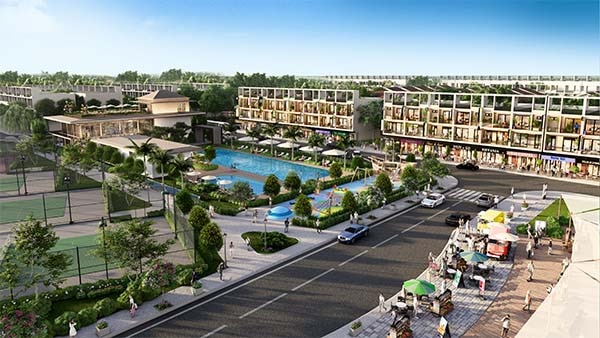 |
The LA Home urban development project begins with the launch of the LA Sol subdivision. This subdivision includes product lines ranging from terraced houses, double-frontage townhouses, canal-side villas to shophouses. Each product features a unique architectural design with harmonious green spaces.
The La Sol residential area's amenities have also been meticulously planned by the developer, Prodezi, to meet the living and experiential needs of residents. Highlights include a modern 1-hectare multi-purpose sports center, a Flea Market shopping area, a medical service area, an internal park incorporating aquatic plants, and a system of parks along natural canals winding through the subdivision.


![[Photo] National Assembly Chairman Tran Thanh Man successfully concludes his participation in IPU-152](https://vphoto.vietnam.vn/thumb/1200x675/vietnam/resource/IMAGE/2026/04/18/1776502638199_vna-potal-chu-tich-quoc-hoi-ket-thuc-tot-dep-chuong-trinh-tham-du-ipu-152-8709975-jpg.webp)





































































Comment (0)