

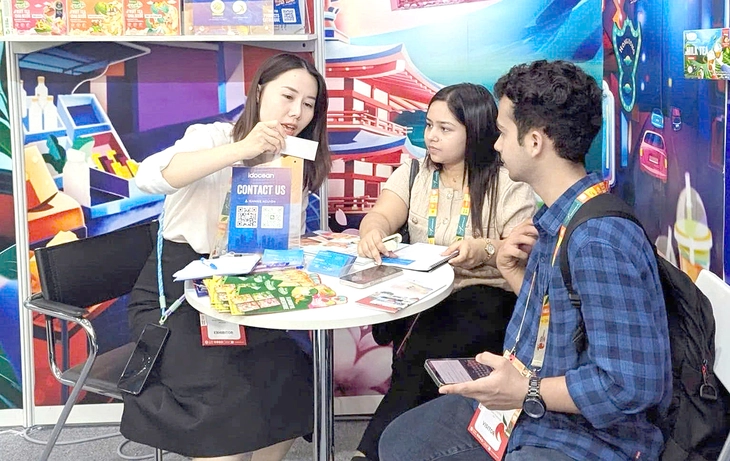
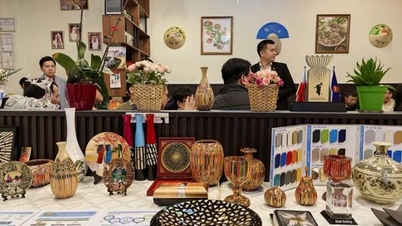
Vietnamese businesses seek new markets at the FHA (Food & Beverage 2025) trade fair in Singapore in April 2025 - Photo: CHI LE
In this context, many Vietnamese businesses are beginning to re-evaluate their internal strengths as a key factor in maintaining their export position.
Expand into Southeast Asia
Having just returned to Vietnam from a major food fair recently held in Singapore, Mr. Nguyen Thanh Hien, CEO of Tomcare Biotechnology Company (owner of the Chilica chili sauce brand), received three collaboration offers from partners in the region.
"We are focusing on expanding our consumer market in Asia, especially Southeast Asia," Mr. Hien told Tuoi Tre newspaper. Previously, the US accounted for 30-40% of Chilica's export revenue, but now that proportion is decreasing to around 20%. The reason he gave is to reduce dependence and avoid direct competition with giants like Sriracha, owned by "chili sauce billionaire" David Tran.
Unlike Chilica, Song Hong Garment Joint Stock Company is maintaining a strong market share in the US and expanding into new markets such as Africa and Dubai. In the first quarter of 2025, the company increased its export volume, boosting net revenue by over 34%, reaching more than 1,000 billion VND, and has secured orders until the end of the year.
The company's management stated that securing numerous orders recently has led to increased revenue, and combined with cost savings, has resulted in a profit increase of over 82%.
When expanding into diverse export markets, especially those considered promising such as Dubai or the African region, the management of Song Hong Garment Joint Stock Company believes that all new markets must be approached with caution.
The most important factor when investing is considering the client's financial capacity. While anticipating potential order reductions, the business still maintains a positive business outlook due to the supply chain shifting from China.
May Song Hong also aims to expand its market share in the US market through strategic partners such as Columbia Sportswear, Walmart, Target… and by establishing a joint venture in Egypt to take advantage of cheap labor and 100% tax exemption on goods exported to the US.
However, challenges in training local managers and the textile supply chain remain significant obstacles.
Reviewing domestic capabilities and export methods.
In an effort to diversify export markets to reduce risks, Vietnamese businesses face numerous challenges, especially price competition with low-cost rivals. Therefore, in addition to short-term solutions, a cautious long-term strategy is needed, carefully calculating cost and profit factors.
In addition, the export method is also an important factor, directly affecting how costs and taxes are calculated. Not all tax increases can be passed on to consumers; this depends on the industry and the sales method.
For example, if a business only covers costs up to the point the goods are loaded onto the ship, the import tax may be borne by the importer. Conversely, if the business covers all costs up to the point of sale, they will have to bear the additional tax themselves.
Mr. Pham Sy Thanh, director of the Center for China Economic and Strategic Studies (CESS), warned that among Vietnam's six key export product groups to the US, many items could be replaced if Vietnamese prices increase due to tariffs, while competitors maintain their price advantage.
"When assessing the impact before seeking solutions, especially for each product group with export turnover exceeding $1 billion, it is necessary to carefully analyze the export methods currently being applied," Mr. Thanh noted.
Despite having the advantage of using raw materials from Vietnamese agricultural products with distinctive flavors, Mr. Nguyen Thanh Hien recognizes that the biggest weakness of the business currently is its marketing activities.
"The biggest challenge is figuring out how to make customers aware of Chilica chili sauce. Our marketing hasn't been effective enough. This is a weakness of many Vietnamese businesses: they lack the resources and experience to market their products," Mr. Hien said.
He argued that if Vietnamese businesses knew how to leverage their unique advantages such as climate, soil, and the original flavors of domestic agricultural products, they could create a distinct difference for their products.
When combined with systematic investment in technology in harvesting, processing, and preservation, businesses can build their own competitive advantage, even when competing with countries that have strengths in large-scale production.
Vietnamese and American fruits: a two-way opportunity.
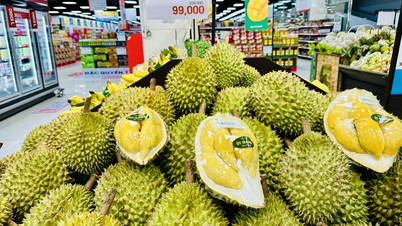
In addition to boosting exports, many businesses are seeing opportunities to import high-end products from the US to meet domestic market demand. In 2024, Vietnam imported fruits and vegetables from the US worth nearly $550 million, a 64% increase compared to 2023.
Currently, eight types of American fruits are licensed for import into Vietnam: apples, grapes, oranges, cherries, pears, blueberries, peaches, and nectarines. Three others—tangerines, lemons, and plums—are also in the negotiation process. Among these, nectarines are a new variety, heart-shaped, with smooth red skin, a sweet and crisp taste, and rich in vitamins and fiber.
The Department of Crop Production and Plant Protection (Ministry of Agriculture and Rural Development) plans to send officials to the United States to assess growing areas in the US at the end of April 2025 and prepare for the upcoming trade season.
Speaking to Tuoi Tre newspaper, Francis Le, representative of the American Agricultural Products Industry Association in Vietnam, said they are working to bring the first shipments of nectarines to Vietnam.
He stated: "The US is the second country allowed to import nectarines into Vietnam, after Australia. Many domestic businesses are proactively placing orders, although the initial production volume cannot yet be estimated because consumers are not yet very familiar with this fruit."
According to the plan, nectarines will be transported by air, similar to cherries. Mr. Francis estimates that Vietnam imports 600,000-700,000 boxes of cherries from the US (5kg per box) and about 2 million boxes of apples (20kg per box) annually.
Source: https://tuoitre.vn/doanh-nghiep-viet-tim-thi-truong-moi-20250504081740948.htm
![[Photo] Prime Minister Pham Minh Chinh presides over a meeting on private sector economic development.](/_next/image?url=https%3A%2F%2Fvphoto.vietnam.vn%2Fthumb%2F1200x675%2Fvietnam%2Fresource%2FIMAGE%2F2025%2F12%2F20%2F1766237501876_thiet-ke-chua-co-ten-40-png.webp&w=3840&q=75)



































































Comment (0)