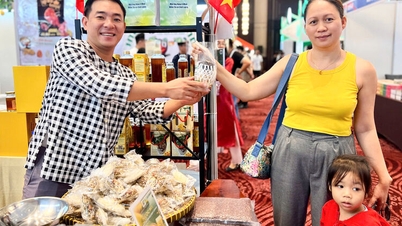
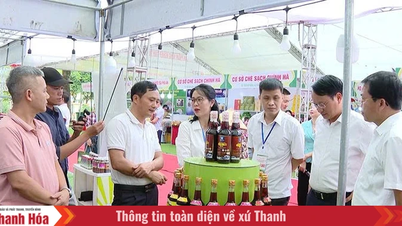
The unique rice wine culture of the Muong people is honored and promoted in the province's cultural and tourism events.
People's Artisan Bui Van Minh, from Man Bui hamlet, Thuong Coc commune, recalls that even though more than two years have passed, the echoes of the Rice Wine Festival within the framework of the Hoa Binh (formerly) Culture and Tourism Week still linger in his mind and that of many people in the Muong region. The festival offered a rich experience with unique artistic activities and community cultural exchanges; it was an opportunity for artisans from the four Muong regions: Bi, Vang, Thang, and Dong, to introduce their unique customs and ways of drinking rice wine, thereby arousing pride and the desire to preserve the precious cultural heritage values of the Muong community.

How Muong women in Dai Dong commune make delicious rice wine.
In the Muong language, rice wine is called "raw toong". No one knows exactly when the Muong people started making rice wine, only that it is a fermented beverage that has been used in their lives for a long time and is made by the skillful hands and intelligence of women. Rice wine is used in families, during celebrations, weddings, housewarming parties, funerals, tomb-paying ceremonies, and other rituals.

Leaf yeast – the “soul” of the rice wine – needs to be prepared meticulously by the Muong people.
According to Ms. Bui Thi Cui, owner of the Muong Vang rice wine production facility in Hoa Binh ward, the secret to making a delicious jar of rice wine lies in the yeast. Considered the "soul" of rice wine, the Muong people's leaf yeast is made from various forest plants, leaves, and natural ingredients such as chili peppers, ginger, galangal, jackfruit leaves, guava leaves, raspberry leaves, camphor bark, wild cardamom vines, and mountain leaves... Especially, ebony bark is indispensable to create the sweet, characteristic flavor of rice wine, which holds both spiritual value and embodies the depth of community culture.




Glutinous rice is mixed with rice husks and steamed over a wood-fired stove.
The ingredients for making rice wine include glutinous rice, rice husks, and yeast. The glutinous rice is soaked overnight to soften it; the rice husks are washed, dried, and then mixed thoroughly with the rice before being steamed over a wood fire. Once the rice has cooled, the yeast is added, and the mixture is left to ferment. This process requires skill and meticulousness to ensure the yeast permeates each grain of rice and husk, preserving the wine's delicious flavor for a long time. Once the wine is successfully fermented, it is placed in jars, sealed tightly, and left to age. In hot weather, it takes about 20 days for the wine to reach the desired sweetness, while in cold weather it takes more than a month before it can be consumed.

After cooling, the rice is thoroughly mixed with yeast before being sealed and left to ferment.
The Muong people have a custom of drinking alcohol in gatherings and groups. When guests arrive, the host spreads a mat on the floor, places a jar of wine in the center, and invites everyone to gather around. After friendly greetings, the host invites guests to drink "from the garden and the stream to ease the fatigue of the long journey." The Muong call this the custom of "thong can" drinking. This is followed by drinking in pairs, men and women, four, six, or more people drinking together, creating a warm, harmonious, and close-knit atmosphere.

Rice wine has become an attractive cultural and tourism "ambassador".
According to Mr. Bui Van Nam, a civil servant in the Cultural Heritage Management Department of the Department of Culture, Sports and Tourism, besides the traditional leaf-wrapped feast, the custom of drinking rice wine is a common cultural feature in the Muong community. Rice wine is present in almost all important rituals. In the Mo Muong epic, when people discovered fire, water, and rice, they also created food, drinks, and the recipe for making rice wine. In weddings, without a jar of rice wine, the bride cannot go to her husband's house; in Tet (Lunar New Year), without a jar of rice wine, spring is not truly complete. Drinking rice wine is not simply about enjoying a beverage, but also a communal cultural feature where people gather, share, and strengthen their bonds of love and affection for one another.

Family recipes combined with the skillful hands of Muong women create these delicious jars of rice wine.


Thanks to the efforts of all levels, sectors, and localities in preserving and promoting cultural heritage values, the traditional rice wine culture of the Muong people has become widely known and appreciated by people throughout the country.
Rice wine has become a cultural and tourism ambassador, offering a unique and captivating experience for both domestic and international tourists. Notably, in 2023, the rice wine of the Muong people in Hoa Binh and Phu Tho provinces was honored by the Vietnam Culinary Culture Association as one of 121 typical Vietnamese foods and drinks.
Bui Minh
Source: https://baophutho.vn/doc-dao-van-hoa-ruou-can-cua-cong-dong-muong-256210.htm
![[Image] Paris's oldest bridge goes viral after transforming into a giant cave.](https://vphoto.vietnam.vn/thumb/1200x675/vietnam/resource/IMAGE/2026/06/24/1782283441197_ndo_br_dsc05314-jpg.webp)
![[Photo] Prime Minister Le Minh Hung presides over the thematic session on promoting science and technology development and innovation.](https://vphoto.vietnam.vn/thumb/1200x675/vietnam/resource/IMAGE/2026/06/23/1782207872934_ndo_br_dsc-1724-jpg.webp)