

On the Pha Din Pass, shrouded in white clouds, the winding roads between towering mountains and deep ravines, 70 years ago, were ablaze with the fervor of the entire nation going to war, determined to crush the Dien Bien Phu fortified complex. Standing on the pass's summit, the verses of a bygone era of war suddenly echo in my ears: "On the Pha Din slope, sisters carry loads, brothers haul; on the Lung Lo Pass, brothers sing, sisters chant; though bombs and bullets shatter bones and flesh, our hearts remain unwavering, we do not regret our youth..."
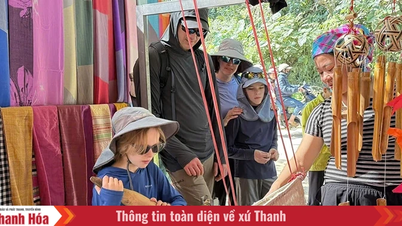
 Mr. Doan Dinh Quang introduces souvenirs to tourists visiting the top of Pha Din Pass. Photo: PV
Pha Din Pass is known as one of the "Four Great Mountain Passes" of the Northwest region of Vietnam, along with O Quy Ho Pass (connecting Lai Chau and Lao Cai provinces), Ma Pi Leng Pass (Ha Giang province), and Khau Pha Pass (Yen Bai province). It is a high pass, situated on the border between Son La and Dien Bien provinces. We followed the winding A-shaped and Z-shaped curves on National Highway 6, crossing Pha Din Pass, sometimes shrouded in swirling clouds, sometimes descending below the vast green expanse of the Northwest mountains and forests. The road, though treacherous, was truly majestic, magnificent, and breathtakingly beautiful.
Mr. Doan Dinh Quang (born in 1966), originally from Nua town (Trieu Son district), has been selling souvenirs on the summit of Pha Din Pass for over six years. He explains the name of Pha Din Pass. According to Mr. Quang, the name originates from the Black Thai ethnic language, originally "Pha Din." "Pha" means sky, and "Din" means earth, implying that the pass, shrouded in white clouds, is a place where heaven and earth meet and intersect. The Thai people living around the foot of the pass often call out "Pha ơi" (oh heavens!). Also in the Thai language, "Pha Din" means a steep, difficult-to-climb earthen cliff.
Starting from Thuan Chau district (Son La province), National Highway 6 crossing Pha Din Pass is full of winding, treacherous curves, clinging precariously to high mountains and deep ravines, with many sharp bends. But it is precisely these winding, dangerous stretches of road that become the unique and attractive feature of the pass, drawing many visitors each year. Most of them are young people who enjoy exploration and challenge. The times most tourists choose to conquer Pha Din Pass are usually the dry, windy autumn days or the bitterly cold winter days.
These days, atop Pha Din Pass, we encounter elderly people with graying hair, former Dien Bien Phu soldiers, youth volunteers, and civilian workers who directly fought and served in the Dien Bien Phu campaign. Although the current road has been upgraded in many sections and is no longer the same as it was in the past, a blood-red memorial remains at the intersection of the old and new roads. They stop there to chat, reminisce about the wartime memories, and take photos along this path that leads back to their heroic past.
The inscription on the memorial plaque reads: “Pha Din Pass is 32km long, with its highest point at 1,648m above sea level. This was the site of numerous bombing raids by French colonial aircraft aimed at disrupting our supply lines of weapons, ammunition, food, and provisions for the Dien Bien Phu Campaign. Under enemy bombardment, with unwavering determination and courage, soldiers, civilian workers, and volunteer youth remained steadfast, simultaneously breaking rocks to open roads, clearing bombs and mines, and maintaining vital transportation routes, ensuring timely support for the campaign until the day of complete victory.” Below are four lines of poetry by the late poet To Huu: “On Pha Din Pass, women carry loads, men haul; on Lung Lo Pass, men sing, women chant; though bombs and bullets shatter bones and flesh are torn; our hearts remain unwavering, we do not regret our youth.”
Seventy years ago, this treacherous mountain pass, one of the most dangerous in Northwest Vietnam, became a crucial point on the supply route for our troops at the Dien Bien Phu battlefield. In an attempt to cut off our advance, the French colonialists sent planes to patrol the Pha Din Pass area dozens of times a day, frantically dropping hundreds of bombs of all kinds. The pass, along with the Co Noi junction, became a bomb-laden pocket.
In this historic clash, the Co Noi intersection – where National Highway 13A (now National Highway 37) and Highway 41 (now National Highway 6) meet – located in Co Noi commune, Mai Son district (Son La province), held an extremely important position as it connected the Northern Delta region, Viet Bac Inter-region, Inter-region 3, and Inter-region 4 with the Dien Bien Phu battlefield thanks to the transportation network: From Viet Bac, via Ba Khe - Co Noi - Son La - Dien Bien; From Inter-region 4 - Nghe An - Thanh Hoa - Moc Chau - Co Noi - Son La - Dien Bien; From Inter-region 3 - Nho Quan - Hoa Binh - Moc Chau - Co Noi - Son La - Dien Bien. However, from Co Noi, the only way for weapons, ammunition, food, and supplies to reach Dien Bien Phu was by crossing the treacherous Pha Din Pass. And to ensure the smooth flow of traffic and the timely provision of manpower and resources for the Dien Bien Phu campaign, thousands of young volunteers and civilian laborers fell on that mountain pass.
A civilian laborer we were fortunate enough to meet recreated some of the fervent spirit of the entire nation during that time. He is Nguyen Duc Ngoc, the leader of the Hoang Dong commune's (Hoang Hoa district) rickshaw team during the months of supporting the Dien Bien Phu Campaign. Mr. Ngoc recounted that back then, his rickshaw team was tasked with transporting goods from Quang Xuong to Dien Bien. Along the hundreds of kilometers of the route, the most difficult part was the Pha Din pass. Going uphill required more than one person to push the cart, while going downhill required two people – one pushing from the front and one pulling from the back – otherwise, the cart would plunge into the ravine. Each trip took a whole month to reach the goods collection point in Tuan Giao district (Dien Bien province).
When the air raid siren sounded, Mr. Ngoc and his comrades scattered, seeking shelter. Once the planes passed, they quickly regained control of their carts, pushing supplies forward. Moreover, the winding mountain pass meant that a single bomb hit a single point, causing landslides that damaged many sections of the road below. But with the spirit of "All for the front lines, all for victory," Mr. Nguyen Duc Ngoc and the other civilian laborers of that era, along with the youth volunteers, held their ground on the mountain pass, filling bomb craters, clearing rocks, and building roads, contributing to the victory that resonated throughout the world.
Seventy years have passed, and today Pha Din Pass is adorned with the colors of life, but the traces of the fervent spirit and the "Fight to the death for the Fatherland" attitude of the soldiers, civilian workers, and volunteer youth remain intact. And National Highway 6 has become a vital economic trade route connecting Dien Bien province with the lowlands, and with the provinces of Northwest Vietnam and Northern Laos via the Tay Trang International Border Gate.
Along the majestic Pha Din Pass, amidst the vast expanse of white bauhinia flowers, we encountered young Thai and Hmong women carrying baskets of plums and oranges to sell to tourists. And at the top of the pass, the souvenir shop of Mr. Doan Dinh Quang – a native of Thanh Hoa – was bustling with laughter.
Do Duc
Source

![[Photo] General Secretary and President To Lam presides over a working session with the Central Policy and Strategy Committee on the development of the materials industry.](https://vphoto.vietnam.vn/thumb/1200x675/vietnam/resource/IMAGE/2026/05/21/1779359935432_a3-bnd-3129-1412-jpg.webp)
![[Photo] National Assembly Chairman Tran Thanh Man working with the Standing Committee of the Law and Justice Committee](https://vphoto.vietnam.vn/thumb/1200x675/vietnam/resource/IMAGE/2026/05/21/1779378929214_ndo_br_1-4610-jpg.webp)





































































Comment (0)