


For two decades, buses have accompanied generations of students to school and people from urban centers to remote villages throughout the province. But now, standing before empty bus stops, people can't help but feel regret for a "bus era" that is gradually fading into the past.
 |
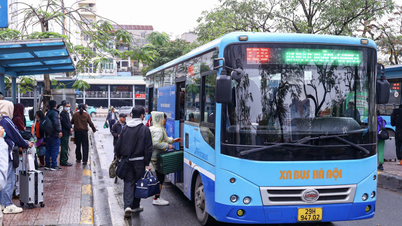
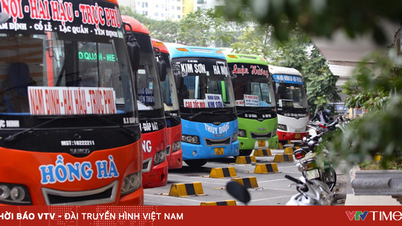
| The buses traveling on Le Hong Phong Street in Buon Ma Thuot ward are a familiar sight to generations of students. |
For the people of Dak Lak , buses are not simply means of transportation; they have become a part of their memories, a piece of life filled with recollections. In this vast highland region, where distance between localities is often a barrier, buses have emerged as a lifeline. They not only facilitate travel between villages and towns but also play a crucial role in alleviating transportation costs, providing affordable travel opportunities for thousands of people.
As bus routes become less frequent, many people feel disappointed and regretful. Mr. Nguyen Van Binh, a resident of Buon Ma Thuot ward but working in the former Lak district, couldn't hide his regret at having to say goodbye to a mode of transportation that had been his companion for a long time. For many years, the bus was his trusted choice for commuting between home and work.
For over two years now, since the Buon Ma Thuot - Lak bus route officially ceased operation, Mr. Binh has been forced to switch to using private transportation. He shared his concerns, saying that although buses are not as convenient as private transportation in terms of time, they have always been his top priority due to their affordable prices and the absence of arbitrary pick-up and drop-off points. He feels sad that the bus service has stopped.
Having relied on the bus as her primary mode of transportation throughout her student years, traveling 30 km from home to university, Ms. Nguyen Thi Lan (from Ea Knuec commune) couldn't help but feel disappointed when this familiar bus route ceased operation.
Mr. Pham Van Manh, Chairman of the Dak Lak Automobile Transport Association - a person directly involved in the bus transport business - reflects on the development of this transport activity with much regret.
He shared that 2005 marked a breakthrough for Dak Lak province when it boldly pioneered the socialization of public transportation, officially launching its first bus services. By the development phase around 2012, the western region of the province alone had 300 buses in operation, covering everything from urban areas to the most remote villages.
However, the rise of private vehicles, coupled with changes in people's habits over the years, has put bus operations in a difficult position. Currently, the number has drastically decreased, to less than 100 buses, and even then, they operate at a minimal level. After a long period of struggling, many bus routes have been forced to cease operation, such as those connecting Buon Ma Thuot to the former districts of Lak, Krong Ana, Ea Kar, and M'Drak.
This situation not only forces businesses and cooperatives to reluctantly liquidate vehicles to cut losses, but also pushes hundreds of drivers and ticket inspectors into unemployment.
The ups and downs of the bus system are not only a concern for those in the transportation industry but also a source of uncertainty for those who have to leave the driver's seat. While bus stops remain, the number of buses is dwindling, leaving the question of the future of public transportation in the province unanswered.
Source: https://baodaklak.vn/xa-hoi/202601/doi-buyt-f8e04c7/

![[Photo] Thousands of tourists visit the Quang Trung Emperor Temple in Nghe An during the early spring season.](https://vphoto.vietnam.vn/thumb/1200x675/vietnam/resource/IMAGE/2026/02/26/1772095410680_img-9305-3882-jpg.webp)


![[Photo] National Assembly Chairman Tran Thanh Man inspects election preparations in Hai Phong city.](https://vphoto.vietnam.vn/thumb/1200x675/vietnam/resource/IMAGE/2026/02/26/1772095420401_ndo_br_bnd-8016-jpg.webp)


































































Comment (0)