


With its abundant forest land and the shift towards a circular growth model, bamboo cultivation not only helps protect the environment but also opens up a sustainable path for the province's rural economy .
Potential from green bamboo
Bamboo is identified as an ecologically sound plant with a rapid growth rate, absorbing 2-3 times more CO2 and releasing 35% more O2 than other plant species. Globally , bamboo is currently a strategic resource in the global green growth trend.
The bamboo industry has a significant share of the trade, with China, for example, accounting for over 65% of the market share with more than 1,000 product varieties. Vietnam also possesses abundant bamboo resources with a total area of 1.48 million hectares and approximately 216 species, contributing between 900 million and 1.1 billion USD in export revenue annually.
Dak Lak province currently has over 3,500 hectares of bamboo and rattan forests, widely distributed in areas along streams, after-slash-and-burn farming land, and barren agricultural lands. Although current exploitation is still largely spontaneous and small-scale, bamboo is proving its multifaceted value: from reforestation for environmental protection to providing raw materials for food (bamboo shoots), construction materials, and handicrafts.
Particularly in indigenous ethnic minority communities like the M'nong, rattan and bamboo weaving is not only a cultural activity but also an important traditional livelihood.
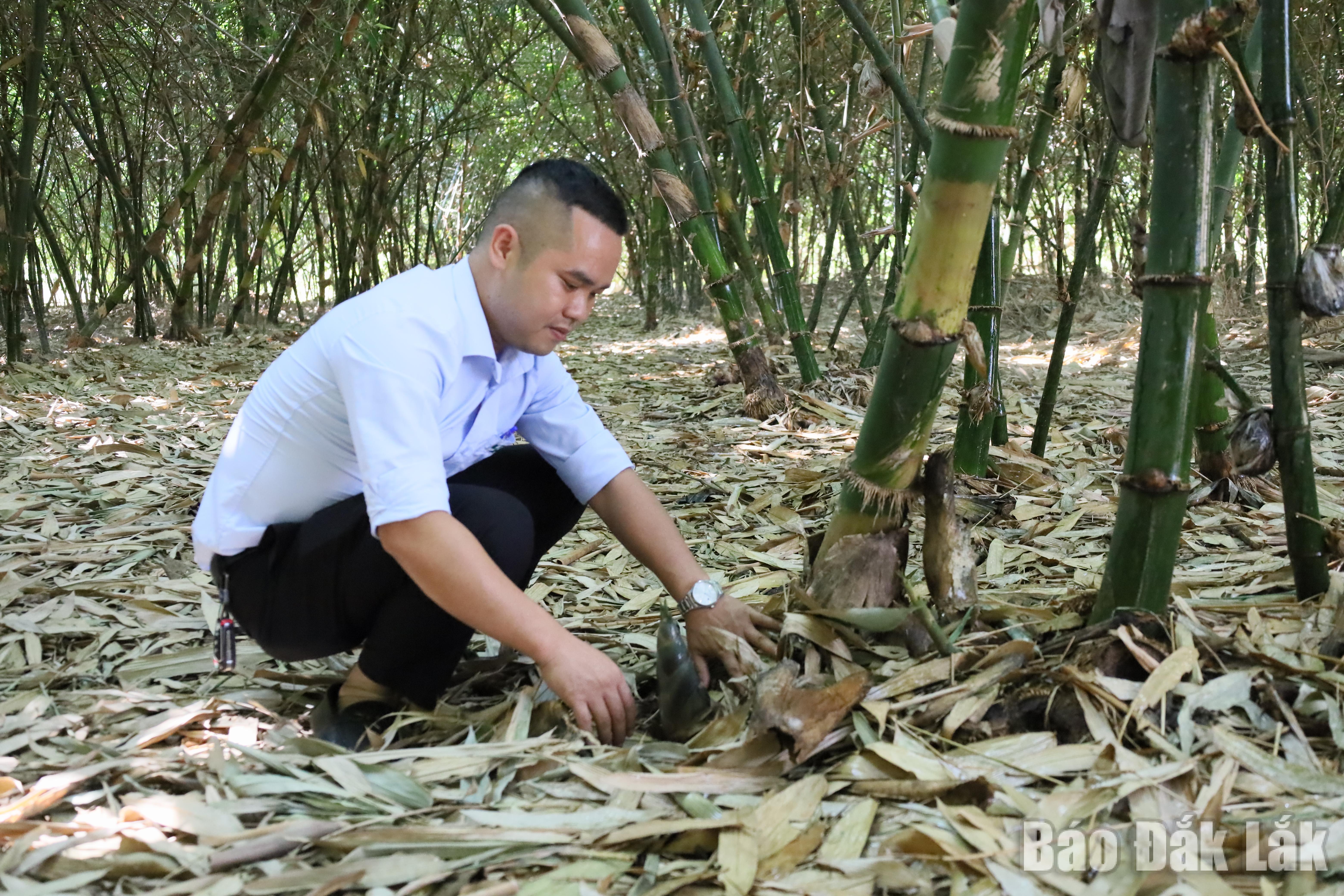 |
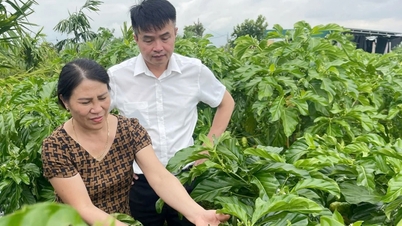
| Bamboo cultivation model for harvesting shoots in Ea Súp commune. |
Furthermore, the model of cultivating bamboo for economic purposes is opening up a promising new direction. For example, many households in the province have planted the Taiwanese bamboo variety (also known as "luc truc" bamboo) for its shoots on abandoned land, generating a relatively high average income of 300-500 million VND/hectare/year, contributing to unlocking the economic potential of these disadvantaged areas in the locality.
According to Mr. Nguyen Ba Ban, Chairman of the People's Committee of Ea Sup commune, some households in the commune who grow four-season bamboo are currently earning high incomes from selling fresh bamboo shoots (over 400 million VND/hectare/year), opening up opportunities for sustainable poverty alleviation for many households in the commune. This is an impressive figure compared to older forestry crops such as acacia or melaleuca, which have long cycles and low economic efficiency.
"We need to change our mindset, not just view bamboo as a 'poverty alleviation' crop, but rather as a green, sustainable, high-value economic sector linked to the international carbon credit market." Deputy Director of the Department of Agriculture and Environment, Dang Thi Thuy |
According to the Department of Agriculture and Environment, in the context of the agricultural sector shifting strongly from a production-oriented mindset to an agricultural economics mindset, the need to develop green agriculture, a circular economy, and reduce emissions is becoming increasingly urgent.
Bamboo, with its advantages of rapid growth, high carbon absorption capacity, and diverse uses in construction, handicrafts, deep processing, and export, is considered one of the crops with great potential for sustainable development.
Linking for sustainable development
Despite its great potential, the bamboo industry in Dak Lak province remains fragmented. The entire province has less than 50 hectares of concentrated bamboo plantations, and harvesting still relies heavily on natural conditions. Currently, bamboo cultivation is primarily for harvesting shoots, providing raw materials for traditional products (chopsticks, rattan and bamboo weaving, handicrafts, etc.); there are no modern, specialized processing plants for producing high-tech, exportable products. Therefore, to realize the goal of making bamboo a key rural economic sector, the province is moving towards a "four-party" linkage model.
According to experts and businesses, Dak Lak needs to plan concentrated raw material areas linked to value chains between farmers, cooperatives, and purchasing businesses. At the same time, the province must promote the application of science and technology in high-yield breeding and implement sustainable forest management according to international standards (VFCS/PEFC) to bring bamboo products to the global market.
The province needs to define the development goals for bamboo not only as selling bamboo shoots and timber, but also as deeply involved in the circular economy value chain, contributing to the effective implementation of the National Target Program for building new rural areas and sustainable poverty reduction in the province.
According to Ms. Dang Thi Thuy, Deputy Director of the Department of Agriculture and Environment, with approximately 27 economically potential bamboo species identified in Vietnam, localities must select good, suitable varieties from the outset to maximize economic benefits, primarily through bamboo shoot harvesting and supplying raw materials for deep processing and handicrafts.
In terms of planning, the agricultural sector aims to review all land resources in localities, expanding bamboo cultivation areas to sloping land and riverside corridors to harmoniously combine economic development and ecological environment protection. In particular, the province also focuses on attracting businesses into sustainable supply chains.
Currently, Dak Lak has about 5 other bamboo planting projects awaiting planning approval. Once a concentrated raw material area is established, investors will proactively seek them out.
The Department of Agriculture and Environment will direct the integration of funding from national target programs to support farmers with seeds, techniques, and livelihood development from bamboo cultivation. Initially, the Provincial Agricultural Extension Center will coordinate with the People's Committee of Ea Súp commune to implement demonstration models. This is an important step to change production mindsets, aiming to build bamboo into a green, sustainable economic sector and eventually participate in the international carbon credit market.
Minh Thuan
Source: https://baodaklak.vn/kinh-te/202602/danh-thuc-tiem-nang-cay-tre-8ab65ec/

![[Photo] Prime Minister Pham Minh Chinh presides over the meeting of the Steering Committee for the Development of Science, Technology, Innovation, Digital Transformation and Project 06.](https://vphoto.vietnam.vn/thumb/1200x675/vietnam/resource/IMAGE/2026/02/25/1772024613089_1772024091685-jpg.webp)
![[Photo] Prime Minister Pham Minh Chinh receives the Director General of TASS News Agency (Russian Federation)](https://vphoto.vietnam.vn/thumb/1200x675/vietnam/resource/IMAGE/2026/02/25/1772024599891_dsc-8041-jpg.webp)




































![[Infographic] Eight task groups in the Action Program to implement Resolution 80-NQ/TW on the development of Vietnamese culture](https://vphoto.vietnam.vn/thumb/402x226/vietnam/resource/IMAGE/2026/02/26/1772064804794_chuong-trinh-17720096665761428525089-0-105-1400-2345-crop-17720097331061282725800.jpeg)












Comment (0)