


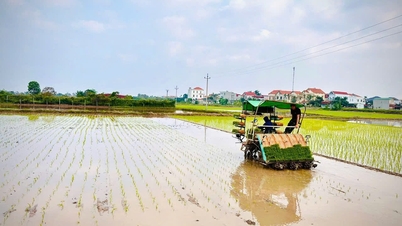
On the morning of the 9th day of the first lunar month, Mrs. Le Thi Thu from Phu Hoa 1 commune went to check on her rice fields and replant seedlings. This season, her family sowed the Dai Thom 8 variety, which was provided by the government. The good variety, combined with sufficient irrigation, resulted in healthy rice growth.
Ms. Thu shared: "From the third day of Tet until now, I've been visiting the fields, replanting rice seedlings to ensure even coverage, and also taking the opportunity to weed and catch snails. Usually, after sowing, the rice is damaged by rats, resulting in uneven planting, but this year there are fewer rats, so the rice is uniformly green, healthy, and sturdy. Currently, my 3 sao (approximately 0.3 hectares) of rice are in the tillering stage and will soon be heading, so they need regular care and sufficient water because the development of the rice plant at this stage is crucial to the yield."
 |
| Farmers go to the fields to replant rice seedlings. |
In Tuy An Nam commune, local leaders organized field visits to promote care and pest control for the winter-spring rice crop during the Tet holiday. Currently, the entire commune has sown 205.8 hectares out of 205.8 hectares, achieving 100% of the planned target. The rice area is divided into three growth stages: early, middle, and late. Of these, most of the early stage rice has already formed panicles, the middle stage is in the tillering to late tillering stage, and the late stage is growing steadily.
According to Mr. Ngo Tan Lang, Secretary of the Party Committee and Chairman of the People's Council of Tuy An Nam commune, the entire rice crop in the commune is developing well, with no significant widespread pest outbreaks. Organizing field inspections at the beginning of the year aims to proactively monitor the development of pests and diseases in the fields, promptly detect and effectively implement control measures. This is because the tillering and heading stages of rice, combined with unusual weather conditions, easily lead to blast disease and rodent damage.
After visiting the fields, the commune leaders requested that agricultural cooperatives in the area continue to promote and encourage farmers to regularly visit their fields, take good care of and manage their crops; and absolutely not be complacent to prevent disease outbreaks during the 2025-2026 Winter-Spring rice crop.
 |
| Farmers go to the fields to spray pesticides to control pests and diseases affecting rice crops. |
In Dong Hoa ward, Mr. Chau Van Ba is pulling a water pump to bring water from the Nam Binh pumping station's canal to his rice fields. Mr. Ba said: "Before Tet, we were worried about a shortage of seeds and water, but by early spring, the rice seedlings are already lush and green. The canals have been reinforced, and the water from the pumping station flows through the branch canals all the way to the fields. We are very happy."
According to the plan, Dong Cam Irrigation Company Limited will open the water supply for the 2025-2026 Winter-Spring crop until May 2026. Mr. Nguyen Minh Hue, Chairman of the company, said that the Dong Cam irrigation system includes a 680-meter-long dam built on the Ba River and a system of self-flowing canals and ditches, ensuring irrigation water for more than 19,000 hectares of double-cropped rice in the eastern part of the province.
The water flow in both the North and South main canals, after being opened, ensures sufficient water for farmers to care for and fertilize their winter-spring rice crop, which is currently in the seedling and tillering stages. The water level at the Dong Cam main dam remains stable, ensuring water regulation for agricultural production in the Tuy Hoa delta region. In addition to providing irrigation water for this winter-spring crop, the company also plans drought mitigation measures for the upcoming summer-autumn crop each year.
Minh Duyen
Source: https://baodaklak.vn/kinh-te/202602/dau-xuan-ra-dong-cham-care-lua-b895aa0/

















































































Comment (0)