Accordingly, during the period 2027-2031, the political system will continue to reduce its workforce by 5-10%. Notably, this reduction is part of a comprehensive set of solutions including decentralization, delegation of power, application of science and technology, digital transformation, streamlining work processes, reducing intermediaries, and reorganizing the organizational structure.
This approach shows that downsizing the workforce is not a mechanical goal. It is the result of a process of innovating personnel management methods, improving the quality of the workforce, and strengthening the mechanism for selecting officials based on competence and performance.
Specifically, Conclusion 40 sets out a series of fundamental requirements such as: shifting from managing the number of personnel to managing the quality and efficiency of public service performance; applying data-driven management methods; quantifying work to determine actual personnel needs; evaluating officials using specific indicators; implementing the principle of "entry and exit," preventing the situation where being on the payroll equates to lifelong stability...
This represents a shift from an input-based management mindset to an output-based management mindset. A modern administration is not judged by the size of its apparatus or the number of personnel, but by the quality of service it provides to citizens and businesses, and the efficiency of its use of public resources.

![[Video] Completing the coordination regulations in the fields of defense, security and foreign affairs.](https://vphoto.vietnam.vn/thumb/192x108/vietnam/resource/IMAGE/2026/06/25/1782398101931_ky-jpg.webp)
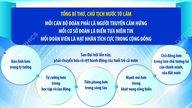
In the context of rapid digital transformation, this need becomes even more urgent. Digital data helps shorten processing times; shared platforms contribute to reducing repetitive data entry and reporting; and artificial intelligence is gradually supporting data aggregation, analysis, and decision-making. As technology changes operating methods, the way the organizational structure and human resources are utilized also need to be adjusted accordingly. Therefore, downsizing the workforce will only yield tangible results when coupled with streamlining processes, cutting intermediate steps, and innovating management methods – requirements set forth by the Politburo in Conclusion 40.
As job performance becomes a crucial measure in public administration, the mechanisms for evaluating, utilizing, and selecting personnel must also be reformed in a more substantive direction. In this context, the requirement to implement the principle of "in and out" and to build stronger mechanisms for filtering out those who do not meet job requirements is a very noteworthy point of Conclusion 40. A strong system not only needs mechanisms to attract capable people but also mechanisms for evaluating and effectively filtering out those who fail to complete their tasks. If all positions are automatically guaranteed long-term security regardless of work performance, the motivation for innovation and the spirit of dedication will hardly be fully fostered.
However, downsizing the workforce does not mean mass layoffs. Conclusion 40 emphasizes the need to address the situation where areas with staff shortages are not being filled, while areas with low efficiency maintain stable staffing levels. Thus, the goal is not to reduce staff at all costs, but to restructure human resources according to development requirements, prioritizing areas that need high-quality professional staff.
More than just a plan for personnel management and allocation, the Politburo's Conclusion 40 has shaped a new approach to managing and utilizing public human resources. This is a crucial foundation for building a more modern, streamlined, and efficient administration that serves the people and promotes national development.



Source: https://daibieunhandan.vn/doi-moi-tu-duy-quan-ly-bien-che-10419877.html
![[Photo] General Secretary and President To Lam receives Palestinian Ambassador Saadi Salama](https://vphoto.vietnam.vn/thumb/1200x675/vietnam/resource/IMAGE/2026/06/25/1782365384740_a1-bnd-9423-8322-jpg.webp)


![[Image] Schools organize meetings and introduce teaching models to students admitted to grade 10.](https://vphoto.vietnam.vn/thumb/1200x675/vietnam/resource/IMAGE/2026/06/25/1782368077271_ndo_br_z7970052192242-1ec8daeb77a6eed1a4e9f58c564ddd3e-jpg.webp)

![[Image] Ho Chi Minh City: Ma Lang area, Chicken-Rice Market about to change its appearance](https://vphoto.vietnam.vn/thumb/1200x675/vietnam/resource/IMAGE/2026/06/25/1782377698627_ndo_br_m1-jpg.webp)