

" BREATHING LIFE" INTO RATTAN AND BAMBOO THREADS
"Living amidst vast mountains and forests, since ancient times, we Co Tu people have chosen resilient rattan and bamboo to weave everyday items. Just by looking at the three-compartment basket a man carries on his back, one can tell his weaving skill. A beautiful basket attracts many admirers and cherishes it..." Elder Pơloong Chướch smiled gently as he began his story about the craft. He said that whether the weaving is beautiful or just "pleasing to the eye," the craft of weaving has remained a part of the lives of all the Co Tu men for generations. However, modern life, with the increasing availability of durable and inexpensive plastic, aluminum, and stainless steel items, has pushed Co Tu weaving into a difficult situation, with fewer people pursuing it.
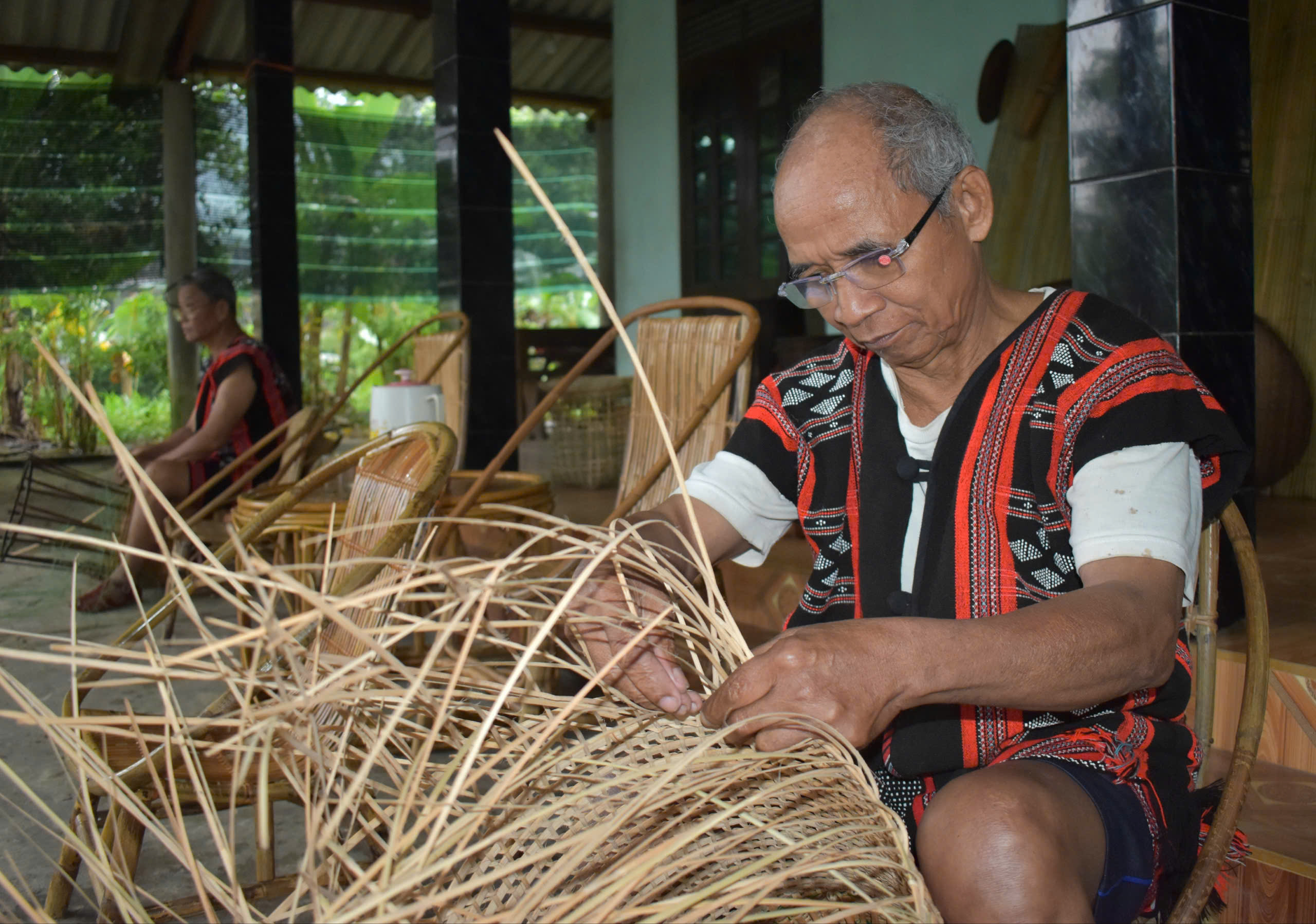
Elder Pơloong Chướch - nicknamed "the golden hands" in Dỗi village for reaching the pinnacle of weaving artistry.
As someone passionate about traditional values, old Pơloong Chướch always fondly remembers the days when young men competed in weaving. It was a measure of skill. While the number of people practicing the craft can be counted on the fingers of one hand, he quietly goes deep into the forest to find rattan, bamboo, and reeds… bringing them back to split, dry, and weave household items. Occasionally, when someone places an order, old Pơloong Chướch enthusiastically and meticulously spends many days creating the most exquisite product. "Depending on the type of item, after harvesting the rattan and bamboo, I usually soak them in water for many days. This method gives the bamboo a more natural, brighter color. To make the items durable, prevent termites, and maintain a beautiful color, I split the bamboo and rattan, whittle them into strips, and then place them on a rack above the kitchen stove," he said.
The weaving techniques of the Co Tu people are so complex that skilled weavers are undoubtedly diligent and very patient. Elder Pơloong Chướch explained that the Co Tu people apply different weaving techniques depending on the function of each item. For example, the basket for transporting rice (zôống) is woven with single-layer bamboo strips, while the firewood basket is woven with hexagonal strips… The men's satchel is woven with single-layer bamboo strips and many complex interlocking weaving techniques using rattan fibers. This type of basket has two small compartments on either side used to hold rice, fire-starting tools, etc., for going into the forest. Depending on skill, making a satchel usually takes a considerable amount of time, sometimes 1-2 months.
Along with the xà lét, p'reng (a small basket for Katu children to carry to festivals), or p'rom (a small basket for women to carry gifts to festivals), jewelry baskets, brocade baskets… all feature meticulous weaving techniques with many unique traditional patterns. When finished, the elderly Pơloong Chướch always pleases customers, because they not only receive a useful item but also one imbued with the artistic essence of the Katu people.
CULTURAL AMBASSADOR OF THE COTU
Mastering advanced weaving techniques to create numerous intricate and sophisticated products, even simple everyday household items like storage boxes, trays, baskets, fishing nets, and buffalo tethering ropes are completed quickly by Elder Pơloong Chướch. These are also the products he often showcases to tourists visiting the Bản Dỗi tourist area (Thượng Lộ commune). Having been involved with the Ka Zan Waterfall Community Tourism Cooperative for over 10 years, Elder Pơloong Chướch has helped countless groups of tourists have enjoyable experiences with the craft of weaving. From here, many of the Cơ Tu people's handicrafts have traveled far and wide.
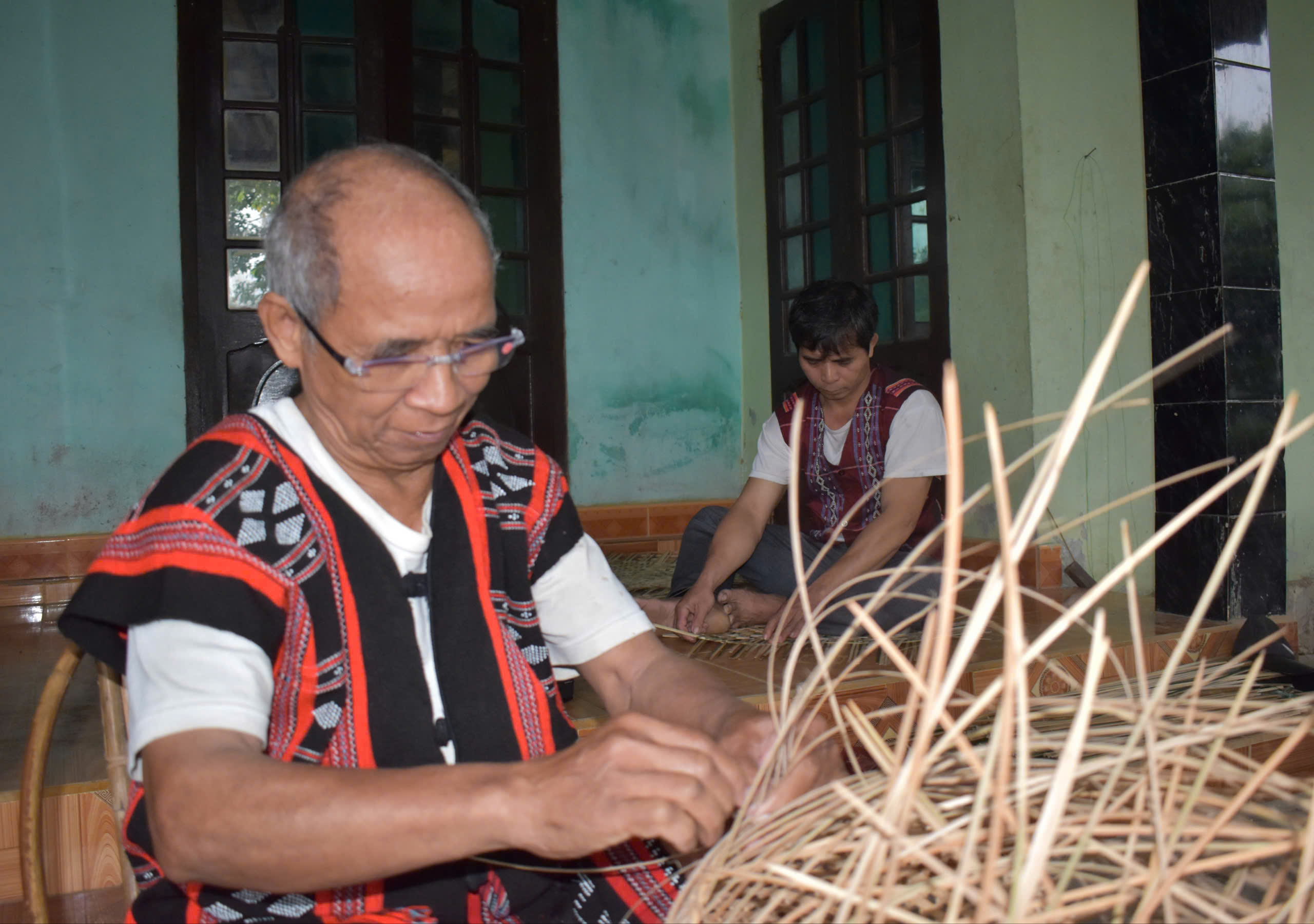
Besides passing on weaving skills to the younger generation, Elder Pơloong Chướch also performs and introduces the traditional Co Tu craft to tourists, contributing to its promotion.
"This is the strap for the basket. And this is a basket for rice, paddy, salt… so the body of the basket must be tightly woven. If it's a basket for cassava, bamboo shoots… we can weave it more loosely to save effort and make the basket lighter," Elder Pơloong Chướch pointed and introduced each product to the group of tourists from Da Nang City. Then, the elder sat down on the steps, demonstrating to the tourists while telling them stories about the weaving craft of the Cơ Tu people. For a long time, when visiting Bản Dỗi, in addition to exploring nature and experiencing the cuisine , tourists also get to listen to the elder's stories to learn more about the culture and life of the local people.
According to the elder, when tourists witness the weaving process firsthand, they understand the values that the artisans put into each product. Therefore, many people do not hesitate to buy many souvenirs. Understanding this demand, after hours of welcoming guests, Elder Pơloong Chướch splits bamboo strips and weaves baskets and decorative containers to sell. Known as the "golden hands" in the weaving village, he is also known for his skillful hands in playing drums and gongs. Ms. A Lăng Thị Bé, Director of the Ka Zan Waterfall Community Tourism Cooperative, said that Elder Pơloong Chướch is a valuable asset to Dỗi village. With dedication and a deep understanding of many aspects of Cơ Tu culture, in his role as the head of the community tourism group, he also strives to preserve and promote the traditional values of his people to tourists.
"Every time I see tourists admiring the rattan and bamboo products, I feel motivated to preserve the craft and create new designs. Tourism is the best way for the Co Tu people's weaving craft to become more widely known," the elder shared. According to Mr. Le Nhu Suu, Head of the Culture and Sports Department of Nam Dong District, the locality has implemented many solutions to preserve and promote the value of the traditional handicrafts of the Co Tu people in conjunction with community tourism. Among them, Elder Pơloong Chướch, despite his advanced age, is always enthusiastic in teaching the weaving craft to the younger generation. "We greatly appreciate the way Elder Pơloong Chướch passes on the craft and demonstrates weaving to tourists… Through his hands, the baskets, containers, and other items that are so dear and closely associated with generations of Co Tu people become simple cultural stories that easily resonate in the minds of many," Mr. Suu said. (to be continued)
Source: https://thanhnien.vn/nhat-nghe-tinh-doi-tay-vang-o-ban-doi-185241217225428042.htm




![[Photo] General Secretary and President To Lam receives Amazon's Senior Vice President David Zapolsky](https://vphoto.vietnam.vn/thumb/1200x675/vietnam/resource/IMAGE/2026/05/22/1779466547770_a1-bnd-3513-6601-jpg.webp)



































































Comment (0)