

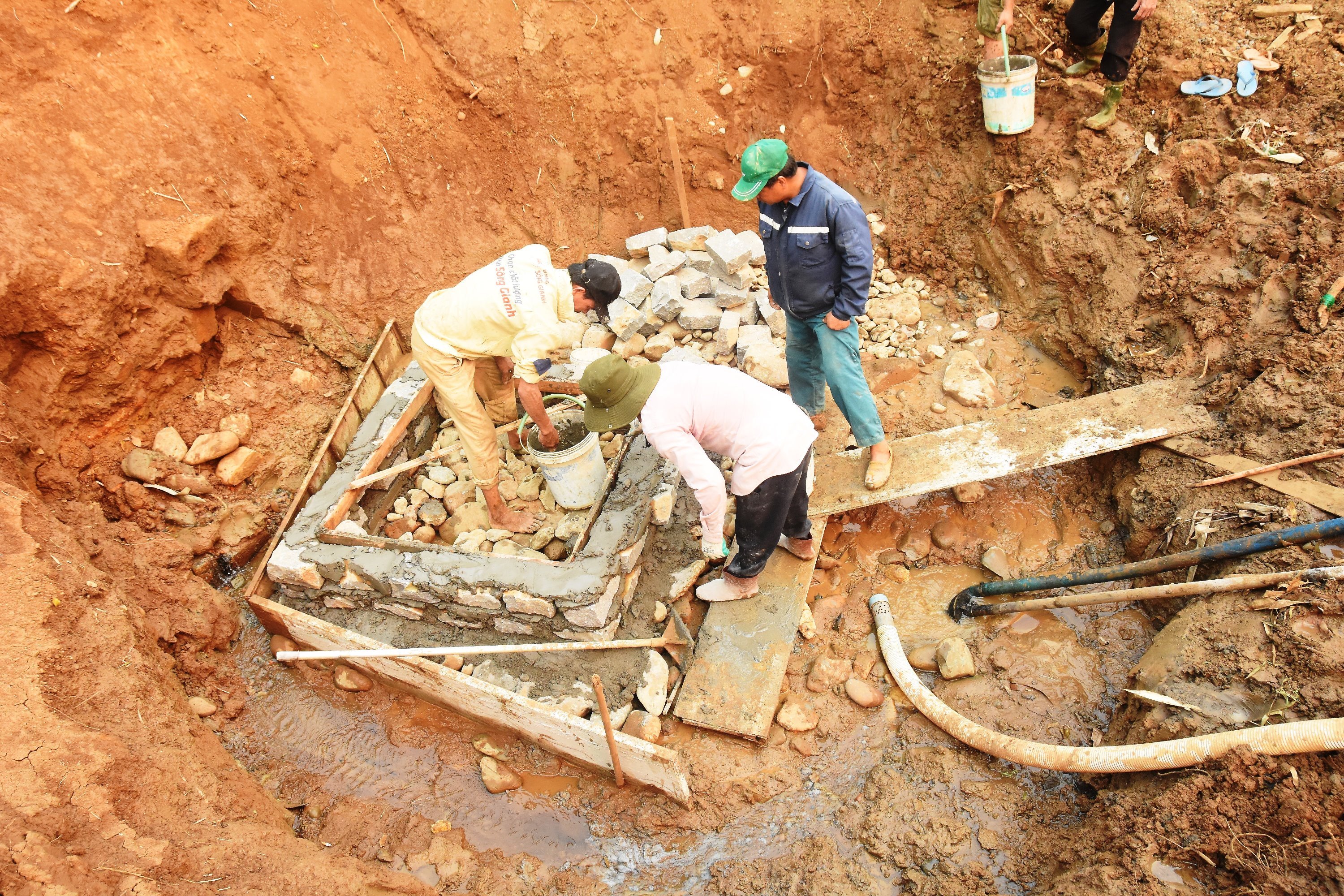
Residents of Cay Dau hamlet join forces to restore the hamlet's ancient well - Photo: D.V.
Working together to restore the ancient well.
Since the groundbreaking ceremony at the end of February in the lunar calendar, 20 households in Cay Dau hamlet, Mai Loc 1 village, Cam Chinh commune, have been taking turns participating in rebuilding the hamlet's ancient well, which had been damaged.
For several days now, Mr. Nguyen Van Thuan (36 years old) has been trying to arrange his work schedule to participate in the construction of the well with his neighbors. “When we learned that the village was undertaking the restoration of the ancient Cay Dau well, everyone wholeheartedly contributed funds and labor. Because this is a precious source and asset left by our ancestors. I am doing my best to work with my neighbors to complete this meaningful project,” Mr. Thuan happily said. According to Mr. Thuan, the area around the ancient Cay Dau well is where the village's ancestral altar is located, and it is also where people hold worship activities during annual festivals and holidays.
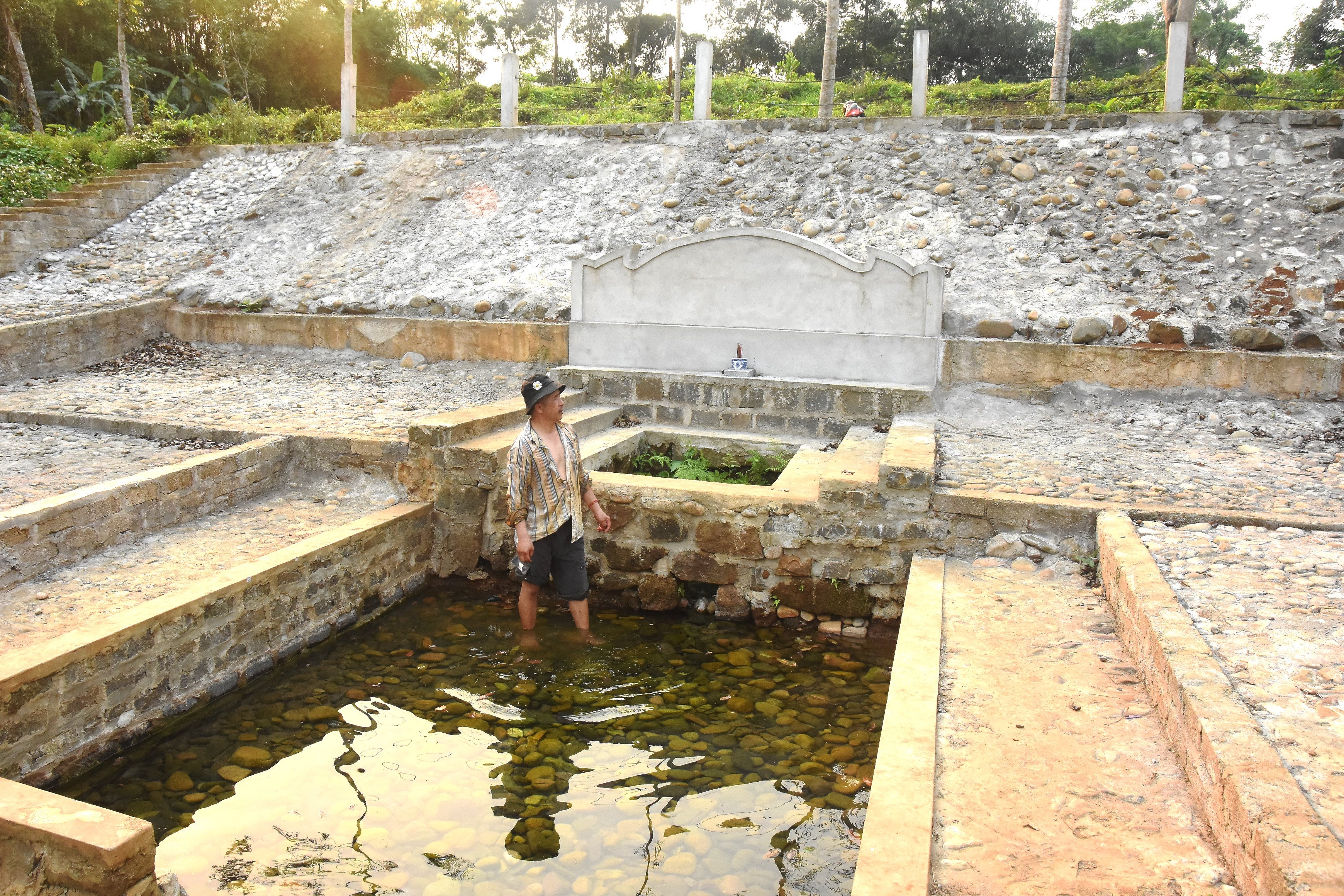
The communal well was restored in 2024 - Photo: D.V.
Ms. Nguyen Thi Lien, a resident of the hamlet, said that in the past, her family mainly used water from the Cay Dau well for drinking and daily activities. But since electricity was introduced, most people switched to using pumped wells, drilled wells, and now tap water, so the Cay Dau well has gradually been forgotten. These past few days, Ms. Lien has been busy helping her neighbors gather stones, mix concrete, and provide logistical support. "Everyone is happy that the well has been rebuilt and restored. People living in the hamlet contributed their labor and resources, while those living far from home provided financial support."
"Seeing the atmosphere of unity and solidarity among everyone in the hamlet, I feel very happy," said Mrs. Lien. Meanwhile, Mr. Nguyen Van Quang (55 years old) neatly arranged the pillars and planks of teak wood that had been taken from the well. He said: "In a few days, after the well's interior is built, we will clean these planks of wood so we can put them back in place. Even after hundreds of years, these pillars and planks of wood are still almost in their original form. The water remains clean and free of mud thanks to this wood and the laterite stone." According to the villagers, the estimated cost for restoring the Cay Dau well is nearly 100 million VND, all contributed voluntarily by the people.
Not far away, Mr. Ho Trung Dung (45 years old) from Cay Da hamlet, Mai Loc 2 village, stopped by the communal well to wash his face and get drinking water after returning from working in the fields. He said that the communal well was renovated in 2024 with funds contributed by families in the hamlet. After the renovation, the well area is spacious, with an inner well, an outer water tank, steps leading down, and a sturdy, well-maintained surrounding fence. "Whenever we return from working in the fields, we often go to the well area to rest, drink water, and wash our hands and feet. Almost everyone is conscious of keeping the well area clean and beautiful. The ancient well is a familiar space, embodying the soul of our homeland for each of us," Mr. Dung shared.
Keep the power supply flowing forever.
According to Mr. Nguyen Viet Tinh, head of Cay Dau hamlet, the Cay Dau well is 800-900 years old. For generations, the well's water has been used by the villagers for daily life and production. Located on a hillside, the well faces the rice and crop fields of the hamlet. The ancient Cay Dau well was constructed by joining planks of teak and ironwood – types of wood that never rot when submerged in water – to prevent mud buildup, maintain clean water, and ensure its longevity.
The well's body is made of laterite stones joined together with mortise and tenon joints without mortar. "Through the ups and downs of time and the development of society, the ancient Cay Dau well was almost forgotten for a while. Recently, the road in the village was upgraded and widened, causing soil and rocks to fill the well, which worried the villagers. Therefore, we unanimously agreed to voluntarily contribute funds, with each household contributing 1 million VND to restore the ancient Cay Dau well," Mr. Tinh informed.
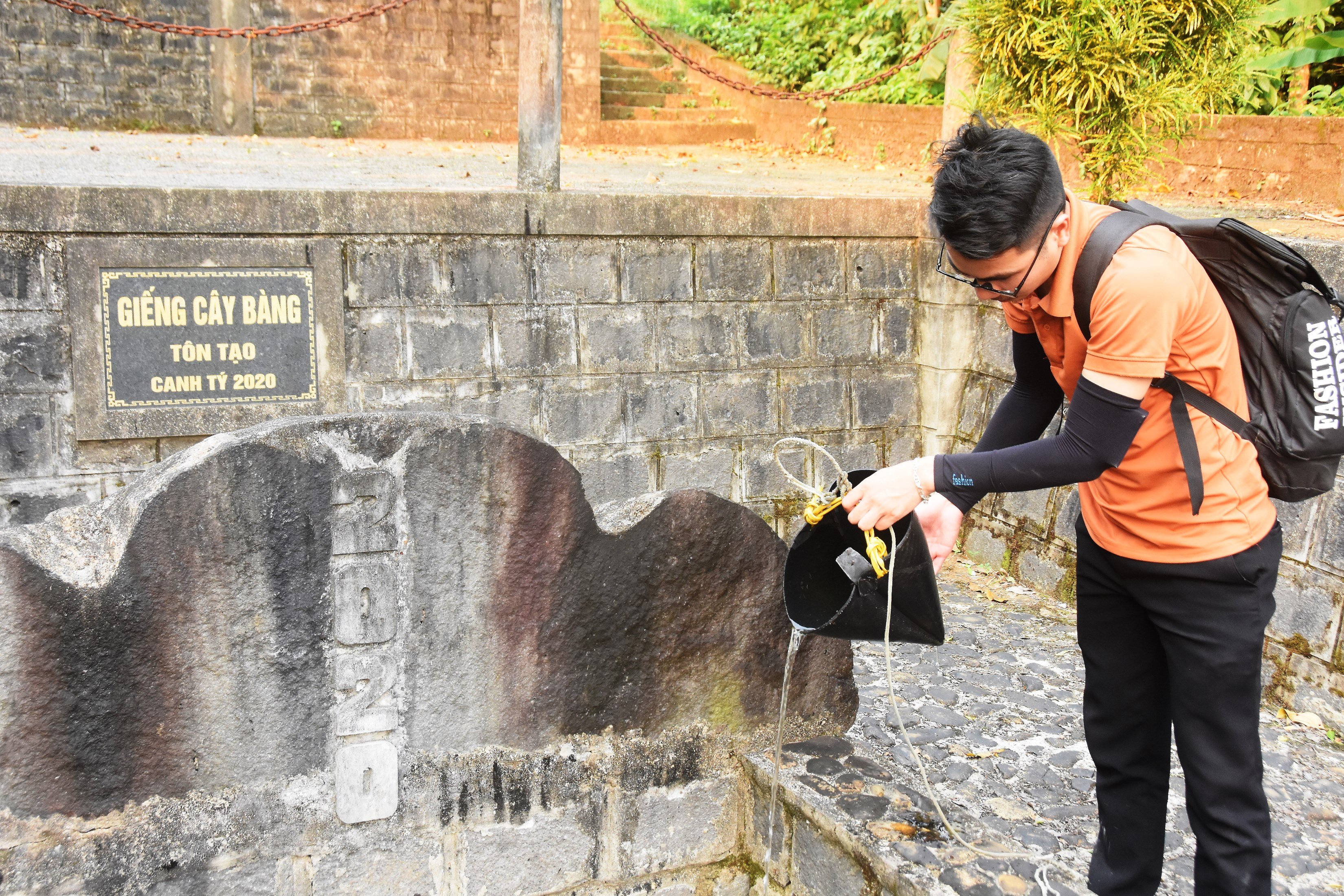
The Banyan Tree Well was restored in 2020 - Photo: D.V.
When renovating the well, the initial plan was to build the well walls with pebbles, but upon completion, it was deemed unsuitable for an ancient well, so the villagers unanimously agreed to change the material to split stone. After completion, the laterite stones and wood will be placed back into the well as before. "To date, the water flow has stabilized again. The Cay Dau well is a valuable cultural and historical asset of the village, so we will all work together to preserve it," Mr. Tinh said.
According to Hoang Ngoc Quy, head of Mai Loc 1 village, restoring the ancient wells is also a way for the villagers to preserve the beautiful traditional cultural values of the locality. Mr. Quy said that besides the Cay Dau well, since 2012, other ancient wells in Mai Loc 1 village have been voluntarily restored by the villagers through contributions of funds and labor, such as the Cay Thi, Ong Cay, and Cay Bang wells. “The Cay Dau well, along with many other ancient wells in other hamlets, has been reopened as a source of fresh water from our homeland, continuing to flow and accompanying the people in building their homeland,” Mr. Quy shared.
According to Tran Thi Anh, Head of the Culture, Science and Information Department of Cam Lo district, the ancient well system in the Cua region was built hundreds of years ago, belonging to the Cham type, made of honeycomb stone and teak wood. Surveys show that there are currently 14 ancient wells in the two communes of Cam Chinh and Cam Nghia, some of which are well-protected and utilized (such as the Gai, Cay Bang, Cay Thi, and Voi wells). Furthermore, many of these ancient wells have been restored and revived thanks to contributions from local people.
Previously, before the availability of clean water systems and drilled wells, the local people used water from ancient wells for daily life. Over time, some wells have deteriorated due to infrequent use and need to be restored, renovated, and protected to contribute to the conservation of groundwater resources; preserving the natural landscape and the unique folk culture of the region. Ms. Anh stated that the Department of Culture, Science and Technology has recently guided the People's Committees of the communes to survey, assess, and document valuable ancient wells, prioritizing the planning of protected areas and strictly managing construction, resource exploitation, encroachment, and damage to the areas surrounding these ancient wells.
The Department proposed that the District People's Committee allocate state budget funds for research, preservation, restoration, and rehabilitation of ancient wells; and provide professional and technical guidance for preservation and repair activities. At the same time, it suggested strengthening propaganda and education to raise community awareness about the value of ancient wells and the responsibility for their preservation; linking the preservation of the cultural and historical value of ancient wells with the sustainable development of new rural areas, tourism, and services.
According to Ms. Anh, local people are the ones who live directly in and are closely connected to the ancient wells. They are the custodians of these wells, playing an important role in identifying their value, building, protecting, preserving, and passing on the stories and memories related to them. “Given the limited resources and local budget, the participation of local people, organizations, businesses, and individuals inside and outside the district in contributing financial resources and technical expertise to the conservation of ancient wells is commendable and should be encouraged,” Ms. Anh observed.
Furthermore, the direct participation of local people in conservation activities, minor repairs, providing information and documents related to ancient wells; organizing cultural activities and festivals; and developing community-based tourism will create economic benefits associated with the ancient wells. Preserving and passing on traditional values to future generations, as well as participating in monitoring conservation activities and promoting the value of ancient wells, is extremely necessary. This will both raise community awareness of the value and necessity of preserving folk cultural works and contribute to protecting, enhancing, and promoting the cultural value of the ancient well system in the area.
Duc Viet
Source: https://baoquangtri.vn/dong-long-hoi-sinh-gieng-co-193221.htm

![[Photo] General Secretary To Lam receives President of the European Council Antonio Costa](/_next/image?url=https%3A%2F%2Fvphoto.vietnam.vn%2Fthumb%2F1200x675%2Fvietnam%2Fresource%2FIMAGE%2F2026%2F01%2F29%2F1769697816651_a1-bnd-5216-9741-jpg.webp&w=3840&q=75)


![OCOP during Tet season: [Part 3] Ultra-thin rice paper takes off.](/_next/image?url=https%3A%2F%2Fvphoto.vietnam.vn%2Fthumb%2F402x226%2Fvietnam%2Fresource%2FIMAGE%2F2026%2F01%2F28%2F1769562783429_004-194121_651-081010.jpeg&w=3840&q=75)


![OCOP during Tet season: [Part 2] Hoa Thanh incense village glows red.](/_next/image?url=https%3A%2F%2Fvphoto.vietnam.vn%2Fthumb%2F402x226%2Fvietnam%2Fresource%2FIMAGE%2F2026%2F01%2F27%2F1769480573807_505139049_683408031333867_2820052735775418136_n-180643_808-092229.jpeg&w=3840&q=75)
![OCOP during Tet season: [Part 1] Ba Den custard apples in their 'golden season'](/_next/image?url=https%3A%2F%2Fvphoto.vietnam.vn%2Fthumb%2F402x226%2Fvietnam%2Fresource%2FIMAGE%2F2026%2F01%2F26%2F1769417540049_03-174213_554-154843.jpeg&w=3840&q=75)




Comment (0)