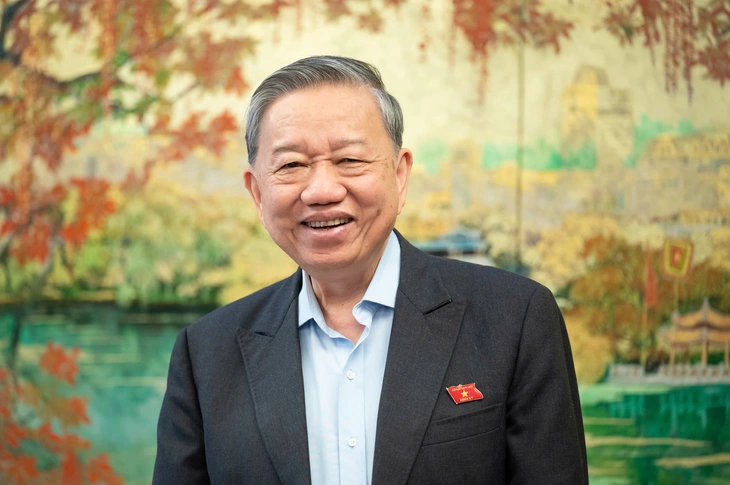
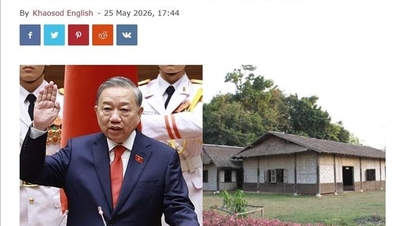
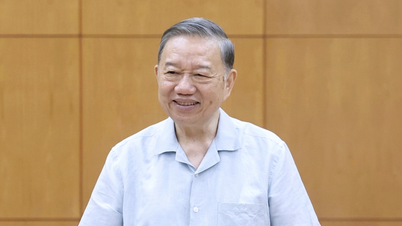
General Secretary To Lam - Photo: GIA HAN
1. Firmly adhering to the goal of national independence linked with socialism is a wise and correct choice of our Party from its inception and throughout the process of leading the revolution. It is the root cause of all victories in the struggle for national liberation and reunification in the past, as well as in the building and protection of the Fatherland today.
In this context, the socialism we are building, as President Ho Chi Minh once emphasized, "is about making the people rich and the country strong"; with the characteristics of "a rich people, a strong country, democracy, fairness, and civilization; the people as masters; a highly developed economy based on modern productive forces and progressive production relations; an advanced culture rich in national identity; people enjoying a prosperous, free, and happy life with conditions for comprehensive development; all ethnic groups in the Vietnamese community being equal, united, respecting and helping each other to develop together; a socialist rule of law state of the people, by the people, and for the people, led by the Communist Party; and friendly and cooperative relations with countries around the world."
The Marxist-Leninist theory of socio-economic formations has demonstrated that human material production is the basis, source, and most decisive cause of social change; production is the fundamental activity that gives rise to and develops human social relations, bringing about cooperation and competition that propels production to new heights, and is also the basis of the formation, transformation, and development of human society.
According to Marx's view, the essential and primary transformation of society is the transformation of material production, and the transformation of material production is the most important central transformation that determines social transformation. In the process of social transformation, changes in economic structure lead to changes in social structure and changes in the system of values and social norms.
Based on the "self-evident truth,... first of all, man needs to eat, drink, have shelter, and wear clothes, that is, he must work, before he can fight for domination, before he can engage in political , religious, or philosophical activities...", Marxism has shown that for man to live, exist, and develop, he must inevitably produce material wealth for society.
At the same time, "different economic eras are not distinguished by what they produce, but by how they produce it, and with what means of labor."
Furthermore, according to Lenin, high labor productivity reflects the superior nature of socialism over capitalism; it is the most important and primary criterion for the victory of socialism. "Ultimately, labor productivity is the most important and primary factor for the victory of the new regime."
Capitalism has created a level of labor productivity unprecedented under serfdom. Capitalism can be utterly defeated, and will be utterly defeated, because socialism creates a new, much higher level of labor productivity."
Thus, in order to successfully build socialism with the characteristics defined in the Party's Platform for Building the Country during the Transition Period to Socialism (supplemented and developed in 2011), human material production activities are of the most decisive importance, with high labor productivity being the key factor.
Through material production activities, the material and technical foundations of socialism are built, positive social changes are created, limitations and inadequacies are thoroughly overcome, and a new socialist person is built with a prosperous, free, and happy life, and conditions for comprehensive development; thereby completing the transitional period to socialism, moving to the higher stage of the communist socio-economic system as Marx predicted in his work *Critique of the Gotha Program*: "When, along with the comprehensive development of individuals, their productive capacity also increases and all sources of social wealth flow abundantly - only then can people completely transcend the narrow limits of bourgeois law and society can inscribe on its banner: from each according to his ability, to each according to his needs."
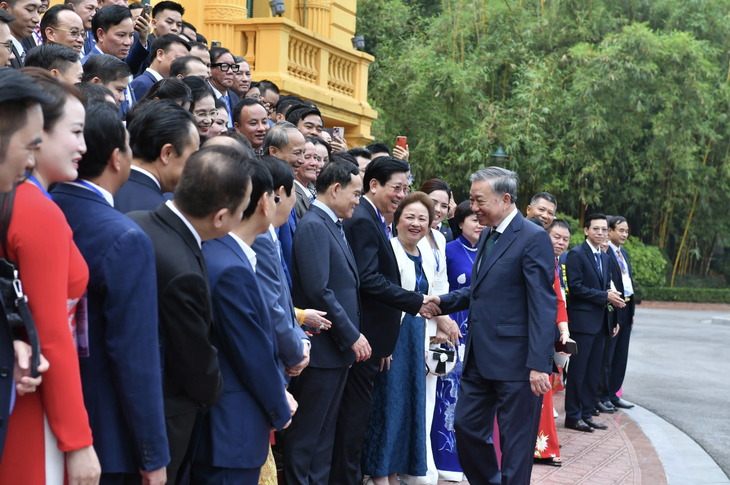
General Secretary To Lam met with representatives of the Vietnamese business community in October 2024 (when he was General Secretary and President) - Photo: VNA
2. The practical experience of economic development, especially private sector development, in China and Russia, as well as the 40 years of reform in Vietnam, has left behind extremely valuable lessons.
Even during the period of centrally planned economic development, V. Lenin's New Economic Policy, which developed various economic sectors, including the private sector, from 1921 to 1991, helped Russia's economy achieve remarkable growth.
During this period, Russia, along with many other less developed countries in the Soviet Union, became a major power, reaching a high level of development in many fields such as energy, industry, and space.
In China, starting with the "Reform and Opening Up" policy in 1978, the 1988 constitutional amendment aimed at strengthening the protection of the legitimate rights and interests of private enterprises, and the recognition of the private economy as an important part of the socialist market economy at the 15th National Congress of the Communist Party of China in 1997, along with the commitment to protecting the legitimate rights and interests of individual and private enterprises, China's private economy has experienced explosive growth. This has led to the emergence of many large corporations that not only dominate the domestic market but also expand internationally, playing a crucial role in technology, telecommunications, and e-commerce.
A large number of private enterprises, accounting for a significant share of industries such as manufacturing, services, and especially high technology, have contributed over 60% of GDP, created 80% of urban jobs, and generated over 70% of inventions and innovations in the Chinese economy.
In Vietnam, with the official recognition of a multi-sector economy in the Party's 6th Congress documents; the affirmation of encouraging and creating conditions for the development of the private economy at the 7th Congress and further emphasized at the 8th Congress; a significant development at the 9th Congress when the Party affirmed that the private capitalist economy is an important long-term economic component in the socialist-oriented market economy, for the first time issuing a specialized resolution "On continuing to innovate mechanisms and policies to encourage and create conditions for the development of the private economy"; emphasizing its important role as one of the driving forces of the economy and specifically regulating the issue of Party members engaging in private economic activities at the 10th Congress; and strongly and decisively affirming the role of the private economy as an important driving force of the economy at the 12th and 13th Congresses, the private economy has made promising strides in development.
From a state of merely "struggling" and "stagnating" within the centralized, bureaucratic, and subsidized system, facing discrimination not only in social consciousness but also in state mechanisms and policies, the private economy has risen strongly during the reform period, contributing increasingly to the state budget, creating jobs for society, developing existing potential and advantages in each locality as well as nationwide, making important contributions to socio-economic development, strengthening national defense and security, and affirming its role as an important driving force in international integration.
It is clear that, with the right vision and policies, in a socialist-oriented market economy, the development of the private economy is a vital choice to boost material production, create social transformation, provide a "boost" in technological level, vocational training, increase capital absorption capacity, promote labor productivity, and build the material and technical foundation for socialism.
To develop the private economy, the most important and core issue is to continue perfecting the socialist-oriented market economy system, with groundbreaking changes in thinking, awareness, and action, creating the fundamental characteristics of a socialist-oriented market economy with state management under the leadership of the Party, compared to the previous socialist-oriented market economy with state management.
3. On May 4, 2025, the Politburo issued Resolution No. 68-NQ/TW on the development of the private economy, with unprecedented goals, viewpoints, tasks, and breakthrough solutions; shaping the Party's new perspective on the development of the private economy within a socialist-oriented market economy under the management of the State and the leadership of the Party; and strongly promoting the development of the private economy – a new driving force for economic development in the coming period.
To successfully implement Resolution No. 68, it is necessary to focus on carrying out the following urgent tasks:
Firstly, we must decisively and effectively implement measures to bring the Party's Resolution into practice as soon as possible. During the 9th session of the 15th National Assembly, the National Assembly will discuss and issue a Resolution on the development of the private economy with specific, feasible, and effective preferential mechanisms and policies.
Establish a National Steering Committee to implement Resolution 68, chaired by the Prime Minister, to periodically review and monitor the implementation of the Resolution by ministries, sectors, and localities on a monthly basis, absolutely preventing any confusion or independent implementation that could undermine the effectiveness of central government policies.
Regularly publicize performance results, using this as one of the criteria for evaluating competence and the fulfillment of responsibilities, especially for leaders. Promote and create a strong shift in administrative thinking from control to partnership, viewing businesses as subjects to be "served" rather than "managed," ensuring the principle of "actions matching words" is consistent throughout the entire political system.
The government should promptly issue a directive requiring ministries, sectors, and localities to shift all administrative processes to post-inspection, except for certain specific areas (security, defense, etc.); provide specific guidance on the official responsibilities of heads of Party committees and governments at all levels in supporting businesses, linked to emulation and reward programs; and standardize the entire investment licensing process using an electronic model, shortening the time for announcing results.
Secondly, it is urgent to institutionalize the Party's viewpoints into law and ensure strict implementation throughout the political system, businesses, and among the people. Research and develop a Law on the Development of the Private Economy and amend and supplement relevant legal regulations to ensure the full institutionalization of the policies outlined in Resolution No. 68.
This includes establishing a fair competition system, clearly identifying behaviors that negatively impact market access and discriminatory practices against the private sector. It also involves creating mechanisms to promote investment and provide financial support, requiring financial institutions to establish credit rating systems suitable for the private sector and provide financial assistance.
Encourage the development of science and technology, with private enterprises taking the lead in major national projects and establishing national research and innovation infrastructure.
Establish a system to protect the rights and interests of market participants, clearly distinguish between economic disputes and criminal offenses, and strictly prohibit abuses of the law in market management.
Implement measures to support procedural and policy services for the private sector, standardize administrative procedures and policies. Amend the Criminal Code, clearly separating fraudulent and profiteering acts from ordinary administrative errors.
Thirdly, special attention should be paid to supporting small and micro-enterprises, promoting the development of a society with an entrepreneurial mindset and a desire for self-reliance, especially in the field of innovation. A separate preferential credit package for small and medium-sized enterprises should be immediately implemented through the state credit guarantee fund.
Allocate 5-10% of land in high-tech industrial parks for startups to lease at preferential rates. Expand the legal sandbox model nationwide, allowing for practical testing of fintech, AI, and digital agriculture within a clear legal protection timeframe. Establish free or subsidized legal consulting centers for small and medium-sized enterprises in localities.
Fourth, we need to build a team of entrepreneurs who truly become "soldiers" on the economic front, actively participating in policy-making.
To protect, support, encourage, and honor entrepreneurs who possess patriotism, national spirit, a sense of law compliance, a desire to prosper and contribute to the country's wealth, knowledge and business management skills in a market economy, and responsibility towards employees and the community.
Creating favorable conditions for entrepreneurs to participate in policy critique and contribute to the planning and implementation of development strategies. When drafting laws and decrees, ministries and agencies need to thoroughly listen to the opinions of the people and businesses, especially those of experienced entrepreneurs.
Provide budgetary and professional support to build strong, independent industry associations capable of critically evaluating policies. Encourage the establishment of a national private business council to directly advise the government on long-term economic and industrial strategies.
We possess a resilient tradition, fervent patriotism, a solid theoretical and practical foundation, and a comprehensive political and legal basis; with the aspirations, will, unity, and high determination of the entire political system, businesses, entrepreneurs, and the whole population in achieving the goal of "stabilizing, developing high-quality, and improving all aspects of people's lives," we will certainly successfully implement the Resolution, soon developing the private economy to its full potential, truly becoming the most important driving force and pillar ensuring the robust development of the national economy, realizing the aspiration to build a socialist Vietnam that is prosperous, strong, democratic, just, and civilized.
GENERAL SECRETARY TO LAM
Source: https://tuoitre.vn/dong-luc-moi-cho-phat-trien-kinh-te-20250511142709968.htm





![[Image] Close-up view of the interchange connecting the two expressways and Long Thanh Airport.](https://vphoto.vietnam.vn/thumb/1200x675/vietnam/resource/IMAGE/2026/05/25/1779703378210_ndo_br_z7863716673926-224453a31600126cce10622af6290afd-4549-jpg.webp)
![[Image] Hanoi's urban life under the challenge of a "scorching hot" environment](https://vphoto.vietnam.vn/thumb/1200x675/vietnam/resource/IMAGE/2026/05/25/1779706979265_nang-nong-t5-2026-minh-duy-7-4636-jpg.webp)













































































Comment (0)