Be persistent with the cleaning method.
At 533 Tran Hung Dao Street, Tan Phong Ward, Lai Chau Province, the Huy Cuong Cordyceps cultivation facility has been regularly illuminated for many years. Inside the enclosed cultivation rooms, thousands of trays of mushrooms are growing under strictly controlled conditions.
Ms. Bui Thi Van, the owner of the facility, recalls the early days when the establishment was only a few dozen square meters, the equipment was rudimentary, and the machinery had to be self-made.

Ms. Bui Thi Van - owner of Huy Cuong Cordyceps facility. Photo: Duc Binh.
To date, the production area has expanded to over 4,000 square meters, providing regular employment for 26 local workers. Despite the significant increase in scale, the facility maintains the same production method that Ms. Van has pursued since the beginning – natural farming practices, minimizing external impacts and interventions.
Cordyceps is a fungus that parasitizes caterpillar larvae. In winter, the larvae lie deep in the soil, and in summer the fungus grows, absorbing nutrients from the host before emerging from the ground. The rule "winter is insect, summer is herb" gives this medicinal herb its unique name.
In the culture room at the Huy Cuong facility, that rule is reproduced almost perfectly. The host used is silkworm pupae, without the addition of growth stimulants.
"People find the tea produced by our facility fragrant and easy to drink. The mushrooms have a deep orange color because they are grown using a clean process. We produce mushrooms entirely on silkworm pupae under strict quality control; we replicate how mushrooms grow in nature," Ms. Van shared.
To maintain this cultivation method, the entire process is strictly controlled. Temperature, humidity, light, and cleanliness of the cultivation room are always kept stable.

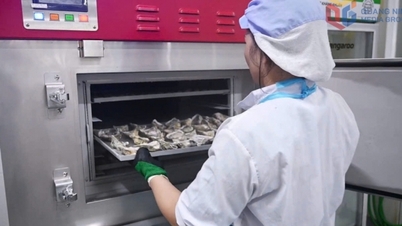
After harvesting, the mushrooms are placed in a freeze-drying system for 25-30 hours. Photo: Duc Binh.
After about two months, the mushrooms reach their maximum height but are not harvested immediately. Producers must wait longer for the plants to accumulate active compounds before processing. The cultivation cycle lasts from 2.5 to 3 months. When harvested, fresh cordyceps has a mild aroma, soft strands, and feels smooth and velvety to the touch.
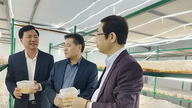
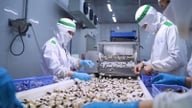
According to the owner of the production facility, fresh cordyceps can only be preserved for about 5-7 days. Therefore, the product must be processed immediately to extend its shelf life. After harvesting, the mushrooms are put into a freeze-drying system. The factory currently has 8 drying machines, each with a capacity of about 50kg/batch.
Freeze-drying takes place at very low temperatures, allowing the water in the product to evaporate directly under low pressure without altering the structure of the mushrooms. As a result, the product retains its natural shape, color, and flavor. The deep orange color of the mushroom strands from root to tip is considered a hallmark of a clean product, free from chemical intervention, preserving up to 99% of valuable active compounds such as Cordycepin and Adenosine.
The factory has a designed capacity of approximately 10,000 product boxes per day. However, actual production is adjusted according to market demand, typically at 3,000-4,000 boxes per day to ensure consistent quality and avoid excess inventory. The selling price ranges from 200,000 to 400,000 VND per 50-100g box.
"This product is the culmination of almost my entire life's work. When I first started, I had to learn and do everything myself. I just hope that Vietnamese people can use clean mushrooms at a reasonable price," Ms. Van said.
Enhancing the value of Vietnamese medicinal herbs.
For a long time, cordyceps has been considered a precious medicinal herb in Eastern medicine, often used to nourish the body, strengthen health, and support physical recovery.

Currently, Ms. Vân's cordyceps mushroom production facility provides employment for nearly 30 local workers. Photo: Quang Dũng
Numerous studies worldwide have also documented the biological activity of this fungus. According to Professor Xuanwei Zhou (Center for Plant Biotechnology Research - Shanghai Jiao Tong University), the active compounds in Cordyceps sinensis have the ability to boost the immune system, fight oxidation, prevent mutations, and help inhibit the growth of certain cancer cell lines in experimental studies.
However, cordyceps is not yet recognized as a medicinal treatment because its mechanism of action still needs further research and clarification.
In Vietnam, this product is still relatively new to many consumers. The relatively high price is also a barrier preventing cordyceps from being widely used.
Huy Cuong's products have received OCOP 3-star certification, ISO certification, and confirmation of a safe food supply chain. This provides a foundation for expanding product sales in the domestic market.
Currently, the company is planning to develop new product lines such as cordyceps drink and products combining bird's nest and cordyceps to reach a wider range of customers. "We are very passionate and want domestic consumers to be able to use clean products at reasonable prices. But to enhance their value, the company greatly needs the support and cooperation of large businesses, especially in the pharmaceutical sector," Ms. Van expressed.

Cordyceps mushrooms are processed into strands for longer preservation. Photo: Quang Dung



The owner stated that they have researched international standards such as the US FDA and European Union standards with a view to exporting. However, given the current scale, fulfilling the criteria for quality management, technical documentation, and traceability remains a challenge.
According to Mr. Nguyen Thanh Dong, Deputy Director of the Department of Agriculture and Environment of Lai Chau province, cordyceps products are opening up a new direction for the development of local agriculture. However, this is also a field that requires large initial investment capital, modern production technology, and high operating costs.
Currently, the entire province only has two facilities for cultivating and processing cordyceps, mainly producing freeze-dried cordyceps in thread form. Therefore, there is still great potential for development, but expanding the scale requires a roadmap and coordinated support.
In the coming period, Lai Chau province will continue to cooperate with units to develop high-value agricultural specialties and medicinal products, linking them with the application of science and technology, deep processing, and the construction of value chains. At the same time, the province will connect production facilities with research institutes, scientific units, and distribution businesses to improve production processes and gradually expand consumer markets.
Source: https://nongnghiepmoitruong.vn/dong-trung-ha-thao-so-1-lai-chau-d818517.html


































![Teaching swimming to rural children: [Part 3] Effective if given the right attention](https://vphoto.vietnam.vn/thumb/402x226/vietnam/resource/IMAGE/2026/07/01/1782875620087_5955-12-145425_971-145427.jpeg)