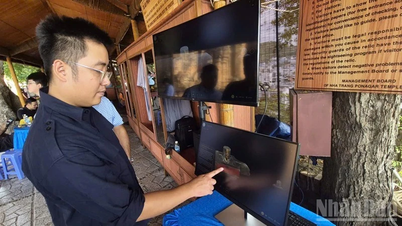
Ms. Tran Thu Phuong from Cua Nam ward said: "Since the city put into operation the Intelligent Traffic Control Center and the AI camera system for handling traffic safety violations, I have noticed that people comply with the Law on Road Traffic Safety much better than before."
Recently, Duc Giang General Hospital has been using unmanned aerial vehicles (UAVs) to transport biological samples, medicines, and medical supplies. The devices have a cruising speed of up to 60 km/hour, an operating radius of 15 km, and integrate real-time surveillance cameras, contributing to shorter transport times, especially in emergency situations, natural disasters, and traffic disruptions.

Using unmanned aerial vehicles (UAVs) to transport biological samples, medicines, and medical supplies at Duc Giang General Hospital ( Hanoi ).
The digital technology industry is an economic and technical sector based on the combination of science and technology, innovation, and digital transformation to create digital products and services. To create a new development space for this field, in early 2026, the Hanoi People's Committee andFPT Group commenced construction of a Digital and Mixed-Use Technology Park in Tay Tuu and Phu Dien wards with a total investment of over 50,000 billion VND.
The project's focus is on building a concentrated digital technology park, promoting innovation and digital transformation, covering approximately 168.9 hectares. It will concentrate research, development, and production activities for key digital technology products and services such as digital data, AI, big data, IoT, blockchain, and the metaverse; and will include training facilities, technology incubators, and spaces for connecting universities, research institutions, and businesses.
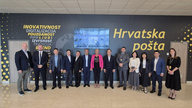
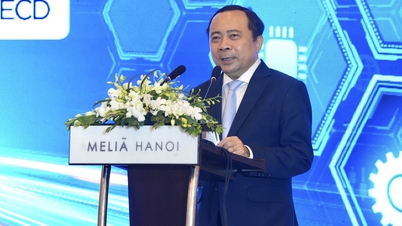
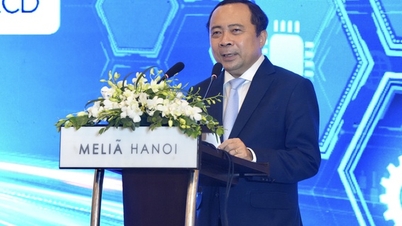
According to Truong Viet Dung, Vice Chairman of the Hanoi People's Committee, the Digital Technology Park is envisioned by the city to become a crucial nucleus in the capital's innovation ecosystem, linked to the goal of building Hanoi into a major center for science, technology, and the digital economy of the entire country.
In addition, Hanoi has attracted a series of large projects in the digital technology industry. Notably, the semiconductor chip manufacturing plant of the Military Telecommunications and Industry Group (Viettel) recently commenced construction on 27 hectares in the Hoa Lac High-Tech Park, serving national industries such as aerospace, telecommunications, IoT, and automation. In the second quarter, Viettel also plans to operate phase 1 of the An Khanh Data Center project (An Khanh commune) with a total investment of 17,500 billion VND.
Recently, MITAC Vietnam Technology Co., Ltd. inaugurated a high-tech factory complex in the South Hanoi Supporting Industrial Park with an initial investment of 66 million USD. This complex specializes in manufacturing electronic components, assembling and processing motherboards for cameras, tablets, IoT devices, etc. Mr. Billy Ho, General Director of MITAC Group, stated that in the coming period, the company will focus on cloud computing and AI, aiming to develop high-application technology products serving the international market and general consumer needs.
In implementing Resolution No. 02-NQ/TW of the Politburo on building and developing Hanoi in the new era, Hanoi decided to allocate 4% of its total budget expenditure to science and technology, innovation, and digital transformation, higher than the average minimum (3%) stipulated by the National Assembly. The city has launched the Hanoi Technology Exchange Platform (HanoTEX), the Digital Transformation Market (DTMarket), and the Hanoi Innovation Center Joint Stock Company...
According to Cu Ngoc Trang, Director of the Hanoi Department of Science and Technology, the supply of technology is increasing, but the potential for transactions, commercialization, and dissemination remains modest. This is due to the lack of a well-organized, transparent market with mechanisms to ensure trust. Therefore, the city is not stopping at issuing policies, but is directly participating in organizing a more proactive technology market.
To focus scientific and technological resources more effectively, the city has announced a list of 30 "major problems" that need solutions to address bottlenecks in urban development, economic growth, social welfare, etc. These "major problems" are oriented towards the application and mastery of new and strategic technologies such as AI, IoT, big data, semiconductors, 5G/6G...
The goal is not only to apply technology, but also to create new products, services, and economic models, generating practical value for various industries and sectors, and solving the problems the city is facing. Based on this, the Hanoi Department of Science and Technology is strengthening cooperation with key universities, directly commissioning solutions to the capital's major challenges, aiming for technological products that can be immediately applied in practice during the 2026-2030 period, making a positive contribution to the development of the capital and the country.
Source: https://mst.gov.vn/dot-pha-cho-cong-nghiep-cong-nghe-so-19726061809223158.htm
![[Image] Ho Chi Minh City: Ma Lang area, Chicken-Rice Market about to change its appearance](https://vphoto.vietnam.vn/thumb/1200x675/vietnam/resource/IMAGE/2026/06/25/1782377698627_ndo_br_m1-jpg.webp)


![[Image] Schools organize meetings and introduce teaching models to students admitted to grade 10.](https://vphoto.vietnam.vn/thumb/1200x675/vietnam/resource/IMAGE/2026/06/25/1782368077271_ndo_br_z7970052192242-1ec8daeb77a6eed1a4e9f58c564ddd3e-jpg.webp)
![[Photo] General Secretary and President To Lam receives Palestinian Ambassador Saadi Salama](https://vphoto.vietnam.vn/thumb/1200x675/vietnam/resource/IMAGE/2026/06/25/1782365384740_a1-bnd-9423-8322-jpg.webp)