

 |
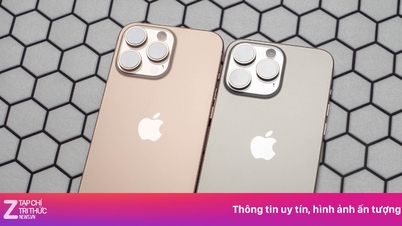
Foldable iPhones will utilize materials science to create screens that are "virtually crease-free." Photo: AppleInsider . |
Until 2026, the foldable phone market will still be grappling with screen creases and cumbersome hinge designs. To flatten the screen, current designs still focus on hinges, support plates, and mechanical tensioning systems.
However, many generations of foldable phones have still failed to completely eliminate this problem, despite sophisticated hinge designs. Hardware improvements have reduced the degree of creasing, but haven't solved the issue of how multi-layered materials react to repeated force.
According to AppleInsider , with the goal of a "virtually crease-free" display, Apple has chosen a different approach for the foldable iPhone.
Specifically, Apple's latest patents describe glass with variable thickness and material strategies designed to better manage stress across the entire screen. Thinner areas at the fold improve flexibility, while thicker areas further away from the fold maintain durability.
This design aims to control distortion across the entire display panel, rather than relying solely on the structural strength of the panel itself.
AppleInsider suggests that iPhone manufacturers typically only enter new product categories after significant technical constraints have been mitigated, and foldable iPhones appear to be nearing that point.
Prioritizing durability and consistency might dampen expectations if the sharpness of the creases is significantly reduced. However, material improvements also directly impact the material in the long term, a major concern for foldable devices.
In a recent post, Bloomberg analyst Mark Gurman confirmed that a foldable iPhone will still launch on schedule alongside the iPhone 18 Pro and iPhone 18 Pro Max. The event is expected to take place in September, and the product will be released the following week.
According to analyst Ming-Chi Kuo from TF International Securities, the iPhone Fold will feature a 5.3-inch outer screen and a 7.7-inch inner screen. The size of the inner screen could be approximately the same as the iPad mini, while the outer screen will be comparable to a smaller iPhone.
Apple plans to use a 4:3 aspect ratio for the inner screen, meaning the iPhone Fold will have a shape similar to an iPad when unfolded, being longer and wider but narrower than most foldable smartphones currently available.
The iPhone Fold is expected to be 4.5 mm thin when unfolded. To achieve this, Apple is said to have to compromise on some features. The device will not have a telephoto camera, will remove Face ID in favor of Touch ID, and integrate it into the power button like the iPad.
Source: https://znews.vn/dot-pha-hua-hen-cua-apple-voi-iphone-gap-post1643306.html
![[Photo] General Secretary and President To Lam and his wife begin their state visit to China.](https://vphoto.vietnam.vn/thumb/1200x675/vietnam/resource/IMAGE/2026/04/14/1776133794926_z7723148772587-ffefa3c4b1e54e100de1554593a862c6-jpg.webp)

![[Photo] General Secretary and President To Lam visits and delivers a policy speech at Tsinghua University.](https://vphoto.vietnam.vn/thumb/1200x675/vietnam/resource/IMAGE/2026/04/14/1776164592318_vna-potal-tong-bi-thu-chu-tich-nuoc-tham-va-phat-bieu-chinh-sach-tai-dai-hoc-thanh-hoa-trung-quoc-8700658-5437-jpg.webp)
![[Image] Expediting land clearance at Alley 310 Nghi Tam to facilitate the construction of Tu Lien Bridge](https://vphoto.vietnam.vn/thumb/1200x675/vietnam/resource/IMAGE/2026/04/14/1776160406551_ndo_br_z7724148990408-9e5d4777e3c4504998b4286178b2e66e-jpg.webp)



















![[Photo] General Secretary and President To Lam receives Slovak Prime Minister Robert Fico](https://vphoto.vietnam.vn/thumb/1200x675/vietnam/resource/IMAGE/2026/04/13/1776080592076_a1-bnd-8227-6002-jpg.webp)










































































Comment (0)