

 |
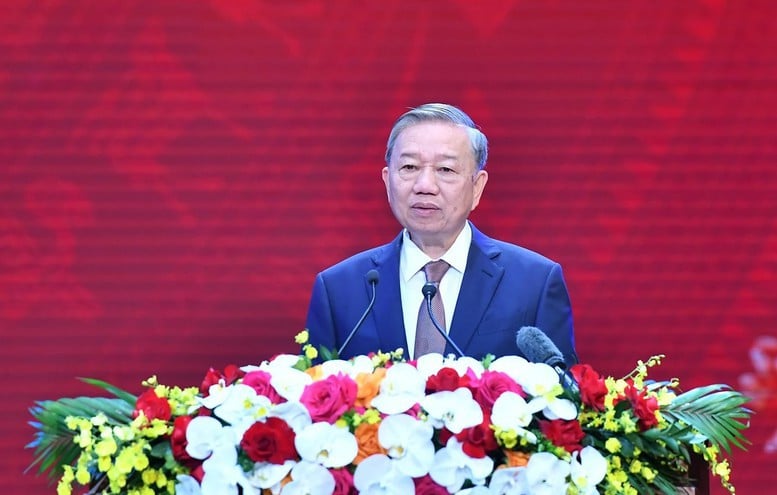
| General Secretary of the Central Committee of the Communist Party of Vietnam, To Lam |
Throughout the process of leading the Vietnamese revolution, the Party has always deeply recognized the role of institutions and laws in the country's development. Simultaneously, the Party has put forth numerous policies and guidelines on perfecting institutions and laws, adapting to each historical stage and achieving significant results. The theoretical understanding and understanding of the socialist rule of law have been continuously refined. Vietnam has formed a relatively comprehensive, open, transparent, and accessible legal system that fundamentally regulates all aspects of social life. This includes the Constitution, major laws and codes on civil, business, commercial, administrative, criminal, procedural, and dispute resolution matters, and approximately 300 other laws and codes currently in effect; creating a legal foundation for socio- economic development, national defense and security, and international integration. It can be affirmed that, over the past 80 years, since the birth of the worker-peasant state, under the leadership of the Party, our country has achieved independence, unity, freedom, democracy, peace, stability, and development because we have a Constitution and have successfully implemented the Constitution and laws.
However, frankly speaking, the work of drafting and implementing laws still has many limitations and shortcomings. Some of the Party's policies and guidelines have not been institutionalized in a timely and complete manner. The thinking in lawmaking in some areas is still heavily focused on management. The quality of laws has not kept pace with practical requirements. There are still overlapping, contradictory, and unclear regulations that hinder implementation and are not conducive to promoting innovation, attracting and unlocking investment resources. Decentralization and delegation of power are not strong enough; administrative procedures are still cumbersome and full of twists and turns; and the cost of legal compliance remains high. The organization of law enforcement remains a weak point; there is a lack of timely and effective policy response mechanisms. There is a delay in researching and promulgating policies and laws to regulate new issues, and a lack of a favorable legal framework to promote new growth drivers.
Currently, the world is facing epochal changes with rapid, complex, unpredictable, and difficult-to-forecast developments. Along with this, the scientific and technological revolution is opening up endless opportunities for development based on knowledge and human potential. Domestically, after nearly 40 years of implementing reforms, our country has achieved great and historically significant accomplishments. From a poor, backward country heavily devastated by war, surrounded and isolated, Vietnam has now become a model of development for many countries around the world, where "everyone has enough food, clothing, and access to education." The size of the economy in 2024 ranked 32nd in the world. Economic, political , cultural, social, scientific and technological, defense, and security potential has been continuously strengthened. Foreign relations have expanded; the country's position and prestige have been continuously enhanced.
To realize the nation's aspiration for progress, we must address many issues, among which a very central task is to continue focusing on perfecting institutions and laws to unleash the full potential of production, unlock all resources, develop all the country's strengths and potential, and seize every opportunity for development. Therefore, along with implementing the revolution to streamline the organizational structure and striving for double-digit economic growth, the work of drafting and enforcing laws must be fundamentally reformed. Responding to this demand, on April 30, 2025, in the solemn and heroic atmosphere of the 50th anniversary of national reunification, the Politburo issued Resolution No. 66-NQ/TW on "Reforming the work of drafting and enforcing laws to meet the requirements of national development in the new era" - a particularly important thematic resolution with many strategic decisions. The main objective of the Resolution is to create a truly democratic, equitable, safe, and transparent society; where the people are truly in control; where they decide on many important national issues; where society is managed and governed in a modern way, fostering development; improving all aspects of people's lives; and firmly protecting the Socialist Republic of Vietnam.
The resolution sets the goal that by 2030, Vietnam will have a democratic, fair, synchronous, unified, open, transparent, and feasible legal system with a strict and consistent implementation mechanism, ensuring the legal basis for the normal, continuous, and smooth operation of agencies after organizational restructuring, resolving obstacles arising from practice, paving the way for development, and mobilizing all citizens and businesses to participate in socio-economic development so that by 2030, Vietnam will be a developing country with modern industry and high middle income. By 2025, the removal of "bottlenecks" caused by legal regulations will be basically completed. By 2027, the amendment, supplementation, and promulgation of new legal documents will be completed to ensure a synchronous legal basis for the operation of the state apparatus according to the three-tiered government model. By 2028, the legal system for investment and business will be completed, contributing to placing Vietnam's investment environment among the top 3 ASEAN countries. By 2045, Vietnam will have a high-quality, modern legal system that approaches advanced international standards and practices, is consistent with the country's realities, is strictly and consistently implemented, respects, guarantees, and effectively protects human rights and civil rights; the supremacy of the Constitution and laws becomes the standard of conduct for all entities in society; and national governance is modern with a streamlined, efficient, effective, and effective state apparatus.
According to Resolution No. 66-NQ/TW, the reform of lawmaking and enforcement in the coming period needs to adhere to five guiding principles, the most important of which is to "ensure the comprehensive and direct leadership of the Party in lawmaking; strengthen the Party's leadership over law enforcement." The Resolution also identifies "lawmaking and enforcement as a 'breakthrough of breakthroughs' in perfecting the institutional framework for national development in the new era; it is a central task in the process of building and perfecting the socialist rule of law state of Vietnam, of the people, by the people, and for the people, under the leadership of the Party." The Resolution requires: Lawmaking must closely follow reality, "stand on the practical ground of Vietnam," selectively absorb the finest values of humanity, ensure systematicity, seize every opportunity, pave the way, and unlock all resources; The resolution emphasizes making institutions and laws a competitive advantage, a solid foundation, and a powerful driving force for development, creating room to promote double-digit economic growth, improving people's lives, and ensuring national defense, security, and foreign relations. It also stresses improving the effectiveness of law enforcement and focusing on building a culture of law compliance. The resolution states that investing in policy and lawmaking is investing in development.
To put Resolution No. 66-NQ/TW into practice and achieve practical results, the entire Party, the entire people, and the entire army need to thoroughly understand and effectively implement the tasks and solutions in the Resolution, especially the following fundamental tasks and solutions:
Firstly, it is essential to ensure the comprehensive and direct leadership of the Party in lawmaking, maximizing the Party's role in the development and implementation of laws. Party committees at all levels must comprehensively and directly lead the institutionalization of the Party's guidelines and policies into laws and strengthen inspection and supervision of this work. Every cadre and Party member must be exemplary and take the lead in complying with and adhering to the law, spreading the spirit of upholding the Constitution and the law. Identifying the development and improvement of institutions and laws, and the inspection and supervision of law enforcement, as central, continuous, and ongoing tasks of central ministries and agencies is crucial. The heads of ministries and ministerial-level agencies must directly lead and direct lawmaking, bearing primary responsibility for the quality of policies and laws within their respective areas of management.
Secondly, we must innovate our thinking and orient the development of legislation towards ensuring effective state management while simultaneously encouraging creativity, unleashing the full potential of productive forces, and unlocking all resources for development. The process of lawmaking must fully, correctly, and promptly institutionalize the Party's policies and guidelines; it must stem from the overall interests of the country; it must resolutely abandon the "if we can't manage it, we must ban it" mentality; it must promote democracy, respect, guarantee, and effectively protect human rights and civil rights; and it must ensure a reasonable balance between the degree of restriction on rights and the legitimate interests achieved.
Law regulations must be stable, simple, easy to implement, and centered around the people and businesses. Emphasis should be placed on proactively researching strategies and policies early on, drawing from practical experience and global best practices, contributing to improved predictability and quality in lawmaking. Besides certain laws regulating human rights, civil rights, and judicial procedures, which need to be specific, other laws, especially those governing development, should only stipulate framework issues and principles within the National Assembly's jurisdiction. Practical issues that are constantly changing should be left to the Government, ministries, and local authorities to regulate, ensuring flexibility and adaptability to reality.
In the immediate future, focus should be placed on building a favorable, open, transparent, secure legal environment with low compliance costs; thoroughly cutting and simplifying unreasonable investment, business, and professional conditions and administrative procedures; promoting innovative startups, and improving the investment and business environment. Ensure the genuine right to freedom of business, property rights, and freedom of contract; equality among enterprises of all economic sectors; and recognize the private sector as the most important driving force of the national economy. Focus on developing laws on science, technology, innovation, and digital transformation. Expeditiously amend and supplement legal documents to meet the requirements of streamlining the political system's organizational structure, rearranging administrative units, and maximizing decentralization and delegation of power according to the principle of "local authorities decide, local authorities act, local authorities are responsible," and restructuring new development spaces in each locality. Develop and improve the legal framework governing the organization and operation of judicial and auxiliary judicial bodies, in line with the goals and directions of judicial reform.
Thirdly, create breakthroughs in law enforcement. Maximize the spirit of serving the people, foster a constructive and development-oriented mindset, and act for the common good among cadres, civil servants, and public employees. Prioritize ensuring the effective implementation of laws to promote socio-economic development, science, technology, innovation, digital transformation, and other important areas of public welfare. Focus on building a culture of law compliance, ensuring the supremacy of the Constitution and laws becomes the standard of conduct for all entities in society. Emphasize the interpretation and application of laws. Strengthen dialogue, receive and listen to feedback and suggestions, and promptly resolve legal difficulties and obstacles faced by individuals, organizations, businesses, and localities. Regularly evaluate the effectiveness of laws after their promulgation, promote the application of technology, and build mechanisms for timely identification, comprehensive and synchronized handling, and rapid resolution of "bottlenecks" stemming from legal provisions.
Fourth, enhance the effectiveness of international cooperation and international law. Improve the capacity of Vietnamese agencies and organizations to ensure the full fulfillment of international legal obligations; effectively participate in the development of international institutions and laws, and shape the international legal order. Effectively handle emerging international legal issues, especially international investment and trade disputes. Implement a special mechanism to attract, select, train, and cultivate highly qualified human resources with practical experience in international law and international cooperation in law and dispute resolution; develop a strategy to strengthen the presence of Vietnamese experts in international legal organizations and international judicial bodies. Expand international cooperation in law and justice.
Fifth, implement breakthrough solutions to improve the quality of legal human resources; strengthen digital transformation, apply artificial intelligence and big data, along with special financial mechanisms for lawmaking and enforcement. Implement unique and superior policies, applying commensurate remuneration and contracting to attract and improve the quality of human resources participating in lawmaking and enforcement tasks and activities. Pay attention to investing in improving the quality of strategic and policy research institutions and legal research institutions of central agencies. Prioritize resources for building and developing information technology infrastructure, big data, and applying digital technology and artificial intelligence to serve the innovation and modernization of lawmaking and enforcement. Immediately implement the Project on building a big data database on law and the Project on applying artificial intelligence in the drafting, review, and revision of legal documents. Innovate the mechanisms for allocating, managing, and utilizing the budget for lawmaking based on the principles of timeliness, accuracy, sufficiency, and linked to performance-based spending on the results and outputs of each task and activity. Establish a fund to support policy and lawmaking.
High-quality institutions and laws that meet the demands of practical development and the aspirations of the people are the primary factors determining the success of each nation. Therefore, for the country to develop strongly, we must resolutely say "no" to any limitations or inadequacies in institutions and laws; we will not compromise with any weaknesses in policy design, law drafting, or implementation.
With the courage and valuable experience that our Party has accumulated in 95 years of leading the national revolutionary cause, the experience of 80 years of leading the State in building institutions and laws, especially the experience of 40 years of carrying out the reform process, along with the involvement of the entire political system and the support of the whole people, we will certainly succeed in reforming the work of building and implementing laws, leading the country to a new era - an era of wealth, civilization, prosperity, and development. Building our country "ten times better than today," as President Ho Chi Minh once hoped./.
Source: https://huengaynay.vn/chinh-polit-xa-hoi/theo-dong-thoi-su/dot-pha-the-che-phap-luat-de-dat-nuoc-vuon-minh-153269.html


![[Photo] General Secretary To Lam receives the Special Envoy of General Secretary and President of China Xi Jinping](/_next/image?url=https%3A%2F%2Fvphoto.vietnam.vn%2Fthumb%2F1200x675%2Fvietnam%2Fresource%2FIMAGE%2F2026%2F01%2F30%2F1769759383835_a1-bnd-5347-7855-jpg.webp&w=3840&q=75)


![OCOP during Tet season: [Part 3] Ultra-thin rice paper takes off.](/_next/image?url=https%3A%2F%2Fvphoto.vietnam.vn%2Fthumb%2F402x226%2Fvietnam%2Fresource%2FIMAGE%2F2026%2F01%2F28%2F1769562783429_004-194121_651-081010.jpeg&w=3840&q=75)

![OCOP during Tet season: [Part 2] Hoa Thanh incense village glows red.](/_next/image?url=https%3A%2F%2Fvphoto.vietnam.vn%2Fthumb%2F402x226%2Fvietnam%2Fresource%2FIMAGE%2F2026%2F01%2F27%2F1769480573807_505139049_683408031333867_2820052735775418136_n-180643_808-092229.jpeg&w=3840&q=75)


Comment (0)