

On December 12th, the My Son World Cultural Heritage Management Board and the Vietnam Institute of Archaeology reported on the archaeological research of the architectural access road to the center of the My Son Sanctuary, following five months of collaborative excavation.
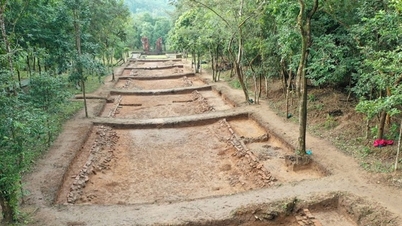
Initial findings have revealed architectural traces of a sacred road leading from Tower K to the central area of My Son Sanctuary. The road's length has been determined to be over 150 meters.

The architecture of the sacred road was previously unknown at My Son throughout the history of this historical site (Photo: Cong Binh).
According to the My Son World Cultural Heritage Management Board, this is the remains of one of the architectural structures never before seen in My Son throughout the site's history.
Previously, in June 2023, the architectural structure of the pathway leading from Tower K to the central temple complex of My Son Sanctuary was first explored by archaeological experts. In March 2024, archaeologists conducted their first excavation covering an area of 220 square meters.
From July to November, archaeologists continued their exploration and excavation of an area of 770 square meters to further research and clarify the architectural ruins of the path leading from Tower K to the My Son Sanctuary of the ancient Champa people.

The road leading to the central area of My Son Sanctuary (Photo: Cong Binh).
The unearthed relic in this excavation area is a 75-meter-long section of an access road to the east of Tower K, oriented east-west, deviating 45 degrees to the north, and totaling 132 meters in length from the base of the tower.
The cross-section of the road is 9m wide at the top, with a carriageway width of 7.9m, a flat surface, and is composed of compacted sand, gravel, and broken bricks, with a thickness of 0.15-0.2m.
The retaining walls on both sides of the road are constructed from rows of bricks. Due to the passage of time, some sections have shifted, tilted, or collapsed. The foundations of the walls have been reinforced with a layer of compacted gravel and brick powder.
Currently, archaeologists have identified four locations where gateways were placed on the southern boundary wall.
Besides the widespread presence of bricks and stones used in the construction of the pathway, experts have discovered several fragments of earthenware and glazed pottery dating from the 10th-12th centuries.

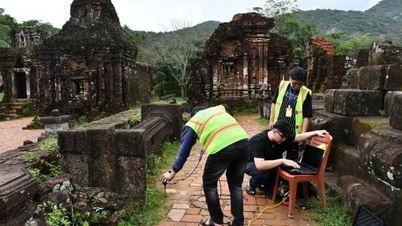
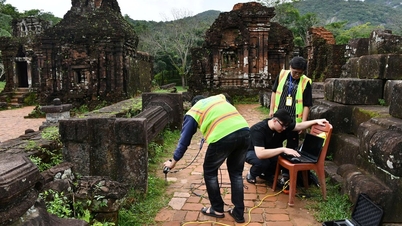
Workers and archaeologists continue the excavation work (Photo: Cong Binh).
Mr. Nguyen Cong Khiet, Deputy Director in charge of the My Son World Cultural Heritage Management Board, said that the results of this survey and excavation have added valuable documents, confirming the religious function of the ruins as a sacred path, a road leading deities, kings, and Brahmin priests into the sacred space of My Son Sanctuary around the 11th-12th centuries.
"This result also opens up a new scientific issue: that My Son remained the religious nucleus of Champa throughout the kingdom's history, with the sacred space of My Son expanding or contracting depending on the reigns of the Champa kings," Mr. Khiet said.
Mr. Khiet also stated that in the coming time, archaeologists will continue to develop a collaborative research program to clarify the scale, structure, and appearance of the entire road within the overall context of the My Son historical site.
The My Son World Cultural Heritage Management Board is also urgently carrying out restoration and preservation work to better promote the historical and cultural value of the relics, and organizing transportation for tourists along the heritage route left behind by the Cham people.
Source: https://dantri.com.vn/du-lich/xuat-lo-cong-trinh-kien-truc-chua-tung-duoc-biet-den-o-my-son-20251212162847331.htm






































































Comment (0)