

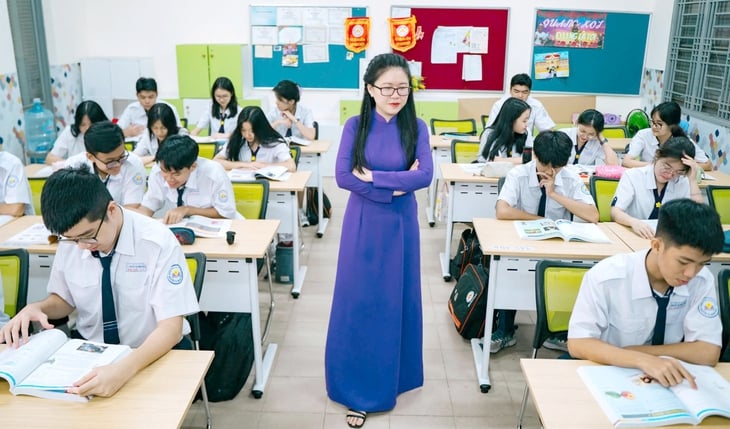
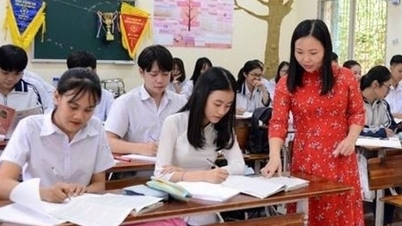
Teachers at Nguyen Thi Minh Khai High School (Xuan Hoa Ward, Ho Chi Minh City) - Photo: THANH HIEP
Notably, this draft specifically stipulates salary policies for teachers, including various allowances such as seniority allowances and increased professional incentive allowances. This is expected to be a breakthrough policy regarding teachers' salaries, in the context of many complaining that "teachers' salaries are insufficient to live on."
Many new policies
According to experts and "insiders," the draft currently being developed includes many new points related to salary and allowance policies for teachers. Specifically, the draft clarifies that teachers appointed to a particular position will be classified and receive a specific salary coefficient applicable to that position.
Salaries must be linked to the performance of teachers and the source of funding (from the state budget or support, and from other revenue sources as stipulated by law) of the educational institution.
Regarding salary adjustments, regular salary increases, and accelerated salary increases, salary adjustments for teachers will be carried out according to current regulations on salary adjustments for civil servants... In addition, the draft also adds a provision that teachers will receive a special salary coefficient according to each civil servant category.
Regarding other types of allowances for teachers, the draft decree stipulates allowances for seniority exceeding the standard rate, job responsibility, regional allowances, mobility allowances, and allowances for working in particularly difficult, hazardous, or dangerous areas, implemented according to current legal regulations. Teachers are entitled to seniority allowances as prescribed by the Government until the new salary policy is implemented.
Notably, the draft decree increases the professional incentive allowance for certain groups of teachers compared to the current level. This is expected to improve income and recognize professional contributions, especially for preschool teachers.
Specifically, for preschool teachers, the current professional incentive allowance is 35%, while the draft proposes increasing it to 45%. An 80% allowance will apply to civil servants and employees working in teaching at preschools in areas with particularly difficult socio-economic conditions as defined by the Government.
Furthermore, according to the draft, teachers are entitled to a maximum of two responsibility allowances when holding multiple positions. At the same time, it is expected that the position allowance will only be granted to the principal, vice-principal, and chairman of the school board.
According to current regulations, the allowance for positions is allocated to principals, vice-principals, heads of departments, and deputy heads of departments. The draft also expands the scope and level of responsibility allowance for many groups of teachers who are concurrently holding important roles in teaching and student support activities...
According to experts, the draft decree also proposes many practical and humane support policies that contribute to improving the lives, health, and working conditions of teachers, especially those in disadvantaged areas.
Teachers are required to have a health check-up at least once a year. Teachers eligible for hazardous work allowances are entitled to at least two health check-ups per year. Policies also include support for public housing, rental housing, support for teachers teaching multi-grade classes, and support for ethnic minority children. In addition, there are policies to attract and value teachers.

Many students in remote areas of Ca Mau province are still keeping up with the curriculum thanks to the dedication of their teachers - Photo: THANH HUYEN
Specifically, to implement the policy of "prioritizing teachers with the highest salaries".
Speaking to Tuoi Tre newspaper, National Assembly delegate Nguyen Thi Viet Nga (member of the National Assembly's Committee on Culture and Society) said that the draft decree, which is currently being finalized, represents a very noteworthy step forward in concretizing the principle that "teachers should receive the highest salary in the administrative and public service salary scale system" as stipulated in the Law on Teachers.
Accordingly, the highest salary coefficient applied to professors is calculated from level 6.2 (A3.1) plus a special coefficient of 1.3, which is equivalent to a coefficient of 8.06 - this is higher than most public administrative positions.
"However, at the general education level, especially for primary and preschool teachers, who are the largest group, their income, despite receiving special salary coefficients and allowances, is still lower than the average in some other sectors."
Therefore, to say that teachers receive the highest salaries, we need to continue improving the base salary, or increase the special coefficient for teachers at lower educational levels – where the professional pressure is currently the greatest," Ms. Nga suggested.
Another point, according to Ms. Nga, is that the salary payment principles in the draft decree also approach the issue in a way that ensures fairness, accurately reflects the specific characteristics of the profession, and the efforts and contributions of teachers.
The proposal includes regulations such as determining the salary and specific salary coefficient applicable to teachers appointed to specific positions. Furthermore, this should not only be based on qualifications and position, but also on performance and the characteristics of the region where they work.
According to Ms. Nga, applying a special salary coefficient alongside the current salary coefficient, plus allowances such as position, seniority, and professional incentives, is a more comprehensive and quantifiable approach compared to the past.
The draft clarifies the responsibility for salary payment sources (from state budget allocations or subsidies and from other revenue sources as stipulated by law used for salary payments) of educational institutions, creating a basis for transparency in implementation.
Research is being conducted on increasing allowances for preschool and primary school teachers.
Besides expressing appreciation, a National Assembly representative suggested that the drafting agency should consider including clearer and longer-term regulations in the draft regarding the retention of allowances for teachers when they are transferred to disadvantaged areas. Currently, the retention period of only 36 months is not sufficient to motivate teachers during this transfer.
In parallel, it is suggested that further research be conducted on increasing allowances for preschool and primary school teachers according to a suitable roadmap. This is because preschool and primary school teachers face the greatest work pressure and are often involved in childcare work, in addition to their purely teaching duties.
Furthermore, a housing or rental subsidy should be provided for teachers working in remote, mountainous, or border areas. Specifically, the subsidy should be based on the actual market rental price in that locality, instead of providing a lump sum that is not less than the regulated rent for public housing.
"There needs to be a mechanism to evaluate the effectiveness of the decree after its issuance, which is expected to take effect from January 1, 2026, in order to promptly adjust to issues arising in practice. This will avoid situations where the decree is issued but its implementation is slow or it is not suitable for the actual conditions of teachers in different regions," this representative suggested.
Meanwhile, delegate Tran Khanh Thu (Hung Yen) suggested that the drafting process of the decree should review and evaluate the method of determining teachers' salaries according to Resolution 27 on salary policy reform for officials, civil servants, and public employees to ensure its appropriateness. At the same time, it should specifically define the source of funding from the state budget to pay teachers' salaries annually.
3 breakthrough points of the draft
Ms. Nguyen Thi Viet Nga highly appreciated the three main breakthroughs in the draft decree that is currently being finalized.
Firstly, for the first time, a special salary coefficient has been applied to each group of teaching positions, from professors to preschool teachers, ranging from 1.1 to 1.6 times. This is a particularly significant new development as it affirms the unique nature of the profession and ensures a commensurate income level.
Secondly, the preferential allowance system for teachers is designed to be diverse, ranging from 25% to 80% depending on the educational level, region, and type of educational institution. Teachers working in remote areas, border regions, and islands receive the highest allowance, clearly demonstrating a priority towards regional fairness.
Thirdly, in addition to traditional allowances, the draft also adds new allowances such as allowances for combined classes, allowances for teachers teaching ethnic minority languages, and responsibility allowances for teachers involved in student counseling... "These are practical and reasonable adjustments, compensating for the very specific hardships faced by teachers," Ms. Nga stated.
Minister of Education and Training:
Teachers' salaries are insufficient to live on, leading them to take on extra tutoring.
During the question-and-answer session in the National Assembly on the afternoon of June 19, 2025, regarding the reasons for extra tutoring and supplementary classes, Minister Nguyen Kim Son stated that the need for extra tutoring and supplementary classes stems from many shortcomings.
First, according to him, teachers' salaries are insufficient to live on; second, there are not enough schools and classrooms to avoid competition among students, especially in large cities, urban areas, and densely populated regions. To fundamentally address this issue, the Minister believes it cannot be resolved "overnight," but requires a very comprehensive solution.
Dr. Nguyen Vinh Hien (former Deputy Minister of Education and Training):
Addressing the concerns of many teachers.
Previously, there were reports that teachers would no longer receive seniority allowances under the new salary system, causing concern among many educators who have dedicated decades to the profession. However, the draft decree still retains seniority allowances and allowances for exceeding seniority limits.
The professional allowance for teachers has been increased by 10% compared to previous regulations, categorized from 25% to 80% depending on the teacher's position, with the addition of a specific coefficient corresponding to the teacher's job position. In addition, there are regulations for teaching across multiple schools, teaching in schools with multiple levels and locations, etc.
These are the advantages of the regulations on salaries and allowances for teachers in the draft decree. The question of how to provide teachers with compensation commensurate with their important status has been a major issue for many years. The Law on Teachers and the decree regulating salary policies, allowances, support policies, and incentives for teachers will provide the legal framework to promote the goal of "teachers' salaries being the highest in the administrative and public service salary scale system."
A principal of a private K-12 school in Hanoi:
Think carefully about the "the longer you work, the higher your salary" mentality.
Upon reading the draft decree regulating salary policies, allowances, and support and incentive policies for teachers, it is evident that salary and allowance payments are based on specific job descriptions, depending on the teacher's category and location. This is reasonable, ensures fairness, and encourages teachers, especially young teachers, to work and contribute.
However, I have some concerns about seniority allowances. Considering the working age and corresponding years of service, at stage 3 (51-70), teachers may be considered "outdated," not keeping up with new trends, stagnation gradually replacing creativity, and overall labor productivity will decrease.
Looking at the career path, paying seniority allowances based on longer service contradicts the principle of paying salaries based on job descriptions (position, productivity, quality).
Ms. Nguyen Thi Mai (Nguyen Du High School, Ho Chi Minh City):
The top student chose to study education.
In the 12th grade class I'm in charge of this year (academic year 2024-2025), two excellent students have chosen to apply to teacher training universities, one majoring in mathematics and the other in physics. When I asked them why they chose to study education, they frankly said: "From 2026 onwards, teachers' salaries will be the highest in the administrative and public service salary scale system."
This demonstrates that the State has paid special attention to the education sector in general and teachers in particular. With attention from leaders at all levels, teachers will have more opportunities to showcase their abilities, improve their expertise, and develop their careers... I am very happy about this.
These changes motivate teachers.
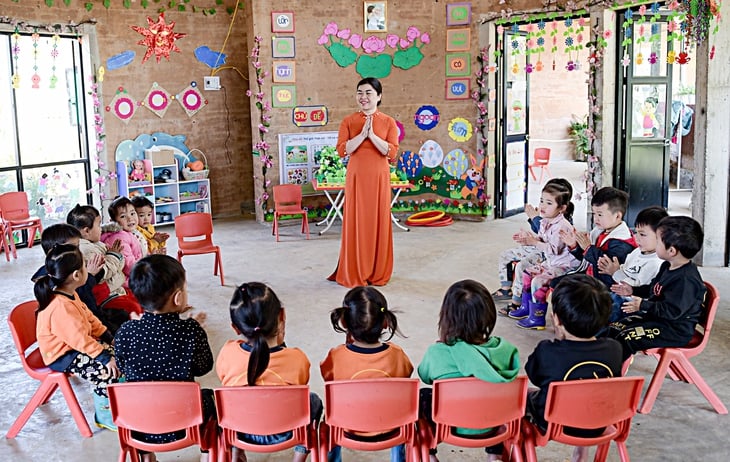
Teachers and students at Lung Vai school, Vi Xuyen commune, Ha Giang (formerly, now Tuyen Quang province) - Photo: NAM TRAN
The draft government decree has raised expectations for a significant improvement in the living standards and income of teachers.
With specific salary principles and calculation formulas, this draft realizes the guiding principles of the Party and the State regarding the cause of education, and promises to create a strong impetus to improve the quality of the teaching staff.
Outstanding features
One of the first notable new features is the principle of salary classification based on job title. This brings greater fairness and transparency in determining salary levels, accurately reflecting the competence, qualifications, and job position of each teacher at a specific time.
Instead of applying a single salary scale, classifying salaries by job title would encourage teachers to continuously improve their professional skills to achieve higher titles, thereby improving their income. However, regulations need to be carefully considered to ensure that job titles are closely linked to actual job positions to create a competitive advantage for employees.
Another advantage worth mentioning is the policy of retaining the salary difference. Retaining the difference creates peace of mind, avoids major financial disruptions, and helps teachers feel secure in their work and dedicate themselves to their profession.
This draft also retains the seniority allowance. This is especially important for teachers with seniority who already had a stable salary under the old regulations.
Furthermore, regular salary increases and accelerated salary increases are still implemented according to current regulations for civil servants. This continues to encourage teachers to strive in their work, perform their duties well to have the opportunity for salary increases, contributing to improving their regular income.
The salary calculation formula is clear and transparent.
This formula demonstrates clarity and transparency in calculating teachers' and lecturers' income. All salary components are specifically listed, including the basic salary coefficient, position allowance (if any), seniority allowance exceeding the standard rate, and especially the retained differential. This helps educators easily visualize and calculate their own salaries, fostering confidence and trust in the new policy.
This creates a great incentive for teachers to confidently dedicate themselves to their work, proactively improve their professional skills, and fulfill their assigned job roles. When their livelihoods are secure, teachers will have more passion and energy to invest in teaching and research, contributing to the improvement of the overall quality of education.
This policy also aims to attract and retain talent in the education sector, especially excellent and dedicated teachers, and to encourage the advancement of young educators.
Assoc. Prof. Dr. Chu Cam Tho (Deputy Secretary General of the Vietnam Association of Psychological and Educational Sciences)
Source: https://tuoitre.vn/dot-pha-ve-tien-luong-cho-giao-vien-20250726082825339.htm

































































































Comment (0)