

Tourism as an OCOP product.
At the end of December 2025, the Nhi Hoa community tourism village in Nhi Long commune (Vinh Long province) officially commenced operations. Notably, from the very beginning of the model's development, the consulting team from the Institute for Economic and Tourism Development Research referenced many criteria of the One Commune One Product (OCOP) program. According to the development team, the goal was not simply to achieve a title, but to create a well-organized community tourism model that effectively utilizes local resources and creates sustainable livelihoods for the people. The story of Nhi Hoa reflects a new trend in rural tourism in Vietnam, especially when tourism is linked to agriculture, culture, traditional crafts, and distinctive local products.
This trend is further reinforced by the Government's recent issuance of a new set of criteria and procedures for evaluating and classifying OCOP products, continuing to identify community tourism, ecotourism, and tourist destinations as key product groups. The new criteria stipulate that OCOP products are evaluated based on three groups of criteria with a maximum total score of 100 points, including product and community strength (40 points), marketing potential (25 points), and product quality (35 points). Products scoring 90-100 points are recognized as 5-star OCOP; 70 to under 90 points as 4-star; and 50 to under 70 points as 3-star.
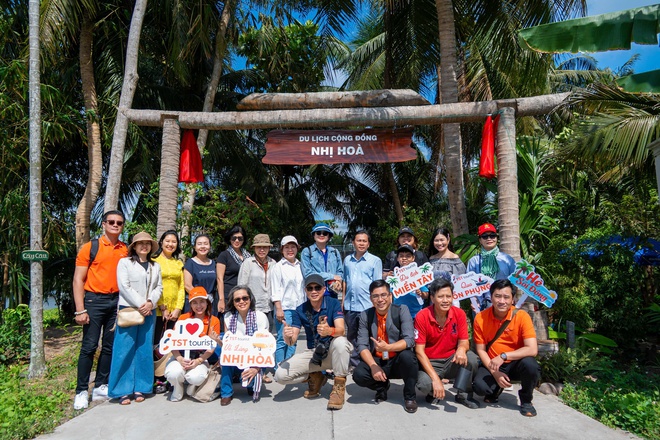
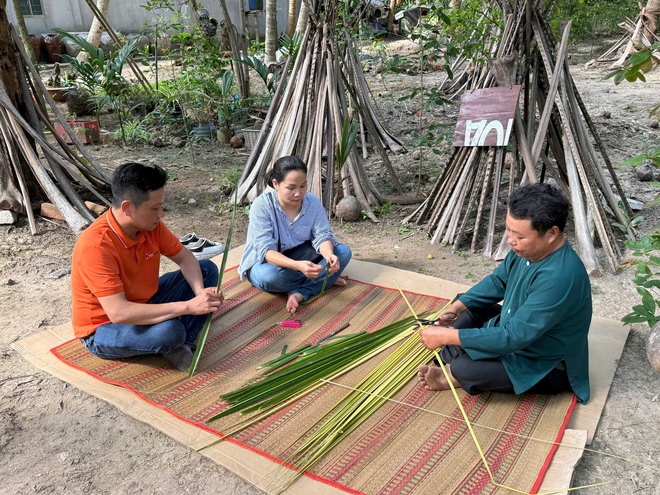
Tourists experience traditional crafts with locals at Nhi Hoa community tourism village (Vinh Long).
PHOTO: HOANG TUYET
Dr. Duong Duc Minh, Deputy Director of the Institute for Economic and Tourism Development Research, believes that the issuance of the new set of criteria stems not only from the requirements of rural economic development but also aligns with the new governance context after Vietnam implemented a two-tiered local government model. Previously, the district level played the role of receiving applications, appraising, and evaluating OCOP products. With the elimination of this intermediate level, many tasks have been transferred to the commune and ward levels, leading to the need to adjust the criteria system and evaluation process. Besides governance, the new set of criteria also reflects the orientation towards green economic development linked to digital transformation. The criteria encourage OCOP entities to incorporate environmentally friendly elements, sustainable development, and the application of digital technology into their products. The nature of Vietnam's OCOP also inherits experience from famous models around the world such as OVOP (One Village One Product) of Japan or OTOP (One Commune One Product) of Thailand. Thanks to this, many Vietnamese OCOP products have gradually conquered the international market. From organic Shan Tuyet tea from the northern mountainous region, coconut flower products from Tra Vinh, to coconut syrup from Can Gio (Ho Chi Minh City)... have been exported and met the world's stringent standards. OCOP is not only about elevating local products but also contributes to spreading the creative values, knowledge, and labor of Vietnamese people to the world.

From the perspective of someone with nearly 25 years of experience in the tourism industry, Master of Science and Doctoral Candidate Tran Giang San believes that officially including community tourism, ecotourism, and tourist destinations in the OCOP product group is a turning point for rural tourism in Vietnam. This is the first time tourism has been recognized not only as a service activity but also as a rural economic product that can be evaluated, categorized, and upgraded like other OCOP products. As OCOP products, tourist destinations will have the opportunity to access government support programs in training, trade promotion, digital transformation, branding, and market connectivity.
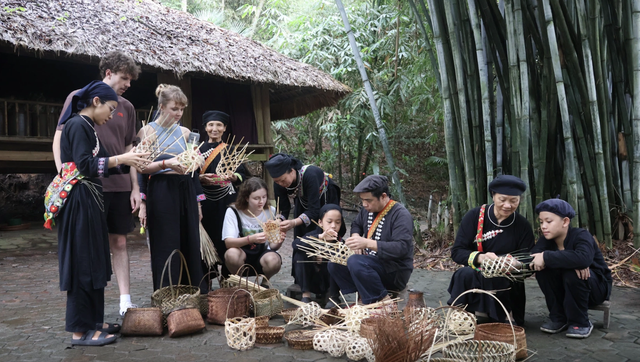
Thai Hai village (Thai Nguyen province), a 5-star OCOP-awarded village.
PHOTO: QUANG TUAN
Mr. Pham Hai Quynh, Director of the Asian Tourism Development Institute (ATI), also shared the view that integrating tourism into the OCOP program helps to closely link specialty agricultural products with local cultural and ecological spaces. Tourists not only come to admire the scenery but also consume agricultural products on the spot, turning tourism into the largest "funnel" for consuming OCOP products.
Lay the groundwork before assigning stars.
While integrating tourism into the OCOP (One Commune One Product) program opens new opportunities for rural Vietnam, achieving a high ranking within the OCOP system is a completely different story. Dr. Ta Duy Linh, Director of the Institute for Economic and Tourism Development Research, who directly participated in designing the Nhi Hoa community tourism village model, shared that the team decided to proceed step by step, initially aiming for a 3-star OCOP rating before gradually upgrading to a 4-star rating. "A 5-star OCOP rating is very difficult to achieve because it requires meeting a series of stringent criteria regarding resources, sustainability, the ability to attract domestic and international tourists, operational efficiency, and the potential to become a model for other localities to learn from," Dr. Linh said.
According to experts, the most challenging aspect of achieving a 5-star OCOP rating lies not in the documentation or paperwork, but in demonstrating the genuine vitality of the local community. A model recognized as 5-star must maintain a stable flow of tourists, create livelihoods for the people, preserve local culture, and operate effectively over the long term. Once a 5-star rating is achieved, the destination also becomes a place for other localities to learn from, leading to immense pressure to maintain quality. Currently, the number of community tourism models achieving 5-star OCOP in Vietnam is still quite small. Commonly mentioned names include Thai Hai Community Eco-village (Thai Nguyen), some models in Quang Ninh, Lai Chau, and Tan Hoa (Quang Binh).

Based on practical experience, Dr. Ta Duy Linh recommends that community-based tourism should not completely replace traditional production activities. Tourism should only be a supplementary livelihood built upon agriculture and local culture. People still need to maintain agricultural production, fishing, or traditional crafts to mitigate risks from fluctuations such as disease outbreaks or economic crises.
MSc-PhD candidate Tran Giang San also noted that localities wishing to effectively utilize the new criteria should focus on four groups of solutions: replanning destinations, building professional community management organizations, improving the quality of experiences, and promoting digital transformation. It is necessary to avoid the situation where localities simply copy other places that offer homestays without basing their actions on their own unique advantages. The important thing is to identify the unique value of culture, landscape, or traditional crafts to create differentiated products. The formation of community tourism cooperatives plays a particularly important role in ensuring legal compliance in business, fair profit sharing, and maintaining consensus within the community.
While the previous phase of OCOP primarily focused on creating local specialty products, the 2026-2035 period is expanding to include the formation of "OCOP destinations." This is seen as an opportunity for rural tourism to shift from development driven by trends to development based on standards, creating sustainable economic, cultural, and livelihood value for local communities.
Source: https://thanhnien.vn/du-lich-cong-dong-duoc-cham-sao-ocop-185260603183244277.htm


















































![[Video] Sunset at Lap An Lagoon – Where the sun sets over the fishing nets](https://vphoto.vietnam.vn/thumb/1200x675/vietnam/resource/IMAGE/2026/05/31/1780192137701_beach-landscape-sea-water-nature-grass-745871-pxhere-com.jpeg)



























Comment (0)