Reduce cost pressure on summer skies.
Ahead of the peak summer travel season, the Ministry of Construction has proposed a further 50% reduction in certain aviation fees, such as landing and takeoff fees and air traffic control fees, for domestic flights. This move is seen as an effort to support airlines, whose operating costs remain under pressure from fuel prices, exchange rates, and operating expenses. The proposal has received particular attention from the tourism industry because for many years, airfare has been considered one of the biggest obstacles to people's travel needs. For most people, airfare typically accounts for a large proportion of their total travel budget. When prices rise, many tourists are forced to shorten their trips, switch to nearby destinations, or change their mode of transportation.

Proposed reductions in certain airline fees are expected to help stimulate tourism during the peak summer season.
Photo: Independent
This reality is quite clearly reflected in this year's summer tour booking trends. Mr. Nguyen Huu Nghi, a marketing specialist at Tugo Company, said that the number of summer customers for his company increased by more than 20% compared to the same period last year, but consumer behavior has changed significantly. In the international market, tours priced under 20 million VND, such as to China, Taiwan, South Korea, and some Southeast Asian countries, are attracting a large number of customers. These are all destinations with short flight times, reasonable total costs, and suitability for the cautious spending habits of tourists.
For domestic tourism, many customers are shifting to destinations accessible by road, such as the Mekong Delta, Phan Thiet - Mui Ne, Vung Tau, or Da Lat, to reduce cost pressure. "A clear trend is that customers are booking tours closer to the departure date. When airfare increases, customers tend to consider very carefully before making a final decision," Mr. Nghi said. Sharing with Thanh Nien newspaper on the afternoon of June 7th, Ms. Doan Thi Thanh Tra, Deputy General Director of Saigontourist Travel Service Company, also noted that this summer is different from previous years, with demand growth coming later. While in previous years the market started to accelerate from mid-May, this year it only truly peaked in early June. To date, the number of tourists is generally still comparable to the same period last year. However, the corporate group tourism segment is growing very well, with many groups ranging from several hundred to over 2,000 people.
Reducing certain aviation fees does not necessarily mean an immediate drop in airfares, as prices depend on many factors such as fuel prices, exchange rates, aircraft leasing costs, and market supply and demand. However, this is still a positive sign as it helps reduce input cost pressure for airlines. Mr. Tran Tuong Huy, Deputy Director of the Institute for Tourism and Social Research, believes that this policy could create more room for airlines to implement promotional programs and support travel businesses in developing more competitive product packages during peak season. If aviation costs decrease, the positive impact will not only be limited to airfares but will also spread to the entire tourism service chain, from travel agencies and hotels to services at destinations.
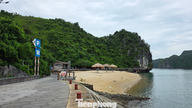



The number of international visitors to Vietnam reached 10.6 million in the first five months of 2026, the highest level ever recorded.
Photo: Nhat Thinh
An unprecedented growth platform.
While tourism businesses are anticipating a boost from aviation policies, the market also possesses a rare growth foundation. According to tourism industry data, Vietnam welcomed 10.6 million international visitors in the first five months of 2026, the highest number ever recorded for the same period in previous years. This figure is equivalent to approximately 42% of the target of 25 million international visitors for the whole year. Notably, even though May is considered a low season for international tourists, Vietnam still welcomed nearly 1.8 million visitors, the highest number ever recorded for May alone. Mr. Mai Thuan Loi, a master's degree holder in tourism from the University of Social Sciences and Humanities (Vietnam National University Ho Chi Minh City), believes that the most positive sign currently is that the tourism industry has moved beyond the recovery phase after the Covid-19 pandemic and into a phase of genuine growth. Tourists are now not only traveling more but are also willing to spend more on experiences, resorts, food, events, and products related to local culture.

Amusement and entertainment venues recorded large numbers of visitors during the summer.
Photo: Le Nam
Besides the increase in tourist numbers, many localities have also proactively innovated their products to meet the increasingly diverse needs of the market. In recent years, a series of destinations have invested heavily in night tourism, festivals, water sports, eco-tourism, community tourism, MICE (Meetings, Incentives, Conferences, and Exhibitions), and cultural and entertainment events. This helps extend the length of stay and increase tourist spending. For example, in June, the effect of the International Fireworks Festival helped Da Nang become the most prominent destination in the domestic market. Many Da Nang tour programs were almost fully booked. Similarly, Central Vietnam tourist routes also benefited from the festival effect. Besides Da Nang and Phu Quoc, routes in the Northeast, Northwest, Ninh Binh, and Ha Long also recorded growth of about 10-15%, especially among overseas Vietnamese returning home during the summer.



Ms. Doan Thi Thanh Tra added that the structure of the international tourist market is changing towards greater diversification. While previously the majority of tourists came from traditional markets, many new markets such as India, Indonesia, the Philippines, Thailand, and South Korea are now experiencing strong growth. In particular, the cruise ship segment has seen an increase of nearly 20% compared to the same period last year. This is a high-value source of tourists and is making a significant contribution to many coastal destinations. Ms. Tra also affirmed that not only is the number of tourists increasing, but their spending is also improving, especially among high-end tourists.
Mr. Tran Tuong Huy predicted that current signals indicate Vietnam's tourism industry has the opportunity to break through this summer. However, the tourism sector needs to take advantage of this opportunity to shift from quantitative growth to qualitative growth. Besides controlling transportation costs, the tourism industry needs to focus on improving service quality, diversifying products, developing green tourism, community tourism, cultural tourism, and the night-time economy to enhance tourist experiences and spending. Meanwhile, Mr. Mai Thuan Loi emphasized the importance of linkages between airlines, travel agencies, hotels, and destinations. If each party independently raises prices during peak season, the market will lose competitiveness. Conversely, if there is coordination to create synchronized product packages with consistent quality and reasonable prices, Vietnam's tourism will have many more advantages. In the long term, the tourism industry needs to shift from a "peak season" mindset to "year-round destination management," developing products and promotional campaigns tailored to each season and each customer group.
With 10.6 million international visitors in the first five months of the year, along with positive signals from the domestic market and expectations of cooling transportation costs, the tourism industry is entering the summer of 2026 with a completely different mindset compared to the years of recovery after the Covid-19 pandemic. If the current opportunities are well-utilized, this summer could become a springboard for Vietnam's tourism industry to move closer to its growth target for the whole year.
Source: https://thanhnien.vn/du-lich-he-cho-cu-hich-moi-185260607150839165.htm
![[Image] Schools organize meetings and introduce teaching models to students admitted to grade 10.](https://vphoto.vietnam.vn/thumb/1200x675/vietnam/resource/IMAGE/2026/06/25/1782368077271_ndo_br_z7970052192242-1ec8daeb77a6eed1a4e9f58c564ddd3e-jpg.webp)

![[Photo] General Secretary and President To Lam receives Palestinian Ambassador Saadi Salama](https://vphoto.vietnam.vn/thumb/1200x675/vietnam/resource/IMAGE/2026/06/25/1782365384740_a1-bnd-9423-8322-jpg.webp)
![[Image] Ho Chi Minh City: Ma Lang area, Chicken-Rice Market about to change its appearance](https://vphoto.vietnam.vn/thumb/1200x675/vietnam/resource/IMAGE/2026/06/25/1782377698627_ndo_br_m1-jpg.webp)






















![[Video] Weather forecast for tonight and tomorrow, June 26, 2026: Northern Vietnam to end heatwave from tomorrow, Central Vietnam to continue experiencing a heatwave.](https://vphoto.vietnam.vn/thumb/402x226/vietnam/resource/IMAGE/2026/06/25/1782392692278_thumb-dem-png.webp)