

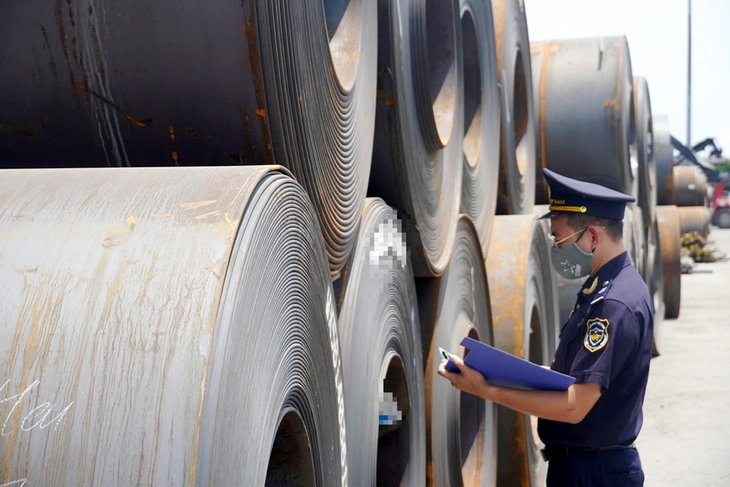
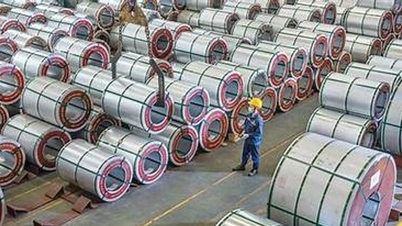
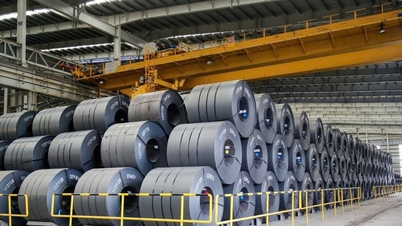
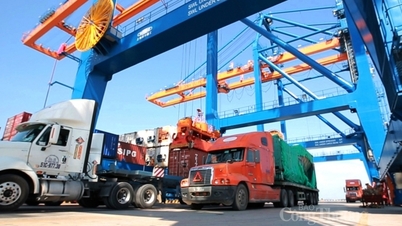
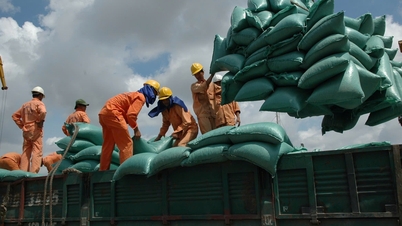
Imported steel arriving at Hai Phong port is stored in a designated customs inspection and monitoring area as per regulations - Photo: CAM GIANG
Previously, under the anti-dumping duty order, steel products originating from China, with a thickness of 1.2 - 25.4mm and a width not exceeding 1,880mm, would be subject to anti-dumping duties ranging from 23.1 - 27.8% for a period of 5 years.
Therefore, many domestic steel manufacturers have circumvented this regulation by importing steel products with widths exceeding 1,880mm in order to avoid taxes.
Are cheap imported goods the preferred choice?
In response to Tuoi Tre newspaper, several businesses that use hot-rolled steel as a raw material for production affirmed that with the applied tax rate, it is almost impossible for them to import steel raw materials from China, so they have sought ways to circumvent this regulation.
In reality, if taxes are added, imported goods will not be able to compete on price, even though the final price is ultimately paid by the consumer.
"Therefore, we import HRC steel with widths exceeding 1,880mm, combined with a 'slitting' machine to over 2,000mm, making full use of raw materials and optimizing production to reduce costs. Importing raw materials to meet production needs is also a practical necessity for businesses when domestic supply is insufficient," said a representative of a steel company in the North.
According to our findings, in order to find alternative sources of supply, many businesses have switched to importing HRC steel products with HS codes different from the list subject to anti-dumping duties, so as to avoid being subject to them.
For steel coils wider than 1,880mm, businesses use "slitting" machines, which cut the steel to the required size (mostly under 1,800mm) to meet production needs.
However, a steel company in Hung Yen admitted to importing hot-rolled steel with widths exceeding 1,880mm to cope with the tariff order. In reality, hot-rolled steel with widths of 1,500-2,000mm is not significantly different, and businesses can utilize various sizes and optimize efficiency through design, machinery, production lines, and "width reduction" machines.
Although some steel companies say that importing wide-width steel and using "slitting" machines isn't always efficient, importing wide-width steel and processing it through these machines is time-consuming and requires extra manpower for the leftover steel. However, because imported steel is cheaper, it remains the choice of many manufacturers.
"But this isn't a major problem; the main issue is ensuring the supply of raw materials for production. In fact, since the imposition of tariffs, domestic purchase prices haven't fluctuated significantly. Although there's a tendency to increase, it's mainly driven by global price movements, and the final price is paid by consumers. However, we also have to ensure competitiveness," the company said.
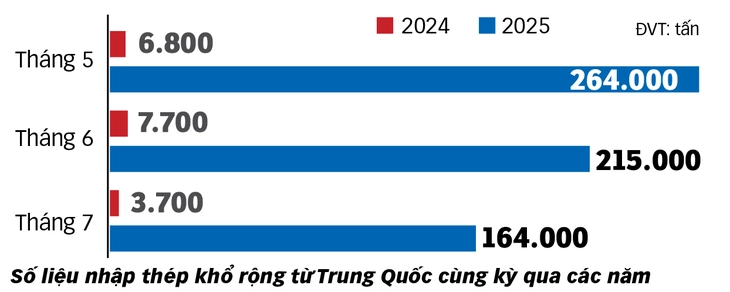
Data: Ngoc An - Graphics: N.KH.
Increase monitoring of imported hot-rolled steel shipments.
In a conversation with us, a steel industry expert stated that the rush by businesses to import wide-gauge steel exceeding 1,880mm as a production input to replace HRC steel smaller than 1,880mm will directly impact the domestic manufacturing industry and the economy, as cheap steel products will continue to flood into Vietnam due to the absence of anti-dumping duties.
"HRC products are input materials for many industries such as steel pipes, galvanized sheets, household goods, etc."
"The influx of cheap wide-width steel into Vietnam, replacing products with widths under 1,880mm, will cause major disruptions to downstream product prices, create unfair competition, distort the domestic market, seriously affect the domestic HRC manufacturing industry, and result in tax revenue losses for the State," this person warned.
More worryingly, according to experts, the sharp increase in the quantity of wide-width hot-rolled coil (HRC) steel imported into Vietnam also risks affecting the determination of Vietnamese origin.
Because HRC steel accounts for 80-90% of the cost structure of downstream steel products, while many major steel importing countries such as the US, Canada, and some EU countries require downstream steel products to be manufactured from HRC products of domestic Vietnamese producers.
"Therefore, allowing large-sized HRC steel (over 1,880mm) to enter Vietnam risks triggering investigations into origin evasion by other countries, and downstream steel product manufacturers risk being negatively impacted," a specialist warned.
Speaking with us, Mr. Chu Thang Trung, Deputy Director of the Trade Remedies Department (Ministry of Industry and Trade), said that they have received information regarding the increased import of hot-rolled steel products with widths exceeding 1,880mm, aimed at circumventing anti-dumping measures.
Therefore, this agency has also sent supplementary investigation questionnaires, requesting importing companies to provide additional information on the import, use, and sale of hot-rolled steel products with widths exceeding 1,880mm.
"We have also sent a letter to the Ministry of Finance (Customs Department) requesting them to consider measures to strengthen supervision of imported hot-rolled steel products declared with a width greater than 1,880mm to limit the possibility of fraud by traders through false declaration of product dimensions to evade anti-dumping duties," Mr. Trung informed.
Imports of wide-gauge steel increased...18 times.
According to statistics from the Customs Agency, in July 2025, the total import volume of hot-rolled coil (HRC) steel was 642,000 tons, with China accounting for 405,000 tons. Of this, wide-width steel products from China accounted for 163,000 tons, representing more than 40% of imported HRC steel.
In the first seven months of the year, Vietnam imported nearly 832,000 tons of hot-rolled steel with a width of 1,880mm or more from China, 18 times higher than the same period last year. Steel with a width of 2,000mm accounted for 72% of imports during this period.
Wide-width hot-rolled steel coils imported from China are mainly common and widely used steel grades (Q235B, Q355B, SAE 1006, SS400, A36...), imported for use as regular HRC (for sheet metal production, steel pipes, structural fabrication...).
Thus, in the first seven months of the year, Vietnam imported 5.2 million tons of hot-rolled coil (HRC) steel, with China accounting for 3.2 million tons, or 61%. Of this amount, wide-width steel from China alone accounted for 832,000 tons, 18 times more than the same period last year.
Customs increases controls to combat fraud.
Information from the Customs agency indicates that a series of measures have been implemented to both prevent fraud and facilitate businesses in the import and export of goods, including the import of hot-rolled steel.
At the Customs Sub-department of Region 3 (managing the Hai Phong area), after the Ministry of Industry and Trade issued a decision to officially apply anti-dumping duties on certain hot-rolled steel products originating from China, the agency notified the business community through its website so that businesses could understand and comply with the regulations.
The agency also directed its units to seriously implement the Ministry of Industry and Trade's decision on imposing anti-dumping duties on HRC steel. This includes focusing on key areas to prevent fraud, such as: collecting information, analyzing, and evaluating the import activities of hot-rolled steel.
In addition, the Customs agency has established and applied inspection channeling criteria in customs procedures for imported steel shipments, in accordance with the risk level. Inspections are conducted according to the system's channeling; and key shipments are monitored and inspected as directed.
Additional investigative measures may be implemented sooner.
Responding to Tuoi Tre newspaper, a representative from the Trade Remedies Department (Ministry of Industry and Trade) stated that they have proactively gathered more information, reported to the Prime Minister, and issued warnings to businesses to strictly enforce legal regulations.
During the official investigation, the Ministry of Industry and Trade also sent supplementary investigation questionnaires to importing businesses, requesting them to provide additional information on the import, use, and sale of steel products.
In addition, the ministry has finalized the institutional framework and issued circulars guiding Decree 86 so that the new regulations on trade defense can be implemented immediately from July 1st.
The new regulations anticipate the possibility of businesses evading trade defense measures, thus allowing for timely application of such measures based on business requests and while also considering the interests of all parties involved.
If tax evasion is found, stricter measures can be applied sooner, instead of requiring a minimum of 9 months for additional measures and 12 months for extended investigations.
Source: https://tuoitre.vn/dua-nhap-thep-kho-rong-de-ne-thue-20250821090641528.htm




























































































Comment (0)