Co Loa is more than just a festival.
The Co Loa Festival was included in the national list of intangible cultural heritage in 2021. According to Professor Nguyen Van Kim, Vice Chairman of the National Heritage Council, these religious practices not only enrich the value of the UNESCO dossier but also demonstrate the aspiration for peace, the will for national independence, and the mark of the authority of the Au Lac state in history.
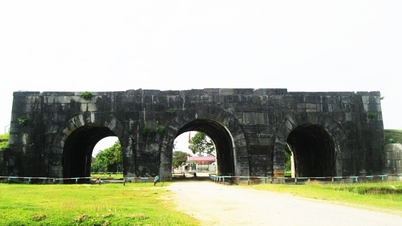
However, the value of Co Loa lies not only in its spring festivals. According to Professor Nguyen Quoc Thong, former Vice President of the Vietnam Architects Association, what makes Co Loa special is the harmony between the ancient ramparts and the villages, agricultural cultivation, and natural hydrological system. Professor Thong stated that while many ancient capitals around the world have been isolated from the lives of their inhabitants or exist only as ruins, Co Loa remains a living space for the local community. In other words, Co Loa is a "living heritage," where layers of historical memories intertwine with present-day life.

Co Loa is expected to become a UNESCO World Heritage site by 2030.
PHOTO: NGU THIEN
It is this connection between heritage and community that leads many experts to view Co Loa as a "living heritage," and also opens up the idea of building an ecological museum – where heritage is preserved right within the living space of the people.
Living with heritage
Unlike traditional museums, ecological museums not only preserve artifacts but also conserve living spaces, customs, traditional crafts, and community memories. In the case of Co Loa, this model is expected to help the public experience the cultural life that has developed around the citadel over more than 2,000 years.


One of the values still preserved in the community life of Co Loa is the craft of making Mach Trang rice noodles. According to documents from the Co Loa Relic Site Management Board, this type of rice noodle has a distinctive ivory white color instead of the bright white of many other types. The difference lies in the processing stage, where the rice is fermented for 2-4 days before being ground, instead of just soaking overnight.

Stir-fried Mạch Tràng rice noodles with celery in Cổ Loa
PHOTO: NGU THIEN
Mạch Tràng vermicelli is also associated with a dish that has become a unique feature of the Cổ Loa region: stir-fried vermicelli with celery. This traditional dish often appears on important occasions, especially the offering to King An Dương Vương during the January festival and the anniversary of the Queen Mother's death in August every year. More than just a dish, stir-fried vermicelli with celery reflects the continuation of cultural customs passed down through many generations. The fact that the craft of making Mạch Tràng vermicelli is still maintained today also shows the vitality of a traditional craft closely linked to community life.
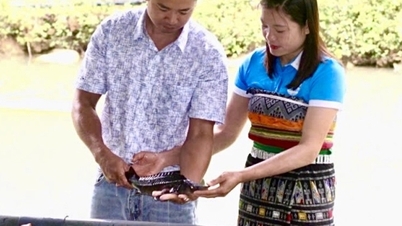
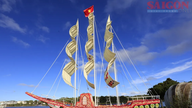
While culinary traditions tell the story of the life of the inhabitants of Co Loa, the legend of the magic crossbow opens up another layer of memory of the ancient capital. Archaeological discoveries of a hoard of bronze arrowheads and traces of metallurgical furnaces have contributed to shedding light on a story that previously only existed in legend. Notably, at least two researchers, Dr. Nguyen Viet (Director of the Southeast Asian Prehistory Center) and rocket engineer Vu Dinh Thanh, have attempted to reconstruct the magic crossbow based on archaeological documents and findings.
Subsequent versions of the crossbow were all successfully tested, capable of firing multiple arrows simultaneously. If properly organized, experiences with the reconstructed crossbow could help the public connect more closely with the story of Co Loa, from legend to history.

The An Dương Vương version of the crossbow and arrows was researched and manufactured by engineer Vũ Đình Thanh.
PHOTO: TRINH NGUYEN



If the UNESCO dossier is an opportunity for the world to learn more about Co Loa, then keeping the heritage alive in community life is the long-term story. From the spring festival and the traditional Mach Trang noodle-making craft to the experiences associated with the legend of the magic crossbow, each cultural value preserved today contributes to making Co Loa not just a memory of the past, but a living heritage.
"How can people make a living from heritage?" is the question shared by Mr. Nguyen Thanh Quang, Director of the Thang Long - Hanoi Heritage Conservation Center. According to him, the center's future activities to promote heritage values will focus on strengthening the connection between Thang Long Imperial Citadel and Co Loa, while placing the local community at the center.
Based on that direction, along with suggestions from experts regarding an ecological museum model, Co Loa is expected to continue preserving the cultural layers accumulated over thousands of years, while allowing the community to become the subject of heritage in their daily lives.
Source: https://thanhnien.vn/dung-bao-tang-sinh-thai-co-loa-185260618193737339.htm
![[Photo] "Hanoi Lotus Festival" honors the lotus flower that has been associated with Vietnam for thousands of years.](https://vphoto.vietnam.vn/thumb/1200x675/vietnam/resource/IMAGE/2026/06/27/1782516943048_sen-ha-noi-2026-minh-duy-1-jpg.webp)