Around 5 PM on April 1, 2026, two children, HTL and HBH (both born in 2014, residing in Giang Tin residential area, Truc Lam ward), went to the beach to swim. When they did not return by late evening, their relatives panicked and split up to search for them.
All that remained on the beach were the bicycles and the children's clothes. The incident was immediately reported to the authorities.
More than 40 officers and soldiers from the Fire Prevention and Rescue Police Department of Thanh Hoa Provincial Police, along with the Hai Binh Ward Police, were mobilized to search the sea throughout the night.
After many hours of effort, the bodies of the two children were found one after another and handed over to their families for burial.
The heart-wrenching cries on the beach that day once again sounded the alarm about drowning accidents among children, a haunting tragedy that repeats itself every summer.
The dangers aren't limited to the sea; they lurk in even the most familiar places. After a football match, a group of students went to a shrimp pond in Ngoc Son ward to cool off.
While playing, NVH (born in 2008) unfortunately slipped and fell into a deep hole and died. The area was dozens of meters deep but lacked proper monitoring.
Even more heartbreaking, some incidents occur right in residential areas. At approximately 3:30 PM on April 12th, two young sisters, LKKC (3 years old) and LKKA (1 year old), residing in Xuan Du commune, wandered off to play in the stream behind their house while their adults were distracted. By the time they were discovered, both had already passed away.
Each accident is unique, but the common thread is a lack of skills on the part of the children, insufficient adult supervision, and gaps in ensuring a safe environment.
According to statistics from relevant authorities, in 2025, Thanh Hoa province experienced 17 drowning incidents resulting in 21 child deaths, an increase in both the number of incidents and the number of victims compared to the previous year.
Notably, 73% of the incidents occurred in ponds, lakes, rivers, and streams near residential areas; the 11-16 age group accounted for 86% of the total victims.
In just the first few months of 2026, the province experienced 8 drowning incidents resulting in the deaths of 9 children. These chilling figures show that the risk remains ever-present when the hot season begins.
The empty spaces after each accident.
The worrying thing is that most drowning incidents are preventable if children are equipped with adequate skills and adults are more attentive.
In many rural areas, ponds, canals, and aquaculture farms are located amidst residential areas but lack fences or warning signs. In some places, the warning signs are old, faded, and lack deterrent effect.

Meanwhile, young children are active and inquisitive but lack the ability to recognize danger. Many parents still have a complacent attitude, assuming their children are old enough to play on their own with friends, and therefore neglect to supervise them. Just a few minutes of inattention can have consequences that last a lifetime.
Another reality is that teaching swimming and survival skills to children still faces many challenges. Many schools lack swimming pools, qualified instructors, and funding to organize skills classes.



In mountainous and remote areas, children have even fewer opportunities to access safe swimming environments. Following heartbreaking incidents, localities throughout the province are making concerted efforts to implement comprehensive solutions to prevent drowning accidents.
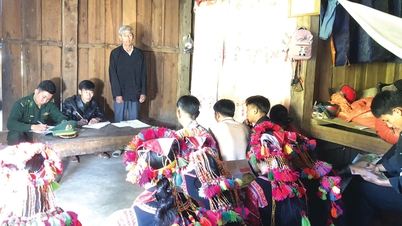
In Thuong Ninh commune, the police force, in coordination with the youth union and schools, organized many direct awareness sessions for students. In addition to providing knowledge, the students were also guided on how to handle situations, provide basic first aid, and perform safe rescue operations.
Lessons are no longer dry and rigid on paper, but are illustrated with visual images and real-life situations, making them easier for students to understand.
In Hoang Son commune, the youth union surveyed and erected 21 warning signs in dangerous areas around ponds, rivers, and canals. These small signs carry great significance, reminding people and children not to be complacent about the danger of drowning.
Meanwhile, in Dong Son ward, the free swimming lessons organized by the ward's police force are attracting a large number of students. Police officers and soldiers are directly involved in guiding students through each floating and kicking movement, as well as how to handle emergencies.
The sound of children's laughter by the pool reassures many parents that their children are learning essential survival skills in a safe environment.
Le Nhan Thinh, a student participating in the class, excitedly shared that he not only learned to swim but also received guidance on how to prevent drowning and assist those in need.
Meanwhile, Mr. Vu Trong Thanh, a parent in Dong Son ward, said that what reassured him most was that his child was learning skills under the direct guidance of law enforcement officials.
"The children participated very enthusiastically, and we hope this model will continue to be replicated," he said.
In addition to teaching swimming, from April 2026 to the present, the Dong Son Ward Police have organized 8 awareness sessions for more than 6,000 students; and coordinated the survey and placement of 69 warning signs in dangerous areas.
When the whole community works together to build a "shield" for children.
In Tho Vuc village, Vinh Loc commune, the section of the Ma River flowing through the area has been a source of worry for residents every summer for many years. Despite the deep, fast-flowing water, many teenagers still gather there to swim.
In response to this situation, the Vinh Loc Commune Police advised on the implementation of the "Life Jacket Provision Point" model, placing life jackets, lifebuoys, ropes, and rescue poles at dangerous locations.
In parallel, warning signs are being put up, and regular awareness campaigns are being organized to help people improve their understanding of accident prevention.
Mr. Trinh Van Minh, a resident of Tho Vuc village, said that previously, people frequently went swimming in the Ma River dike area, which was very dangerous. But since the model was implemented, people's awareness has changed significantly, and the unsafe situation has decreased considerably.
Not only in river and lake areas, but also at tourist beaches, drowning prevention measures are being tightened.

At Sam Son beach, the Fire Prevention and Rescue Police force, in coordination with the Beach First Aid Team, maintains the "Permanent Task Force for Propaganda and Rescue" model.
Forces are stationed in key areas to promptly detect and handle any emerging situations. In addition to rescue services, tourists are also instructed on how to recognize warning flags, dangerous areas, and safe swimming techniques.



Mr. Le Van Minh, a tourist from Ninh Binh, said that the frequent reminders and guidance from rescue forces made his family feel more secure when letting their children play at the beach.
Given the complex situation regarding drowning accidents, the People's Committee of Thanh Hoa province has also issued Plan No. 145/KH-UBND on preventing and combating injuries to children in the period 2026-2030.
Accordingly, the province aims to reduce the rate of child injuries to 300 per 100,000 children by 2030; and reduce the number of child deaths due to drowning by 20% compared to 2020.
Thanh Hoa province also strives to have an additional 250,000 safe homes, 95% of schools meeting the "Safe School" standard, and 90% of communities meeting the criteria for safety in preventing accidents and injuries to children.
In particular, the goal of having 80% of children aged 6 to under 16 know water safety skills and how to swim safely demonstrates a strong determination to build a protective "shield" for children from the grassroots level.
To achieve that, in addition to the efforts of the relevant authorities, the most important thing remains a change in awareness from each family.
Preventing children from swimming in rivers or lakes unsupervised; not entrusting young children to older siblings who are not capable of looking after them; reminding children to stay away from dangerous areas; teaching children to swim and survival skills… these are small things that can save a life.
Summer is supposed to be a time of laughter, trips, and beautiful childhood memories. But with just one moment of carelessness, summer can turn into a season of tears.
Source: https://baovanhoa.vn/doi-song/dung-de-mua-he-thanh-mua-nuoc-mat-235635.html


![[Photo] "Hanoi Lotus Festival" honors the lotus flower that has been associated with Vietnam for thousands of years.](https://vphoto.vietnam.vn/thumb/1200x675/vietnam/resource/IMAGE/2026/06/27/1782516943048_sen-ha-noi-2026-minh-duy-1-jpg.webp)


![[Photo] A phone-free summer afternoon at the village library](https://vphoto.vietnam.vn/thumb/1200x675/vietnam/resource/IMAGE/2026/06/27/1782551770949_anh-1-jpg.webp)