

To avoid the situation of "prices, wait for the salary increase" when there is a salary increase policy, strengthening price management and control measures plays an important role.
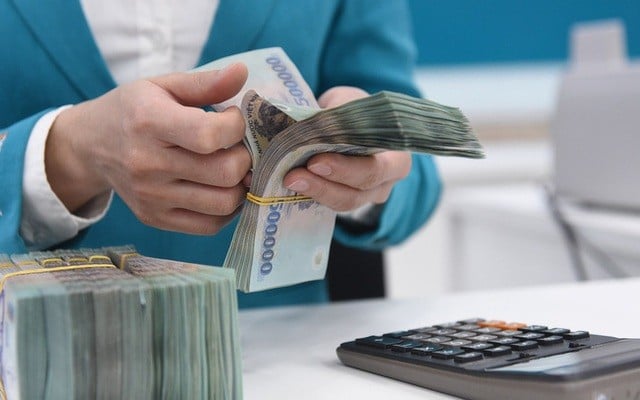 |
| The base salary increased by 30%, and several new adjustments to the wage policy came into effect on July 1st. (Illustrative image) |
The 30% increase in the base salary and several new adjustments to the wage policy, effective from July 1st, are bringing great joy to many, but also raising concerns about rising prices.
In fact, over the past few days, some essential goods have seen slight price increases. Some people are even worried that, if prices are not well managed, the "price race" could outpace the "wage race," and the familiar saying "prices, wait for wages!" from decades ago will repeat itself.
The issue of "salary-based compensation" is also a "hot" topic in the National Assembly forum. Many National Assembly deputies have proposed solutions to address this situation.
In reality, the number of people receiving salary increases this time is not very large. According to statistics at the end of 2023, approximately 2.78 million civil servants and public employees nationwide (excluding the armed forces) received salary increases. In addition, nearly 3.4 million people receive monthly pensions and social insurance benefits from the Social Insurance Fund, and 1.8 million people receive social retirement benefits from the State budget. Thus, the number of civil servants receiving salaries from the State budget only accounts for a few percent of the population; the scale is not large enough to create real pressure for price increases. The core issue creating upward price pressure is due to psychological factors and the exploitation of the "loophole" of salary increases to raise prices unreasonably.
Therefore, according to many National Assembly deputies and economic experts, the crucial and urgent solution at this time is for state management agencies to strengthen inspection and supervision to promptly detect cases of violations of competition law and arbitrarily increasing prices, affecting the market. This includes examining the factors that determine prices, preventing wage increases from leading to unreasonable price increases that negate the purpose of wage increases and negatively impact the lives of workers. Especially important is inspection and control, particularly of essential food items, and price listing in traditional markets... Strict action must be taken against violations of price laws.
To ensure the effectiveness of the salary increase policy from July 1st, last weekend, Prime Minister Pham Minh Chinh signed and issued Official Dispatch No. 61/CD-TTg to Ministers, Heads of ministerial-level agencies, government agencies; and Chairmen of People's Committees of provinces and centrally-administered cities on strengthening measures to manage and regulate prices.
Accordingly, the Prime Minister requested that ministries, according to their assigned functions and tasks, urgently review, report, and propose specific roadmaps, along with the level and expected timing of price adjustments for goods and services under their management (medical examination and treatment services; electricity; education services, etc.); closely coordinate with the Ministry of Finance, the General Statistics Office, and relevant agencies to thoroughly assess the impact on the consumer price index and specific inflation control targets and scenarios, and report to the Prime Minister before June 30, 2024.
The Prime Minister also assigned the Ministry of Finance to take the lead in coordinating with the Ministry of Planning and Investment, the State Bank of Vietnam, the General Statistics Office, and relevant agencies and localities to accelerate the implementation of the work of compiling, analyzing, and forecasting market prices, and updating detailed and specific price management scenarios in a timely manner for the remaining months of the year to advise the Government and the Prime Minister on appropriate and timely measures; ensuring the inflation control target for 2024 in accordance with the National Assembly Resolution.
Along with controlling prices, the Prime Minister requested ministries, sectors, and localities to prevent shortages and disruptions in the supply chain that could lead to sudden price increases, such as for gasoline, food, and construction materials.
The Prime Minister also instructed relevant ministries and agencies to strictly handle cases of spreading false information that causes panic among consumers and destabilizes the market.
Economists argue that, excluding speculative factors, wage increases are not the primary, direct cause of inflation. Therefore, to avoid a situation where prices are rising and wages are increasing, the strict implementation of the Prime Minister's directive is crucial at this time. Relevant authorities need to act immediately to prevent price hikes for goods and services. Providers of goods and services should also carefully consider the implications before raising prices, as this could lead to unsold goods and legal violations.
Source: https://baoquocte.vn/dieu-chinh-muc-luong-co-so-dung-de-te-nuoc-theo-luong-276428.html


![[Photo] General Secretary To Lam receives President of the European Council Antonio Costa](/_next/image?url=https%3A%2F%2Fvphoto.vietnam.vn%2Fthumb%2F1200x675%2Fvietnam%2Fresource%2FIMAGE%2F2026%2F01%2F29%2F1769697816651_a1-bnd-5216-9741-jpg.webp&w=3840&q=75)


![OCOP during Tet season: [Part 3] Ultra-thin rice paper takes off.](/_next/image?url=https%3A%2F%2Fvphoto.vietnam.vn%2Fthumb%2F402x226%2Fvietnam%2Fresource%2FIMAGE%2F2026%2F01%2F28%2F1769562783429_004-194121_651-081010.jpeg&w=3840&q=75)


![OCOP during Tet season: [Part 2] Hoa Thanh incense village glows red.](/_next/image?url=https%3A%2F%2Fvphoto.vietnam.vn%2Fthumb%2F402x226%2Fvietnam%2Fresource%2FIMAGE%2F2026%2F01%2F27%2F1769480573807_505139049_683408031333867_2820052735775418136_n-180643_808-092229.jpeg&w=3840&q=75)
![OCOP during Tet season: [Part 1] Ba Den custard apples in their 'golden season'](/_next/image?url=https%3A%2F%2Fvphoto.vietnam.vn%2Fthumb%2F402x226%2Fvietnam%2Fresource%2FIMAGE%2F2026%2F01%2F26%2F1769417540049_03-174213_554-154843.jpeg&w=3840&q=75)





Comment (0)