

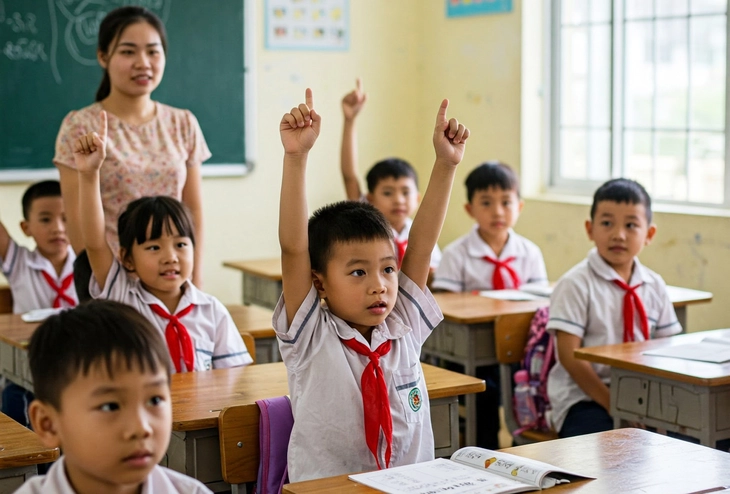
Children should be encouraged to confidently express their opinions - Illustration by AI
First story
The school is located in a highland area, surrounded by towering, jagged mountain ranges. The teachers in the program brought books for the students and eagerly went out to the playground to interact with them.
- Does anyone here enjoy reading?
No hands went up. The children bowed their heads in silence, looking at each other without answering. She asked again, but still no one raised their hand. She bent down and quietly asked the nearest student.
Why aren't you answering?
- I'm afraid of getting punished for answering incorrectly.
The teacher was stunned, then understood the root of the problem. She asked all the students in the schoolyard:
- How are the children usually punished?
- Cleaning the toilets, sweeping the schoolyard, washing dishes...
- Today, I promise that anyone who answers incorrectly will not be punished in any way. All the teachers here agree. Please be brave, students.
Only then did the children dare to raise their hands to speak.
Second story
At a computer donation ceremony for a primary school in another province, hundreds of students attended. Upon entering the school, our horrifying impression was that the entire schoolyard was covered in mud, up to half a meter deep.
We learned from our teachers that the school has been flooded like this for over four years. Teachers and students have to wade through water constantly, and many people have developed leg ulcers. Students have to sit in the classroom during recess and can hardly do any outdoor activities. It's truly a pitiful situation.
After listening to the students and the school express their gratitude for the donated computers, a teacher in the delegation approached them to interact and asked:
- Do you love your school, kids?
Yes, ma'am, we do!
- What do you love about your school?
- Yes, because we have teachers who love us very much; because we have friends; because we have many books...
- Everything about our school is great. Is there anything about our school that isn't good enough and that makes the children unhappy?
- No, not at all! Our school has great teachers! We have many great friends! Coming to school is so much fun!
The teacher suggested it.
So, is there anything about your school that you're unhappy with, dislike, or would like to change?
Almost all the students said in unison:
No, sir/ma'am!
Are you sure about that? Look around you!
The entire hall fell silent for a moment, but then dozens of hands went up, confidently asserting that everything was fine and nothing needed changing. At this point, the teacher felt compelled to speak up:
- So, do you children like having a schoolyard full of mud and water like this? Do you find it beautiful? Don't you want a clean, dry schoolyard where you can run and play during recess?
They all said in unison:
Yes, we do!
In the first story, what prevents the children from expressing their opinions? Fear of making mistakes! Because making mistakes means punishment, not correction and guidance. Punishment becomes an obsession, a psychological barrier. This fear of speaking up gradually becomes a habit and then a character trait of submissiveness and resignation.
In the second case, students volunteer to speak, and they speak quite enthusiastically, but their opinions are one-sided, focusing only on praising the school and highlighting its positive aspects. They fear displeasing their teachers if they mention anything negative about the school. In the long run, this will stifle critical thinking, diminish their multifaceted perspective on things, and make them afraid to speak the truth, thus losing their honesty.
Are these things unique to the two schools we visited? Or will they be present in many other schools as well?
HOANG THI THU HIEN (FORMER TEACHER AT LE HONG PHONG SPECIALIZED HIGH SCHOOL, HO CHI MINH CITY)
Source: https://tuoitre.vn/em-so-tra-loi-sai-bi-phat-20250516093755069.htm


![[Photo] President Luong Cuong receives Speaker of the Jordanian House of Representatives Mazen Turki El Qadi](/_next/image?url=https%3A%2F%2Fvphoto.vietnam.vn%2Fthumb%2F1200x675%2Fvietnam%2Fresource%2FIMAGE%2F2026%2F02%2F03%2F1770112220330_ndo_br_1-3704-jpg.webp&w=3840&q=75)




Comment (0)