

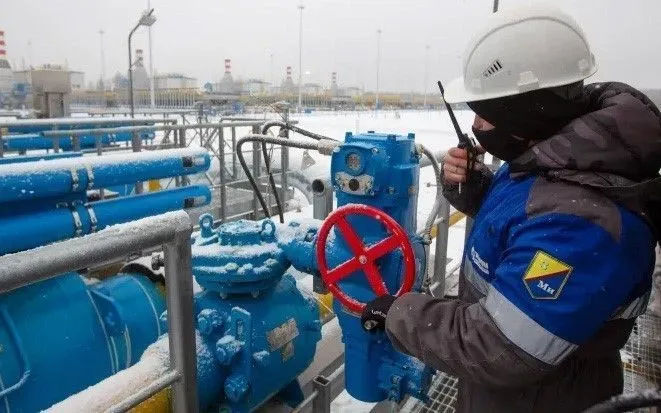
Workers adjust valves at the Slavyanskaya compressed air station on Gazprom's Nord Stream 2 gas pipeline in Ust-Luga, Russia. Photo: Getty Images/VNA
According to data from the European Statistical Agency (Eurostat), in the third quarter of 2025, European Union (EU) exports to Russia exceeded imports from Russia by 1.5 billion euros (1.76 billion USD). This marks the second consecutive quarter that the EU has achieved a trade surplus with Russia. Although the proportion of imports from Russia remains high in certain goods, overall, the "lost" supply from Russia is being replaced by goods from other countries.
Since the start of the Russia-Ukraine conflict in 2022, European exports to Russia have fallen by 61%, while exports to Russia have decreased by 89%, according to a new Eurostat report. From January to September 2025, bilateral trade fell by 12.9% year-on-year to €43.9 billion. EU imports from Russia during this period are estimated at €21.7 billion, while exports reached €22.2 billion.
In the third quarter, EU imports from Russia totaled €5.73 billion, while exports reached €7.25 billion. Compared to the previous quarter, these figures decreased by €1.4 billion and €0.3 billion respectively. As a result, the EU achieved a quarterly trade surplus of €1.5 billion with Russia. This marks the second consecutive quarter of a positive trade balance – something that hasn't happened since 2002, Eurostat noted.
Russia's share of natural gas imports in Europe in the third quarter was 15.1%, down from 39% four years earlier. Despite this, Russia remains the EU's second-largest gas supplier. However, the gap between Russia and the leading supplier, the US, has widened significantly. The US's share of EU supplies has increased from 24% to 56% in four years. The EU intends to completely phase out gas purchases from Russia as early as 2027.
Russia's share of European imports of petroleum products also continued to decline sharply, currently standing at 1.26% compared to 28.7% in Q3 2021. The lost supply is being offset by countries including the US (up from 8% to 14%), Norway (up from 8% to 12%), and Kazakhstan (up from 8% to 9%). Russia's share of nickel imports also decreased, estimated at 19.7% (42% in Q3 2021). The US remains the EU's main trading partner in this sector, with a 26% market share.
Russia's iron and steel supply to European countries continues to decline as planned by the EU. Currently, Russia's market share is just over 3%, down from 18.3% in 2021. While four years ago Russia was the main supplier in this sector, the leading countries now include China with 11% market share, Turkey (10%), South Korea and India (9% each).
The EU is preparing to gradually phase out fertilizer imports from Russia. Russia's share of fertilizer imports in Europe currently stands at 12.8%. For comparison, this figure was estimated at 25.8% at the beginning of this year, and 28.2% four years ago.
For European exports to Russia, only pharmaceuticals remain unaffected by the restrictions. Exports of this item reached €2.5 billion in the third quarter of 2025 (€1.9 billion in 2021 and €2.1 billion in 2022).
Source: https://vtv.vn/eu-giam-dan-nhap-khau-tu-nga-100251226102647421.htm



























































































Comment (0)