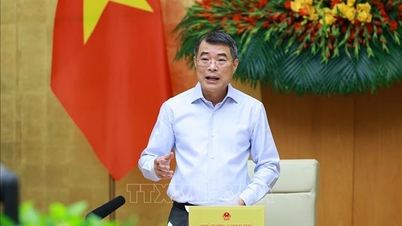
EC Vice President Virkkunen speaks to the press on June 3. Photo: AP
The European Commission (EC) has just announced the “Technology Sovereignty Package” to boost Europe’s domestic technology industry. Speaking to the press on June 3, EC Vice President Henna Virkkunen said the new EU initiative focuses on four priority areas: developing the semiconductor industry through the Chip 2.0 Act; promoting cloud computing and artificial intelligence (AI) infrastructure; strengthening the open-source software ecosystem; and accelerating digitalization and AI applications in the energy sector with the ultimate goal of reducing dependence on American and Chinese technology companies.
The new initiative centers on the proposed “Cloud Computing and AI Development Act” (CADA), aimed at promoting the development of European-owned cloud computing platforms and AI infrastructure. Brussels hopes the initiative will triple data center capacity within the next 5-7 years to meet the growing demands of the digital economy and AI applications, and commits to establishing a rating system to ensure their “sustainable” integration into the European energy system.
Notably, the new initiative proposes four levels of digital sovereignty that public authorities must consider when purchasing cloud computing services. Accordingly, the highest level, encompassing sectors such as defense and healthcare, would effectively prevent non-European companies from winning public contracts. The aim is to prevent an “emergency switchout” scenario – the risk of a foreign government cutting off access to hospitals or fighter jets.



"We are living in a world where geopolitics and technology are inseparable. Those who advocate for technological innovation will shape the future, and we must ensure that Europe plays a leading role in this," Ms. Virkkunen emphasized.
The aforementioned series of measures is expected to realize the ambition of transforming Europe into an "AI continent," strengthening digital autonomy and building a more sustainable digital future.
For a long time, the EU has imported most of its services and technology products from abroad. The continent's digital market is dominated by Chinese tech giants like Alibaba and ByteDance, as well as American tech giants like Google, Microsoft, and Apple, which account for 80% of the European market. According to a report by the French consulting firm Asteres, the EU is estimated to spend 264 billion euros annually on cloud computing software from the United States.
Although the increasing reliance on foreign technology has been a cause for concern among European policymakers for decades, the increasingly assertive trade policies of US President Donald Trump and China's willingness to weaponize that dependence are the impetus for the EU's announcement of the aforementioned technology sovereignty package.
However, will Brussels' move be enough to change the situation, given that the EU is lagging behind in building the necessary data centers to meet the demand for AI services in the coming years, mainly due to slow licensing, high energy costs, and scarce land? “Europe cannot escape its dependence on foreign technology by adjusting regulations. Therefore, Europe must build its own capacity, overcome one-sided dependence, and restore choice for both businesses and consumers,” said Matthias Ecke, a MEP from the German Social Democratic Party. Even so, Ecke predicts that US suppliers will still “dominate” despite the EU’s efforts.



TRI VAN (Compiled)
Source: https://baocantho.com.vn/eu-quyet-tu-chu-ve-cong-nghe-a206371.html

![[Photo] "Hanoi Lotus Festival" honors the lotus flower that has been associated with Vietnam for thousands of years.](https://vphoto.vietnam.vn/thumb/1200x675/vietnam/resource/IMAGE/2026/06/27/1782516943048_sen-ha-noi-2026-minh-duy-1-jpg.webp)