


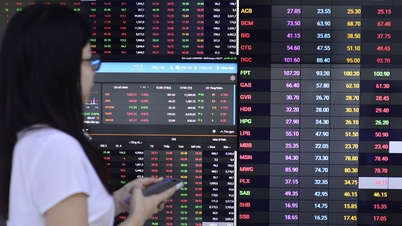
The majority of collateral held by banks is real estate - Photo: QUANG DINH
Land ownership certificate: The most common type of collateral at banks.
The Agricultural and Rural Development Bank ( Agribank ) recently released its consolidated financial report for 2024.
The report's explanatory notes indicate that the total value of collateral and pledged assets of customers at Agribank has nearly reached 3.19 million billion VND, an increase of over 9% compared to 2023.
Of that amount, real estate remains the primary collateral at this bank, reaching over 2.92 trillion VND, an increase of more than 10% compared to the end of the previous year. In addition, movable assets and securities account for 190,000 billion VND and 54,663 billion VND respectively.
In terms of total collateral value, Agribank still lags behind its two "siblings" in the Big4, BIDV and VietinBank.
At BIDV, the total value of assets, securities accepted as collateral, pledged, and discounted amounted to 3.32 million billion VND at the end of 2024. At Vietcombank, the figure was also quite high, reaching nearly 3.29 million billion VND.
However, if the collateral is real estate alone, no other bank has surpassed Agribank.
In total, the amount of real estate collateral held by customers at the 15 banks listed below reached nearly 15.54 million billion VND, accounting for a large portion of the total collateral assets.
Data: Audited consolidated financial statements 2024
A former deputy general director of a bank in Hanoi said that collateral assets at banks are quite diverse, ranging from factories and goods to savings accounts, stocks, hydroelectric power plants, imported liquor, and even… funeral homes.
However, the most popular asset used by banks has long been real estate. The advantage of this type of collateral is that it is not subject to damage or depreciation, and its value even increases over time.
According to this source, the value of collateral assets is always higher than the outstanding loan balance to mitigate risk. This explains why, at Agribank, the total outstanding loan balance to customers reached over 1.72 trillion VND at the end of 2024, but the amount of collateral in the form of real estate was significantly larger.
The resurgence of the real estate market will help improve liquidity.
Mr. Tran Tanh, an analyst at Yuanta Securities Vietnam, also stated that the majority of collateral assets held by banks are real estate. Therefore, a resurgence in the real estate market will help improve liquidity and facilitate the sale of collateral assets to resolve bad debts, thereby stabilizing asset quality.
According to Mr. Tanh, recent risks in the real estate market are the main reason why bank stocks are undervalued. Therefore, the expected recovery cycle of the real estate market will lead to higher valuations for bank stocks in 2025 as asset quality improves.
Regarding the issue of bad debt, in a recently published banking industry analysis report, MBS Securities' analysis team pointed out that the average bad debt ratio of listed banks (excluding Agribank) at the end of Q4 2024 decreased by 34 basis points compared to the previous quarter, down to 1.91%, after four consecutive quarters of increase.
In addition, the rate of non-performing loan formation decreased by 10.1% compared to the previous quarter. Meanwhile, the ratio of Group 2 loans (loans overdue from 10 to 90 days) also recorded its fourth consecutive quarterly decrease, falling to 1.6% in the fourth quarter of last year.
According to MBS, the boost in credit growth coupled with the proactive handling of bad debts by banks in the last quarter of last year contributed to improving the asset quality of the entire industry in 2024.
In addition, the loan loss coverage ratio (LLR) of listed banks improved, reaching 91.6% by the end of 2024 thanks to increased provisions and a reduction in the rate of non-performing loan formation.
However, speaking to Tuoi Tre Online , the leader of a credit rating company expressed concern that the capital adequacy ratio of Vietnamese banks remains low, averaging only 12.5% at the end of 2024. This level is lower compared to many countries in the region.
Moreover, this year, banks are under pressure to increase credit growth to support the economy, while also facing limitations in their ability to raise funds while maintaining low interest rates, and having to meet the ratio of short-term capital used for medium- and long-term lending.
According to this source, the slowdown in deposit growth over the past two months has put significant pressure on liquidity, forcing banks to increase equity capital and issue bonds to balance their funding sources.
Source: https://tuoitre.vn/gan-3-trieu-ti-dong-bat-dong-san-the-chap-loi-the-cua-agribank-trong-xu-ly-va-thu-hoi-no-xau-20250413210708329.htm


![[Photo] Prime Minister Pham Minh Chinh presides over the conference announcing the establishment of the International Finance Centre in Vietnam.](/_next/image?url=https%3A%2F%2Fvphoto.vietnam.vn%2Fthumb%2F1200x675%2Fvietnam%2Fresource%2FIMAGE%2F2025%2F12%2F21%2F1766309817714_ndo_br_dsc-3400-jpg.webp&w=3840&q=75)
![[Photo] Prime Minister Pham Minh Chinh presides over a meeting on private sector economic development.](/_next/image?url=https%3A%2F%2Fvphoto.vietnam.vn%2Fthumb%2F1200x675%2Fvietnam%2Fresource%2FIMAGE%2F2025%2F12%2F20%2F1766237501876_thiet-ke-chua-co-ten-40-png.webp&w=3840&q=75)


























































































Comment (0)