Narrowing the digital divide
For many years, hamlets 6 and 7 (Tra Leng commune) were classified as "three no's" (no roads, no electricity, no telecommunications signal), causing significant obstacles to people's lives. Implementing the policy of eliminating areas without signal coverage, MobiFone Da Nang has actively surveyed the terrain of hamlet 6 to deploy an optimal technical solution, ensuring stable coverage. The biggest advantage is that by the end of 2025, Da Nang Power Company will operate the power supply project at Ong Binh peak (hamlet 6), creating an important foundation for maintaining the sustainable operation of the mobile base station.
In mid-February 2026, the mobile phone base station in Hamlet 6 officially went into operation, much to the delight of the local people. Mr. Ho Van Khai, Head of Hamlet 6, shared that having telecommunication coverage helps 217 households communicate conveniently, easily access information and digital services. Hamlet officials can also promptly grasp policies and guidelines to disseminate to the people. Especially during the rainy season, information about the residents' situation can be quickly reported to the authorities, particularly when transportation is disrupted.
Mr. Chau Minh Nghia, Chairman of the People's Committee of Tra Leng commune, stated that extending mobile coverage to areas with no signal has significantly contributed to narrowing the digital divide between mountainous and urban areas. Currently, the local government is actively coordinating with telecommunications companies to accelerate the process of eliminating remaining areas with poor signal coverage in the commune.
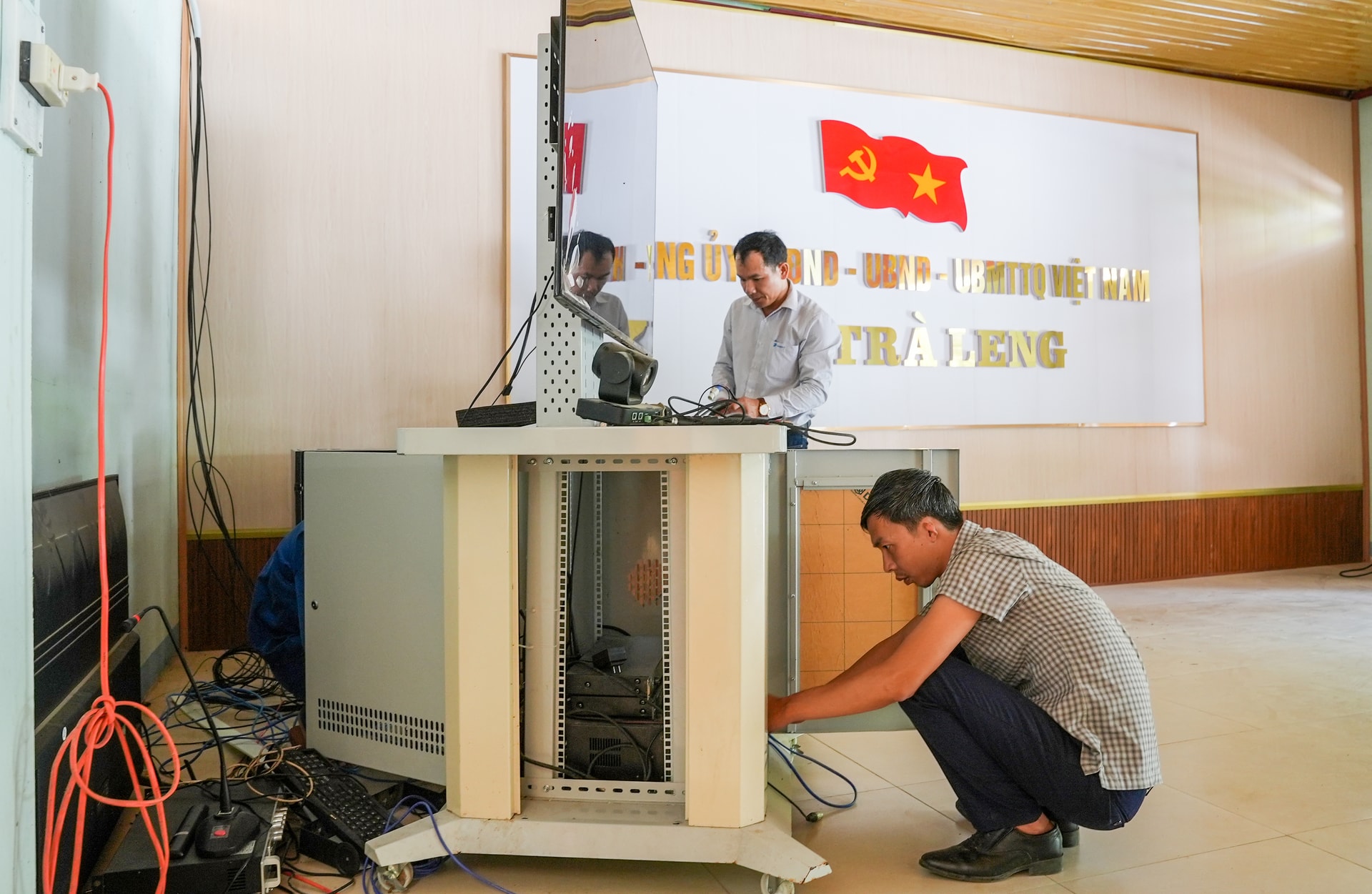
Besides disbursing city-allocated funds for infrastructure and equipment investment, the People's Committee of Tra Leng commune is promoting digital literacy among its residents. The core force implementing this task is the eight Community Digital Technology Teams. Mr. Nguyen Dinh Nghia, a member of the team, shared that because the digital skills of the people in the highlands are still limited, the team members have to go directly to each household to provide hands-on guidance, determined to ensure no one is left behind.


“We focus on guiding people to register for electronic identity accounts, use online public services, and verify subscriber information. At the same time, we introduce essential applications and information channels such as VNeID, Zalo OA, and social media pages of the government and commune police. The team also prioritizes supporting young people, intellectuals, and those who are tech-savvy to spread digital knowledge to their families and communities,” Mr. Nghia said.
Infrastructure investment
As of early July 2025, the entire city had 23 villages with no signal and 71 villages with poor signal coverage. After nearly a year of decisively implementing comprehensive solutions under the direction of the City People's Committee and the efforts of businesses, the number of areas with inadequate signal coverage has significantly decreased.
Currently, the city still has 8 villages and 13 residential clusters with poor signal coverage, including 2 villages and 7 residential clusters without electricity. These areas are mainly located in the western mountainous region with rugged terrain and difficult transportation. In addition, weak and intermittent signal still persists along the roads leading to villages or residential clusters far from the city center.
The city aims to fundamentally address areas with weak signal coverage by June 30, 2026. A representative from Viettel Da Nang stated that they will deploy Starlink satellite transmission infrastructure in challenging areas to improve coverage efficiency. For areas without grid electricity, the company plans to place base stations in densely populated residential areas, combining the use of generators or solar power to maintain connectivity.
According to the city's Department of Science and Technology, by 2026, the city aims to expand 5G coverage to over 90% of the existing 4G base station capacity. Simultaneously, the development of the Starlink satellite internet service will contribute to improving digital infrastructure capacity and enhancing connectivity, especially in areas where terrestrial transmission infrastructure is difficult to deploy.



According to Mr. Nguyen Thanh Hong, Director of the Department of Science and Technology, in 2026, the city will allocate 2 billion VND to each commune and ward to implement tasks related to science and technology, innovation, and digital transformation, with a total budget of 186 billion VND. This resource will help localities proactively choose content and methods of implementation suitable to their reality, while also investing in infrastructure and equipment to support the digitalization roadmap.
“Communes and wards need to effectively utilize funding to invest in information technology equipment, lease internet connections, and establish online systems. At the same time, the provision of computers and terminal equipment must adhere to the technical requirements and minimum configurations as guided by the Ministry of Science and Technology to ensure efficient work in the digital environment,” Mr. Hong emphasized.
Source: https://baodanang.vn/gan-hon-nho-ha-tang-so-3341258.html
![[Photo] "Hanoi Lotus Festival" honors the lotus flower that has been associated with Vietnam for thousands of years.](https://vphoto.vietnam.vn/thumb/1200x675/vietnam/resource/IMAGE/2026/06/27/1782516943048_sen-ha-noi-2026-minh-duy-1-jpg.webp)