

Why is the rate of stroke among young people increasing?
According to statistics, the Stroke Center receives an average of 50-60 severe and complex stroke cases per day, transferred from satellite hospitals due to the limitations of local facilities and the difficult prognosis.
Notably, strokes in younger people (45 years old and under) have tended to increase in recent years, accounting for approximately 15% of the total cases received by the Center.
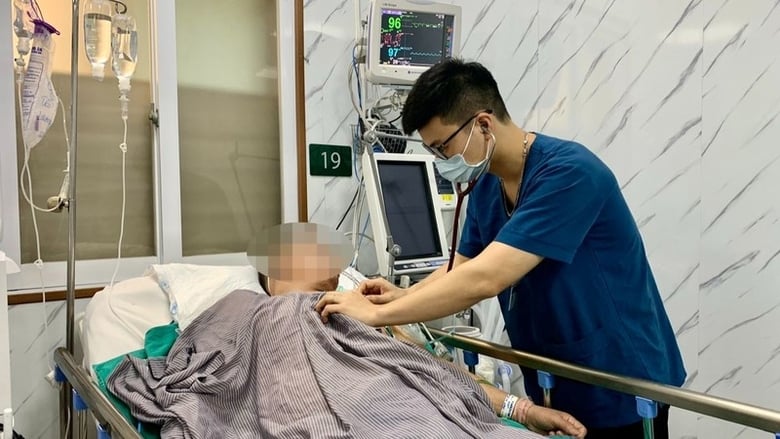
Dr. Nguyen Tien Dung, Specialist II, Stroke Center, Bach Mai Hospital, examines a patient.
According to Dr. Nguyen Tien Dung, a specialist at the Stroke Center of Bach Mai Hospital, the rate of severe stroke patients and their age has tended to increase recently. Up to 70% of stroke patients experience impaired ability to work.
A 32-year-old female patient from Hung Yen province was admitted to the hospital with symptoms of complete left-sided hemiplegia and slurred speech within the first hour. She was diagnosed with acute ischemic stroke due to right internal carotid artery occlusion within the first hour. Within just 35 minutes of admission (the second hour of the illness), the patient received thrombolytic therapy. The interventional team at the Radiology Center successfully recanalized the artery at TICI 2c using intracranial stent placement and Solumbra.
The center recently admitted a 43-year-old patient from Lac Thuy, Hoa Binh province , who had underlying health conditions but was unaware of them due to not having undergone a health check-up previously. Diagnosis revealed acute cerebral infarction due to basilar artery occlusion. This is a large cerebral artery that supplies a vital central region of the brain. The patient was fortunate to be diagnosed and brought to the hospital within the golden hour.
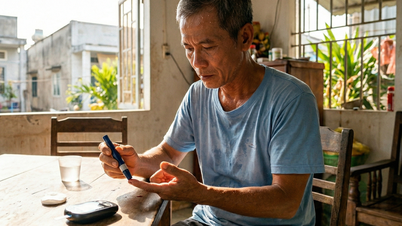
However, not every case is fortunate enough to arrive at the hospital during the critical "golden hour" for emergency care. Recently, there was a case of a young patient with a history of high blood pressure for many years, but who did not receive treatment or take medication because they felt completely normal. By the time the patient suffered a stroke and arrived at the emergency room, it was too late; the patient required mechanical ventilation and suffered from hemiplegia with little chance of recovery.
"Notably, the center has received stroke patients who are very young, only 15-16 years old, and in some cases, even 6-year-olds have suffered strokes. These patients were admitted to the emergency room with cerebral hemorrhage due to arteriovenous malformations. After being stabilized, they were transferred to the pediatric intensive care unit, where the prognosis is difficult," Dr. Dung said.
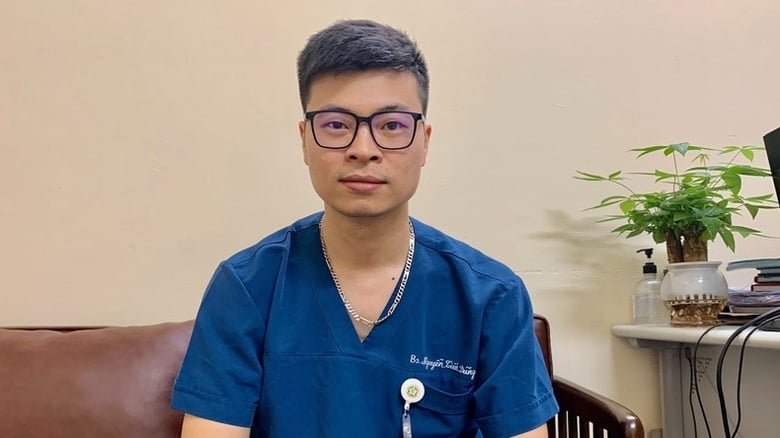
Dr. Nguyen Tien Dung, Specialist II, Stroke Center, Bach Mai Hospital.
According to this expert, risk factors that increase the risk of stroke in young people include: abuse of stimulants such as alcohol, tobacco, and e-cigarettes; being overweight or obese, lack of physical activity; lack of clear awareness of health protection; and a relatively stressful social life, with pressure and tension in life and work.
"Young people often underestimate or rarely monitor their blood pressure, thinking that because they are young they have good tolerance. Besides that, many are inactive, overweight, obese, unwilling to exercise, or eat fast food, stay up late, and experience work stress – all risk factors that are often overlooked."
"In particular, many people think they are young and healthy, so they don't get health checkups. Only when they have a stroke and are hospitalized do they discover they have underlying conditions such as high blood pressure and cardiovascular disease... If these underlying conditions are not detected early, examined, and treated properly, they will eventually flare up and, combined with other factors, lead to a stroke," Dr. Dung warned.
Early detection of stroke signs
Stroke has two forms: ischemic stroke and hemorrhagic stroke. Ischemic stroke occurs when a blood vessel is blocked by a blood clot, preventing the flow of oxygen and nutrients to the corresponding brain cells. These brain cells die, leading to the loss of functions such as motor control, cognition, learning, and language.
Brain hemorrhage occurs when a blood vessel in the brain ruptures, which can be caused by cerebral vascular malformations (common in young people) and by hypertension that is not regularly or properly treated.
"In young people, the most common causes of cerebral hemorrhage are cerebral arteriovenous malformations and cerebral aneurysms. In clinical practice, the majority of strokes are ischemic strokes, accounting for nearly 80%, and hemorrhagic strokes account for about 20%," Dr. Dung said.
Young people who suffer a stroke and do not receive emergency care within the "golden hour" (the first 4.5 hours after stroke symptoms appear), or who are diagnosed and treated late, have very difficult chances of recovery. Many become disabled, affecting themselves due to the loss of the ability to care for themselves, and in more severe cases, losing their ability to work, becoming a burden on their families and society.
With stroke, the most important thing is recognizing the early signs.
The first sign is the letter F (face). Looking at the patient's face, if the corners of the mouth (mouth corners) are crooked or droopy when the patient speaks or smiles, or if there is water dripping when drinking, then a stroke should be suspected.
Secondly, the letter A (in the right or left arm or leg) is weak, paralyzed, or numb.
Thirdly, there's the letter S (language, speech), which means it's more difficult than usual to speak, speech difficulties, or the inability to speak at all.
These are three typical and very common signs; when these signs appear, you should immediately consider the possibility of a stroke.
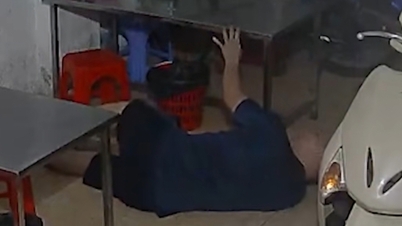
If the patient exhibits these three signs, family members should not hesitate. Some folk remedies such as applying lime to the palms and soles of the feet, pricking the earlobes, drawing blood from the fingertips and toes, or lying immobile and monitoring at home are all incorrect actions that can harm the patient and hinder the doctor's treatment process. Call an ambulance to take the patient to the nearest medical facility capable of treating stroke as soon as possible to maximize the chances of recovery.
To prevent stroke, people must know how to recognize stroke symptoms, pay attention to their bodies, remember stroke signs, and if they suspect they are having a stroke, they must go to the hospital immediately.
"Young people should balance their lives, increase physical activity, maintain an ideal weight, avoid stimulants and e-cigarettes, and have regular health checkups to detect any illnesses early so that they can have an optimal treatment plan. If they have underlying conditions, they should have regular checkups so that doctors can adjust medication dosages to achieve treatment goals, especially if the patient has previously had a stroke," said Dr. Dung.
Source



![[Photo] National Assembly Chairman Tran Thanh Man attends the policy seminar to promote Vietnam-Türkiye cooperation.](https://vphoto.vietnam.vn/thumb/1200x675/vietnam/resource/IMAGE/2026/04/16/1776351415367_vna-potal-chu-tich-quoc-hoi-tran-thanh-man-du-toa-dam-chinh-sach-thuc-day-hop-tac-viet-nam-tho-nhi-ky-8705791-jpg.webp)





















![[Image] Bridges and roads connecting the eastern part of Ho Chi Minh City](https://vphoto.vietnam.vn/thumb/1200x675/vietnam/resource/IMAGE/2026/04/16/1776328595108_ndo_br_bh-vt5-jpg.webp)






























![[Infographic] Details of the Hanoi-Quang Ninh High-Speed Railway Project](https://vphoto.vietnam.vn/thumb/402x226/vietnam/resource/IMAGE/2026/04/16/1776338188424_anh-man-hinh-2026-04-16-luc-18-16-10.png)

![[Photo] National Assembly Chairman Tran Thanh Man meets with the Speaker of the Georgian Parliament](https://vphoto.vietnam.vn/thumb/402x226/vietnam/resource/IMAGE/2026/04/16/1776338494029_anh-man-hinh-2026-04-16-luc-18-21-21.png)

























Comment (0)