

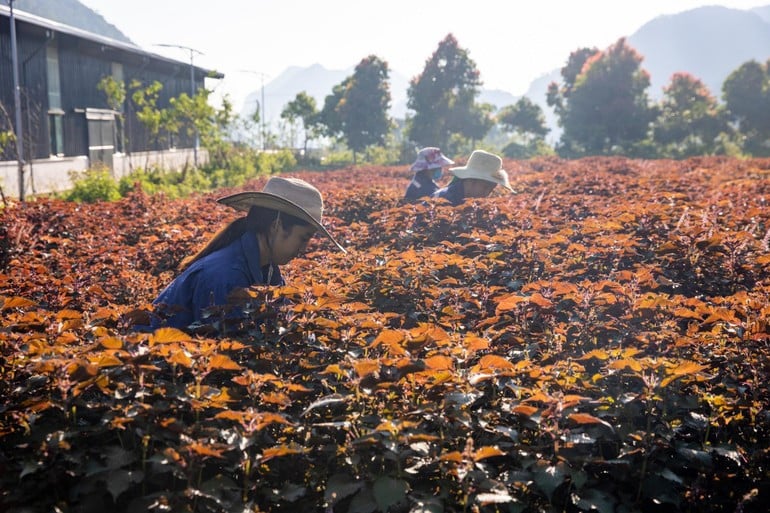
The Euphorbia hirta (or Euphorbia triangularis) has over 370 species widely distributed in tropical and subtropical regions worldwide ; among them, many Euphorbia species have medicinal value, notably with anti-inflammatory, antibacterial, and cytotoxic activities against cancer cells. In Vietnam, 12 species have been recorded, including the three-leaved Euphorbia hirta, which commonly grows in the rivers and canals of Southern Vietnam and can be used to prepare anti-inflammatory preparations.
Combretum is the largest genus in the family Combretaceae, consisting of trees and shrubs. Currently, many species of Combretum exist in Vietnam, but only five are traditionally used to improve health and treat liver, stomach, and jaundice conditions.
Dr. Nguyen Tan Phat and scientists at the Institute of Advanced Technology, Vietnam Academy of Science and Technology (Academy) have successfully completed the research project "Study on the chemical composition and creation of anti-inflammatory preparations from the three-leaved Combretum (Combretum trifoliatum)" (project code: VAST04.08/23-24). During the research process, Dr. Nguyen Tan Phat and his colleagues conducted in-depth analysis of the chemical composition and evaluated the anti-inflammatory activity of this plant; they also developed a process for isolating and purifying 25 valuable compounds.
The Euphorbia hirta (or Euphorbia triangularis) has over 370 species widely distributed in tropical and subtropical regions worldwide; among them, many Euphorbia species have medicinal value, notably with anti-inflammatory, antibacterial, and cytotoxic activities against cancer cells. In Vietnam, 12 species have been recorded, including the three-leaved Euphorbia hirta, which commonly grows in the rivers and canals of Southern Vietnam and can be used to prepare anti-inflammatory preparations.
The team also discovered two new saponin compounds, comtrifoside A and comtrifoside B, in the leaves. These are triterpenoid compounds, known for their numerous biological effects such as anti-inflammatory, antioxidant, liver-protective, and potential anticancer properties.
In addition, nine compounds were discovered for the first time in the genus Combretum and 14 compounds were isolated for the first time from the species C. trifoliatum, enriching the natural botanical resources of Vietnam. Scientists focused on studying the composition and anti-inflammatory activity through the inhibition of nitric oxide (NO) production of extracts and compounds isolated from the leaves of the three-leaved Combretum plant.
According to Dr. Nguyen Tan Phat, inflammation is a natural protective response and also the first line of defense of the immune system. It is a common, dynamic process in the body, playing a crucial role in maintaining homeostasis and tissue repair. However, many studies have shown that when inflammation becomes chronic, it can disrupt the function of cells, tissues, or organs, while increasing the risk of acute vascular events and many serious diseases such as chronic inflammatory bowel disease, obesity, diabetes, or cancer.
Based on this, the research team tested the anti-inflammatory activity of extracts from the leaves of the three-leaved Euphorbia hirta, through their ability to inhibit nitric oxide production in RAW264.7 macrophages. The results showed that several extract fractions, especially the saponin-rich extract CTE.1, exhibited significant effects (with an IC50 of only 46.39 µg/mL). Among the 12 purified compounds investigated, many compounds such as ursolic acid, pomolic acid, uncaric acid, belleric acid, etc., all demonstrated clear anti-inflammatory effects.
This research topic has contributed to the body of research on natural compounds with biological activity.
Dr. Bui Dinh Thach, Member of the Project Acceptance Council
Academy
In the future, the research team will continue to focus on studying the stem and fruit parts of this three-leaved Eugenia species; at the same time, they will conduct in-depth research to determine the anti-inflammatory mechanism through the inhibition of nuclear factor KB (NF-KB), inducible nitric oxide synthase (iNOS) genes, etc. Previously, scientists also successfully prepared an anti-inflammatory preparation from the leaves of the three-leaved Eugenia.
Evaluating the research results of the research team, Dr. Bui Dinh Thach, a member of the research project acceptance council of the Academy of Sciences, stated: The research project has contributed to the research treasury of natural compounds with biological activity. Specifically, the research team isolated and purified 25 compounds from n-hexane extract, EtOAc extract, MeOH extract, and 75% MeOH from the leaves of the three-leaved Eugenia; thereby creating a scientific basis for promoting the development of herbal products to serve the management, use, and effective utilization of available local raw materials, contributing to local economic development.
Source: https://nhandan.vn/giai-phap-khang-viem-tu-thao-duoc-post928520.html
![[Photo] General Secretary and President To Lam meets with National Assembly delegates from ethnic minorities.](https://vphoto.vietnam.vn/thumb/1200x675/vietnam/resource/IMAGE/2026/04/20/1776696701056_a1-bnd-8331-3342-jpg.webp)


![[Image] National Assembly discusses the implementation of the socio-economic development plan.](https://vphoto.vietnam.vn/thumb/1200x675/vietnam/resource/IMAGE/2026/04/20/1776696707422_ndo_br_img-20260420-185419-jpg.webp)












































































Comment (0)