

Mr. TRAN VAN QUANG, Director of the Department of Natural Resources and Environment, answers an interview.
Currently, within the province, there are 66 approved quarries for leveling materials included in the 2021-2030 planning period, with a total area of 948.11 hectares and a total estimated resource of 50.715 million m³ , of which land managed by households accounts for approximately 85%.
 |
- Sir, could you please tell us about the current situation regarding the planning and licensing of quarries for earth fill materials in Quang Tri province?
Currently, within the province, there are 66 approved quarries for leveling materials included in the 2021-2030 planning period, with a total area of 948.11 hectares and a total estimated resource of 50.715 million m³ , of which land managed by households accounts for approximately 85%.
In 2022, the Department of Natural Resources and Environment presided over and organized the auction of 27 quarries for landfill materials, with 16 quarries successfully bid on. To date, 10 quarries (out of a total of 16) that successfully bid for landfill materials (with an estimated resource of approximately 11.845 million m³ ) have submitted complete applications for exploration permits to the Department of Natural Resources and Environment.
On May 31, 2023, the Provincial People's Committee issued Decision No. 1118/QD-UBND granting a mining license for the Hai Le 1 soil mine to Toan Thinh Quang Tri One-Member Limited Liability Company with an exploitable reserve of 2.712 million m³ .
On October 4, 2023, the Provincial People's Committee issued Decision No. 2261/QD-UBND granting a mining license for the Vinh Ha 3 soil mine to Quy Hoai One-Member Limited Liability Company with an exploitable reserve of 0.194 million m³ ; for the Vinh Long (reserve 1.937 million m³ ), Trieu Thuong (reserve 4.467 million m³ ), Hai Le 4 (reserve 3.412 million m³), Vinh Thuy 1 (reserve 0.576 million m³ ), and Vinh Son 6 (reserve 0.385 million m³ ) soil mines, the investors are currently revising and supplementing the mining license application dossiers. The Dong Luong (2.01 million m³ ) and Km 6 Hung Vuong Extended (5,228,298 m³ ) earth mines have had their mineral exploration reserves approved by the Provincial People's Committee. They are currently requesting investment approval and are coordinating with relevant departments and localities to review the area and land use plan; prepare mine designs, environmental impact assessment documents, and reforestation plans. The Hai Lam earth mine (with reserves of approximately 1.8 million m³ ) is currently undergoing exploration.
Currently, the source of soil for backfilling in the province is mobilized from three sources. These include: approximately 6.31 million m³ of soil from six licensed mines, of which about 353,248 m³ have been extracted; approximately 14.44 million m³ of soil recovered from dredging 27 irrigation reservoirs, of which nearly 1.773 million m³ have been dredged and recovered for backfilling purposes; dredging units are currently storing approximately 289,000 m³ of soil, which can be immediately supplied for backfilling; and approximately 1.009 million m³ of surplus soil from the balance of excavation and embankment work in 10 projects.
According to calculations, the total volume of soil from the 6 licensed mines, recovered from lake dredging, and from the balance of excavation and embankment is approximately 21.76 million m³ . The annual mobilization capacity is approximately 6.1 million m³ of soil for leveling (of which: 0.54 million m³ from the 6 licensed mines, 4.76 million m³ from lake dredging, and the remainder from the balance of excavation and embankment).
Upon review, the total demand for 2023 is approximately 4.22 million m³ , but only 0.83 million m³ of soil for backfilling can be supplied immediately. In early 2024, with the licensing of the Hai Le 4, Vinh Son 6, Vinh Thuy 1, Vinh Long, and Trieu Thuong mines, excluding the dredging of the lakebed and the balancing of excavation and embankment, the available soil supply from the 11 licensed mines will be 1.371 million m³ .

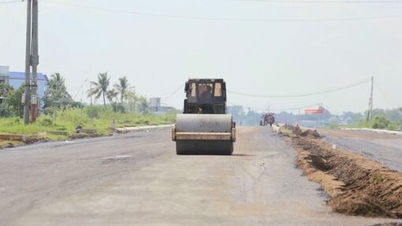
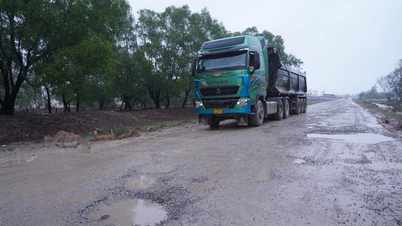
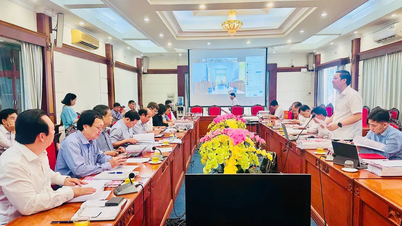
Rational planning of soil mines to create a source of soil for leveling materials serving key projects in the province - Photo: HNK
To date, the department has received, reviewed, and assessed two applications for the exploitation of soil mines to serve the construction of the Van Ninh-Cam Lo section of the expressway, submitted to the Provincial People's Committee by representatives of the construction contractors. Specifically, the Linh Truong 3 soil mine has an area of 5.53 hectares and an allowable soil reserve of 700,000 m³ , while the Vinh Son 5 soil mine has an area of 3.52 hectares and a reserve of 270,000 m³ .
- It is known that the capacity for mobilizing soil for leveling materials in one year is approximately 6.1 million m³ , and a review of the total demand for 2023 shows it to be around 4.22 million m³ , but currently only 0.83 million m³ can be supplied immediately, with an estimated 1.371 million m³ for 2024. Therefore, could you please explain the difficulties and obstacles in ensuring a sufficient supply of soil for leveling materials?
- Currently, the legal regulations on minerals still have many overlapping points, with content found in many different sectors, causing difficulties in the implementation of state management; especially the issue of classifying land used for common construction materials as "minerals," thus requiring licensing under the Mineral Law.
For example, some businesses won bids for land mines intended for leveling materials (in some cases, the price increased 31 times compared to the starting price) but did not submit applications for exploration and exploitation. After winning the bids for these mines, the investors had to prepare documents and submit them for appraisal and approval according to administrative procedures regarding: exploration, reserve approval, investment policy approval, land use change and reforestation, environmental impact assessment, technical design and construction drawing appraisal, exploitation permits, and land allocation/lease for project implementation, with a total time of more than 15 months, involving many departments, agencies, and localities.
Most importantly, investors need to proactively prepare and complete all necessary documents. Furthermore, relevant departments, agencies, and localities need to actively coordinate in reviewing and evaluating documents and procedures, and provide support for land clearance. In addition to completing the required documents and procedures, investors are facing significant difficulties in paying the winning bid amount before receiving a mining license.
Currently, the planned mining areas mainly consist of agricultural land already allocated to local people, with existing assets, trees, and crops. Meanwhile, according to the Land Law and its implementing regulations, mining projects are not subject to land expropriation; compensation is based on negotiation (assets on the land are under the ownership of households and individuals). Therefore, compensation and land clearance after winning the auction face many difficulties.
In the past, investors have not been very proactive in coordinating with material quarry owners (or units whose dredged material can be used as backfill material) in the process of supplying backfill materials for construction projects.
Price competition is one of the key factors influencing investors' decisions regarding the selection of landfill material suppliers. Some quarries stop at the stage of submitting bids for appraisal due to financial difficulties faced by the investors. Another difficulty is that households and individuals are only permitted to explore and exploit land for landfill purposes on a maximum of 1 hectare and a maximum of 3,000 m³ /year.
- To address the difficulties in securing land for leveling materials to meet the construction needs of many key projects in the province, could you please tell us what basic and key solutions the Department of Natural Resources and Environment has implemented?
- In order to promptly meet the demand for land for leveling materials for projects that the province has implemented, is implementing, and will implement from now until 2025, and to ensure the timely implementation of key projects and medium-term public investment projects in accordance with the law, it is essential to propose to the Provincial People's Council and the Provincial People's Committee several solutions to remove obstacles in the process of licensing the exploitation and use of land for leveling materials in the province. The proposed solutions must ensure a balance between socio -economic development and the interests of the people and businesses.
Therefore, the Department of Natural Resources and Environment proposed to the Provincial People's Committee, and reported to the Party Committee of the Provincial People's Committee to seek the opinion of the Standing Committee of the Provincial Party Committee, two solutions:
Firstly, designate areas where land leveling quarries will not be auctioned for projects serving transportation infrastructure development, irrigation and hydropower projects; disaster relief; and new rural construction in the province; in accordance with the provisions of Article 22 of Government Decree No. 158/2016/ND-CP dated November 29, 2016; and Articles 78 and 82 of the 2010 Mineral Law.
Secondly, it allows for the improvement of residential land, agricultural land, and the utilization of land as leveling material; this solution is consistent with the provisions of Articles 9, 166, and 170 of the 2013 Land Law, the 2010 Mineral Law, and the 2020 Environmental Protection Law.
To arrive at these two fundamental solutions, we conducted a very careful survey and review of land resources and the current state of land exploitation and use in the province; we also scientifically and rationally investigated and analyzed the shortcomings and problems in state management regarding the licensing and exploitation of land for leveling materials.
In particular, these solutions closely adhere to the provisions of the 2010 Mineral Law, the 2013 Land Law, and the 2020 Environmental Protection Law. Therefore, we expect that if these two solutions are approved by the Provincial Party Standing Committee, they will fundamentally address the current shortage of land for leveling materials serving investment projects in Quang Tri province.
Thank you very much, sir!
Ho Nguyen Kha (compiled)
Source
![[Photo] Closing Ceremony of the 15th Conference of the Central Committee of the 13th Party Congress](/_next/image?url=https%3A%2F%2Fvphoto.vietnam.vn%2Fthumb%2F1200x675%2Fvietnam%2Fresource%2FIMAGE%2F2025%2F12%2F23%2F1766462841764_a1-bnd-3731-1647-jpg.webp&w=3840&q=75)


































































Comment (0)