

 - Lang Son possesses a diverse range of folk songs and dances of ethnic minorities, which have been passed down to the present day. Over time, the provincial authorities and local governments have been actively preserving, protecting, and promoting these values so that folk songs and dances can increasingly assert their vitality in modern society.
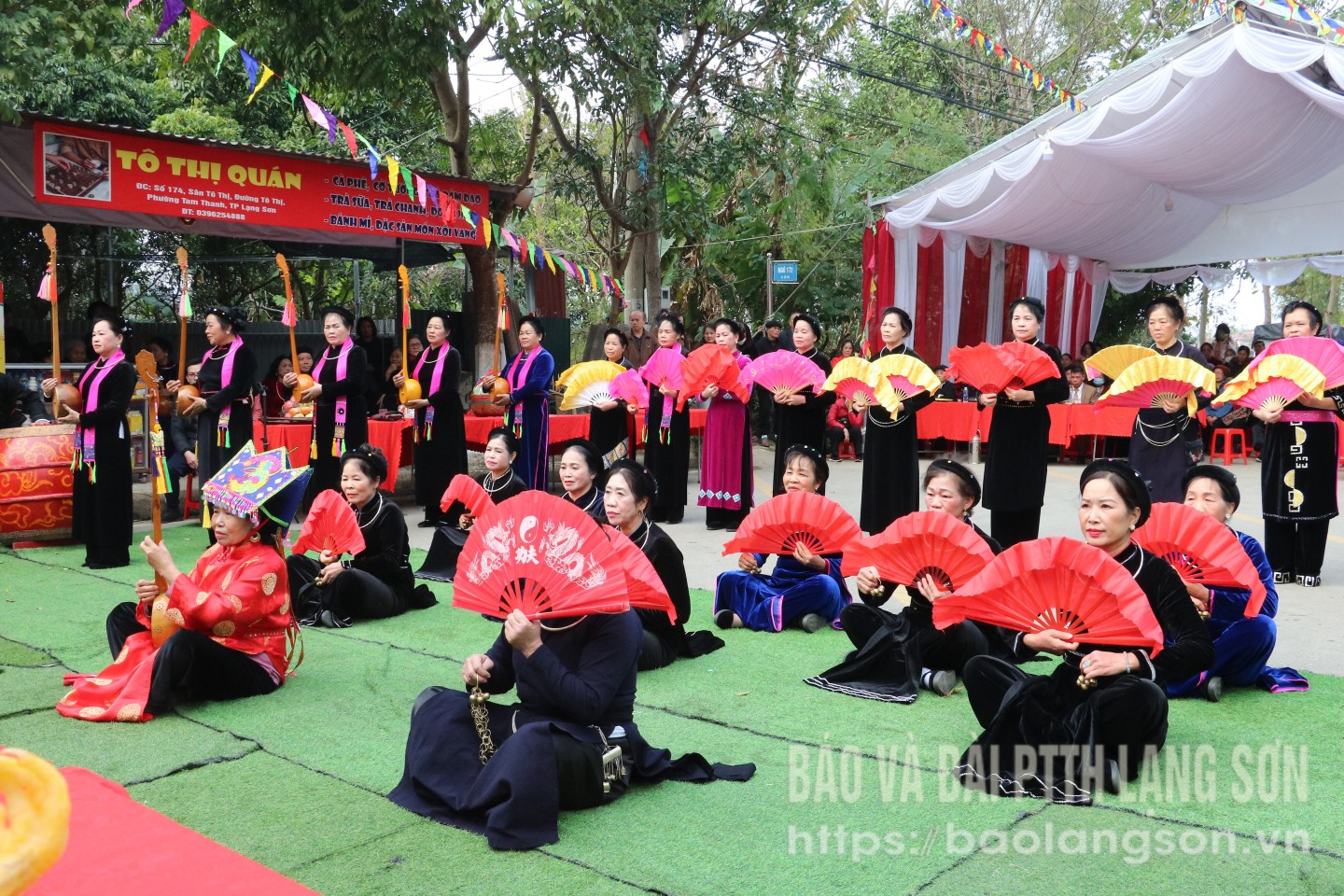
Folk songs and folk dances are both traditional art forms, deeply rooted in the cultural identity of a community, but differ in their forms of expression. Folk songs are traditional songs and melodies, while folk dances are dances and movements passed down through generations. These are considered valuable cultural heritages, creating the value and identity of each ethnic group in Lang Son, reflecting the creativity of the community in building their lives and cultivating spiritual values over many generations.
A distinctive flow of traditional culture.
In Lang Son, a land where many ethnic groups and long-standing cultural identities converge, folk songs and dances have become deeply ingrained in daily life, becoming a unique "spiritual nourishment" in rituals and everyday activities. Typical examples include the Then singing and Tinh playing, the lion dance of the Tay and Nung people; and the Pao Dung singing of the Dao people... Through ups and downs, these songs and dances not only reflect the thoughts and feelings of the people but also serve as a mirror reflecting the history of this culturally rich land of Lang Son.
The "then" ritual of the Tay and Nung people of Lang Son province is a comprehensive form of folk performance that serves both the spiritual life and artistic needs of the people in the province. Currently, the province has more than 600 then practitioners, including 34 who have been awarded the titles of People's Artist and Distinguished Artist, in two categories: social customs and beliefs; and folk performance art. With its unique artistic values, then has contributed to nurturing the soul, emotions, will, and aspirations for a prosperous and happy life of the Tay and Nung ethnic groups, passed down from generation to generation.
Distinguished artisan Be Thi Van, from Na Van village, Tri Phuong commune, Trang Dinh district, who has practiced ancient then singing for over 70 years, shared: "One of the unique features of then singing is its language, which is imbued with profound cultural depth. The content of then songs reflects deep humanistic ideas, containing love for nature, love between couples, marital devotion, moral teachings, and praise for villages and homelands..."
Unlike Then singing, Sli singing is closely associated with the daily celebrations and productive work of the Nung ethnic group. "Sli" in the Nung language means "poetry," and Sli singing is a form of courtship singing expressed through verses, performed in a call-and-response style between male and female pairs. Generally, Sli has three basic styles: spoken singing (reciting poetry); chanting Sli (reciting poetry); and raising the pitch of Sli or rising the pitch. In Lang Son today, popular Sli melodies include Nung Chao's Sli Slinh Lang, Nung Phan Slinh's Sli Sloong Hao, Nung Inh's Sli Inh, and Nung An's Heo Phun. In 2019, the Nung people's sli singing in Lang Son province was included in the National List of Intangible Cultural Heritage according to Decision No. 2966/QD-BVHTTDL of the Ministry of Culture, Sports and Tourism. Currently, at Ky Lua markets and during every festival, the melodies of sli still resonate among folk music lovers amidst the bustling urban life in the heart of Lang Son city.
Continuing amidst the rhythm of modern life
Faced with the risk of decline due to rapid urbanization and the dominance of modern audiovisual culture, the Department of Culture, Sports and Tourism of the province has implemented many positive solutions to preserve and promote the value of traditional folk songs and dances.
Mr. Luu Ba Mac, Deputy Director of the Department of Culture, Sports and Tourism, said: Based on closely following the directives from the central and provincial authorities, we have been actively implementing many measures such as: promoting propaganda and training; reviewing, inventorying, and compiling a list of folk songs, folk dances, and folk music of ethnic minorities; researching and building a database on intangible cultural heritage of ethnic minorities…; using the cultural heritage of ethnic groups, especially folk songs and folk dances, as a foundation and driving force for tourism development; strengthening the organization of cultural and tourism programs and events on the occasion of major holidays of the province and the country, prioritizing the performance of sli and then singing and showcasing the heritage of ethnic minorities in the province...
Accordingly, from 2016 to the present, the Department of Culture, Sports and Tourism has chaired and coordinated with the People's Committees of districts and cities to organize training courses on the dissemination and implementation of the Law on Cultural Heritage and related documents in all 11 districts and cities, reaching thousands of people. In addition, implementing Project 6 under the National Target Program for socio-economic development of ethnic minority and mountainous areas in the period 2021-2030, from 2022 to the present, the Department of Culture, Sports and Tourism has actively coordinated with relevant agencies and the governments of districts and cities to implement several sub-projects. Furthermore, over 12 folk art clubs have been established in the province, following the model of ethnic folk cultural activities, teaching knowledge and practicing performances of various forms of folk cultural activities... contributing to enriching the cultural and artistic activities of the people in districts and cities throughout the province.
Furthermore, in recent years, folk songs, folk dances, and folk games have been used as materials for staging and creating professional artistic performances. Accordingly, the directors and choreographers of the Provincial Ethnic Arts Troupe have spent a lot of time going on field trips to ethnic minority villages to research and collect unique traditional folk songs, folk music, folk dances, and characteristic festivals, creating a foundation for the creation of professional artistic performances.
A prime example is the "grass-grazing" dance performance, featuring graceful Nung boys and girls from Lang Son participating in a traditional folk game, which was well-received by audiences at the Hang Po festival in Thien Thuat commune, Binh Gia district in May 2024. The performance depicted the affection between a Nung couple, reflecting the daily life of working people and helping the public, especially the younger generation, to better understand the culture of the Nung Phan Slinh ethnic group.
Ms. Hoang Thi Ha, Head of the Provincial Ethnic Arts Troupe, said: "We have been focusing on training and improving the professional capacity of our artists and performers; concentrating on researching and collecting materials on traditional folk art forms of ethnic groups in the province to incorporate into the creation and choreography of artistic works that are rich in national identity. At the same time, we are constantly innovating and creating new artistic works that harmoniously combine tradition and modernity, meeting the increasingly sophisticated tastes of the audience."
The journey of preserving Lang Son's cultural heritage, including folk songs and dances, is not just about preserving an art form, but more profoundly, about preserving community memory, national identity, and the cultural pride of a region. In the ever-changing flow of time, the revival and strong spread of these folk values is vivid evidence of the vibrant life of cultural heritage, because "as long as culture exists, the nation exists."
Source: https://baolangson.vn/suc-song-di-san-giua-nhip-song-hien-dai-5049174.html


![[Image] Spectacular performances at the Light Concert celebrating the New Year 2026](/_next/image?url=https%3A%2F%2Fvphoto.vietnam.vn%2Fthumb%2F1200x675%2Fvietnam%2Fresource%2FIMAGE%2F2026%2F02%2F01%2F1769901942536_image.jpeg&w=3840&q=75)


![[Image] Spectacular performances at the Light Concert celebrating the New Year 2026](/_next/image?url=https%3A%2F%2Fvphoto.vietnam.vn%2Fthumb%2F402x226%2Fvietnam%2Fresource%2FIMAGE%2F2026%2F02%2F01%2F1769901942536_image.jpeg&w=3840&q=75)


![OCOP during Tet season: [Part 3] Ultra-thin rice paper takes off.](/_next/image?url=https%3A%2F%2Fvphoto.vietnam.vn%2Fthumb%2F402x226%2Fvietnam%2Fresource%2FIMAGE%2F2026%2F01%2F28%2F1769562783429_004-194121_651-081010.jpeg&w=3840&q=75)


![OCOP during Tet season: [Part 2] Hoa Thanh incense village glows red.](/_next/image?url=https%3A%2F%2Fvphoto.vietnam.vn%2Fthumb%2F402x226%2Fvietnam%2Fresource%2FIMAGE%2F2026%2F01%2F27%2F1769480573807_505139049_683408031333867_2820052735775418136_n-180643_808-092229.jpeg&w=3840&q=75)




Comment (0)