

VHO - In Quang Ngai, there are many royal decrees from feudal dynasties that have been preserved by generations of people. Royal decrees are a special type of administrative document, granted by the king to human deities, celestial beings, or individuals who have made great contributions to the country.
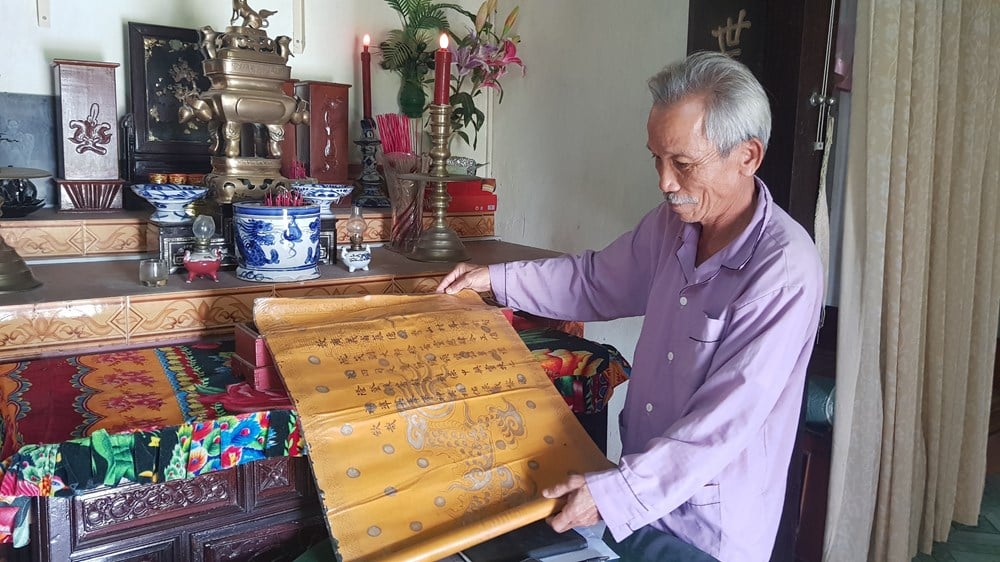
Currently, many royal decrees from feudal dynasties have been preserved by generations of people for hundreds of years. These decrees are stored in many ancestral temples, mausoleums, shrines, and pagodas throughout the province. Of concern is that many of these decrees are showing signs of damage due to unscientific preservation methods. The preservation of these decrees varies from place to place.
In the ancestral temple of Tran Van Dat, in Phuoc Xa village, Duc Hoa commune (Mo Duc district), there is currently a royal decree dated July 25th, the 9th year of Khai Dinh (1924), bestowing upon Mr. Tran Van Dat (who contributed to the reclamation and establishment of Van Phuoc village in the 15th century) the title of "Duc Bao Trung Hung Linh Phu Ton Than".
This royal decree was wrapped in traditional Vietnamese paper by the descendants of the Trần family, the founding ancestors of the Six Villages of Vạn Phước, and preserved in a wooden box. This box containing the royal decree is placed solemnly on the altar and is worshipped with incense and offerings year-round.
For a full hundred years, through many ups and downs, this imperial decree has retained its original lettering. However, the red color of the seal has faded, and in some places, such as the left corner and along the edges of the decree, there are signs of deterioration and tearing.
Meanwhile, in Tu Son village, Duc Lan commune (Mo Duc district), the royal decree bestowed by King Khai Dinh upon the village's founding ancestor, Mr. Nguyen Mau Pho (who contributed to conquering and reclaiming the Tu Son wilderness into fertile fields in the 17th century), has been entrusted to the Nguyen Mau family for safekeeping.
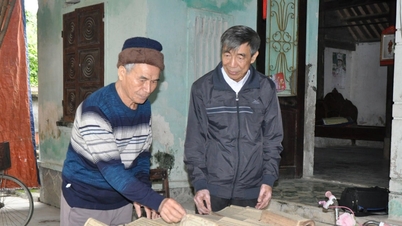
Considering the royal decree as a treasure, every five years the clan organizes an election to choose a "royal decree keeper" who is responsible for safekeeping and worshipping the decree at their private residence.
Every year, on the 2nd day of the 2nd lunar month, the family organizes a ceremony to carry the imperial decree from the home of the current decree holder to the Nguyen Mau ancestral temple for worship. After the ceremony, the decree is returned to the residence of the decree holder for safekeeping.
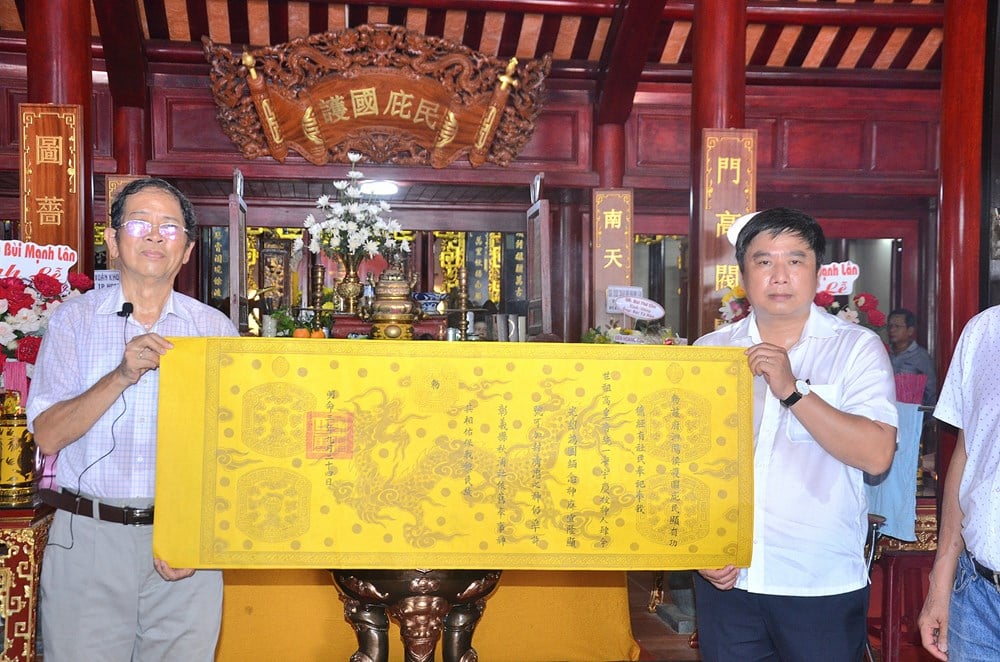
To preserve this royal decree, the Nguyen Mau family laminated it with plastic, then placed it in a wooden box on the altar. While this method successfully prevented the decree from decaying or becoming moldy, the drawback is that, over time, as the plastic coating ages and yellows, it will affect the aesthetics and color of the decree.
Furthermore, over time, moisture accumulates inside, accelerating the decay process, and when the resin layer is peeled off, the imperial decree is at high risk of damage. At the temple of Tran Quoc Cong Bui Ta Han in Quang Phu ward (Quang Ngai city), 23 imperial decrees from the time of King Canh Thinh to the time of the Nguyen dynasty kings are also preserved in the temple by the Bui Quang Phu family.
Mr. Bui Phu Anh, the 14th-generation descendant of Tran Quoc Cong Bui Ta Han, shared that the imperial decree is a precious asset, so even after going through war, the descendants of the Bui Quang Phu family have taken turns guarding it.
Even amidst bombs and stray bullets, previous generations were determined to preserve and protect the royal decrees to the very end. Among the 23 royal decrees, nine were granted by the king to Duke Tran Quoc Bui Ta Han. Of these, the oldest decree dates back to the time of King Canh Thinh, more than 200 years ago.
"Generations of the family have preserved and protected the royal decrees using traditional methods, which involved placing them in wooden chests, later replacing them with aluminum chests to protect them from mold, dampness, and termites."
This aluminum chest was made to a very large size, large enough to lay out flat 23 imperial decrees inside, not rolled up. Because if rolled up, the decrees would easily bend, break, or tear.
"After preserving and safeguarding the royal decrees manually for over a hundred years, about 20 years ago, the family laminated all 23 of these decrees," Mr. Anh added.
According to Dr. Nguyen Dang Vu, former Director of the Department of Culture, Sports and Tourism of Quang Ngai province, the content of the royal decrees contains information about the rank, divine title, honorary title, etc., of each person to whom the decree was granted and approved for the local people to worship.
Through numerous surveys conducted in recent years, more than 100 royal decrees are still preserved in the province. However, some of these decrees have been damaged. The majority of royal decrees from the feudal dynasties that have survived to this day are stored in historical sites that have been classified at the provincial or national level.
Meanwhile, most of those responsible for safeguarding imperial decrees have not received detailed, in-depth guidance on how to preserve them. This is also one of the reasons why many imperial decrees are gradually deteriorating, decaying, and the inscriptions are no longer legible.
"Given this reality, the cultural sector needs to promptly train and guide relevant individuals and organizations on how to scientifically preserve royal decrees in order to minimize damage over time."
In addition, it is necessary to compile a detailed list of damaged royal decrees; and those showing signs of damage or mold, in order to promptly find solutions for preservation and restoration.
On the other hand, the cultural sector needs to consider compiling, researching, and translating the entire content of the royal decrees, and then proceeding with photocopying and digitizing these decrees.
"Digitization is necessary and urgent to preserve and safeguard the values of royal decrees for future generations," Mr. Vu emphasized.
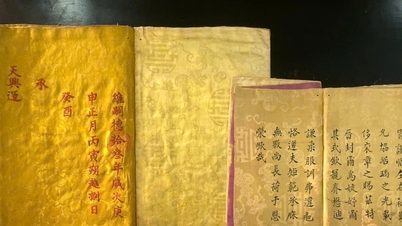
In the monograph "Han Nom Heritage in Quang Ngai - Characteristic Types and Values," edited by Dr. Nguyen Dang Vu (published by the Social Sciences Publishing House, Hanoi , 2020), it is clearly stated that the imperial decrees found in Quang Ngai were made of a type of yellow, flexible paper, crafted by artisans from Lai Nghe village (Hoai Duc district, now part of Hanoi).
The imperial decrees typically measure between 1.2 and 1.3 meters in length and about 0.5 meters in width. They are often decorated with patterns depicting the four mythical creatures, dragons and clouds, or the characters for "ten thousand" (萬) and "longevity" (壽).
There are royal decrees covered with gold leaf, like some decrees from the Minh Mệnh era, or silver leaf, like those from the Tự Đức era, found at Hoa Sơn Pagoda in Nghĩa Phú commune (Quảng Ngãi City) and the temple of Trấn Quốc công Bùi Tá Hán in Quảng Phú ward (Quảng Ngãi City).
Source: https://baovanhoa.vn/van-hoa/gin-giu-sac-phong-nhu-bao-vat-103456.html


![[Photo] General Secretary and President To Lam meets with National Assembly delegates from ethnic minorities.](https://vphoto.vietnam.vn/thumb/1200x675/vietnam/resource/IMAGE/2026/04/20/1776696701056_a1-bnd-8331-3342-jpg.webp)
![[Image] National Assembly discusses the implementation of the socio-economic development plan.](https://vphoto.vietnam.vn/thumb/1200x675/vietnam/resource/IMAGE/2026/04/20/1776696707422_ndo_br_img-20260420-185419-jpg.webp)













































































Comment (0)