

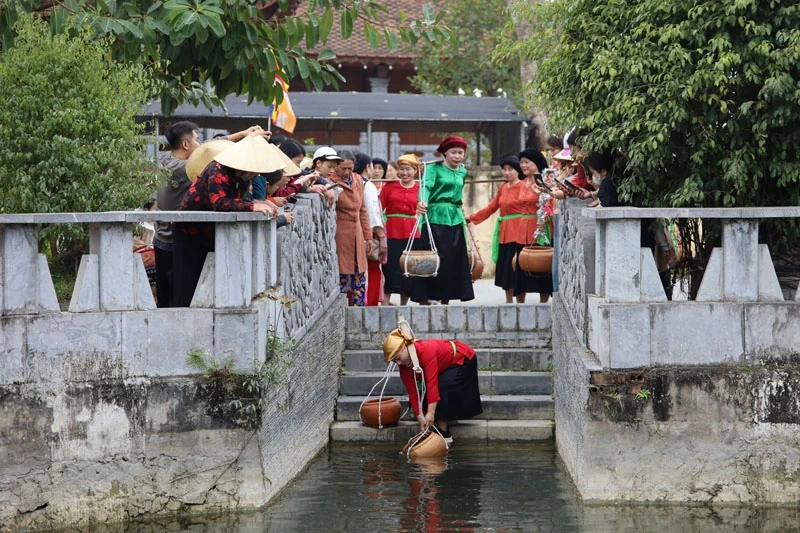
The Ky Phuc Festival of Quy Chu Village.
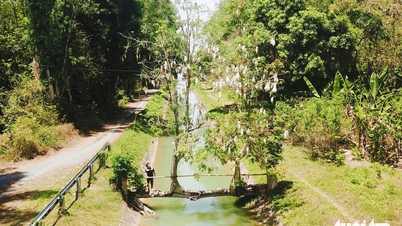
Visiting Quỳ Chử village, an ancient land with a history spanning thousands of years, renowned for its rich culture and close-knit community life, we are immersed in the cultural atmosphere of an ancient Vietnamese village. The road leading into the village has been neatly paved with concrete. The forms of community cultural life, from the village architecture, village ponds, village wells, and communal houses to customs, traditions, and festivals, have been preserved almost intact.
Leading us on a tour of the village, the village head of Quỳ Chử, Lê Đình Biên, shared: "Quỳ Chử village has a long history closely linked to the Đông Sơn culture. In the past, the village was called 'Kẻ Tổ'. Currently, the village has three hamlets: Tây Phúc, Trung Tiến, and Đông Nam. Every year in the second lunar month, the people of Quỳ Chử village gather at Trung communal house – a place that holds the cultural memories of many generations – to organize the village festival. The Kỳ Phúc village festival, held every two years in the second lunar month, is the largest gathering point for the community. During the festival, the three hamlets and four sub-hamlets return to Trung communal house to offer incense, perform rituals, and recreate traditional community life. The festival atmosphere is both solemn and vibrant with folk culture. Traditional rituals such as the palanquin procession, female and male official ceremonies, and traditional games like rice-eating contests, water-carrying games, and cooking rice on dry land are interspersed, creating a joyful and cohesive atmosphere for the people of Quỳ Chử village." It's worth noting that even in the age of technology, when young people tend to leave the village to study and work, the village festival remains a "promise to return," a gathering of all generations in Quy Chu village. For them, it's not just a reunion, but a way to affirm their roots and continue the flow of family and homeland culture.
What gives Quỳ Chử village its unique vitality today lies not only in its historical depth, but also in how the community "lives" with cultural values in a natural and enduring way. For many years, the people of Quỳ Chử village have always cherished and preserved cultural and historical relics, ancient wells, and the architectural space of a traditional Vietnamese village. To this day, Quỳ Chử village still preserves four relics: the Nguyễn Đình ancestral temple, the Trung communal house, the temple dedicated to the Holy Mother, and the Đồng archaeological site.
The village of Cáo is a national historical site. Two-thirds of the village's ancient wells have been restored. The village's customary regulations are maintained, becoming a "soft framework" that binds the community together.
The village of Quỳ Chử is also impressive for its strong sense of community and mutual support. Every afternoon, at the community center or the village square, the elderly sit and chat about old times, the young exercise, and the children play. These simple activities have become a bond connecting people to one another.
Mr. Le Nhat Truong, head of Tay Phuc village, said: “The people of Quy Chu village have always been united and compassionate for generations. With the development of technology, the villagers have used technology to connect their children and grandchildren across the country. Zalo groups have been formed, and village affairs are regularly updated to their descendants. Thanks to this, many activities related to building new rural areas, constructing roads, and restoring and upgrading historical relics... have been actively contributed to by the people and their children living away from home. In the past nearly 5 years, the people and their children living away from home have contributed more than 5 billion VND to build local projects.”
Leaving Quỳ Chử, the journey to preserve the village's soul continues to Phượng Mao – where culture is not only preserved in each historical site and heritage but also permeates every aspect of daily life. Phượng Mao is an ancient village that has undergone many upheavals, resulting in the destruction of many cultural artifacts. However, with a spirit of unity and pride in their homeland, the people here have meticulously restored and preserved almost entirely the village communal house, royal decrees, and many cultural and religious values. Phượng Mao village stands out for the enduring vitality of its intangible cultural values, especially the art of Chèo (traditional Vietnamese opera).
The traditional folk opera (Chèo) of Phượng Mao village is preserved naturally and vibrantly. The villagers maintain their own Chèo clubs, passing the craft down from generation to generation. Children grow up to the sounds of Chèo drums, the elderly play a central role, and the middle-aged generation acts as a connector, integrating traditional art into modern cultural activities. Many artisans in Phượng Mao have become core performers at district and provincial-level festivals, bringing pride to the entire community. Mr. Hàn Hải Vịnh, a son of Phượng Mao who is wholeheartedly dedicated to Chèo, shared: “Phượng Mao Chèo has existed for an unknown period of time, but the Chèo melodies and drum sounds have become an indispensable part of the people's lives. Regardless of the era, Chèo has always been the thread that binds the community together, connecting generations of people in Phượng Mao village.”
According to Khương Bá Sơn, Head of the Culture and Social Affairs Department of the Hoằng Giang Commune People's Committee: “Hoằng Giang Commune has 21 villages, many of which still preserve traditional cultural values. Village culture has nurtured each individual and become a driving force for local development.”
The journey of preserving the village spirit of Hoang Giang commune in the digital age shows that village culture can absolutely coexist with the digital era, provided there is community consensus and the vision of the Party committee and government. The more correctly the value of village culture is understood, the more it becomes a solid spiritual foundation for the development of new rural areas and modern life.
Text and photos: Thùy Linh
Source: https://baothanhhoa.vn/giu-hon-lang-nbsp-thoi-cong-nghe-so-271779.htm

![[Photo] Hanoi is ready for the "National Festival"](https://vphoto.vietnam.vn/thumb/1200x675/vietnam/resource/IMAGE/2026/03/12/1773305846167_ndo_br_z7612336508628-14627dc7d18cc27532ffea5d4089713b-4105-jpg.webp)
![[Photo] Trial run of the election process at polling stations in Dong Da ward (Hanoi)](https://vphoto.vietnam.vn/thumb/1200x675/vietnam/resource/IMAGE/2026/03/12/1773306146728_ndo_br_van-hanh-thu-to-bau-cu-4070-755-jpg.webp)











































Comment (0)