


The sound of memory and identity
Pà Vầy Sủ and the western communes of the province are home to the majority of the Nùng ethnic group. Along with festivals, traditional costumes, folk songs, and the sound of the Lìn Xìn instrument, it has long been an indispensable part of the community's spiritual life. The Lìn Xìn instrument is often played at spring festivals, weddings, housewarming parties, courtship nights, and even funerals. In each context, the sound of the instrument takes on a different nuance: sometimes profound and heartfelt; other times lively and invigorating. It is especially indispensable at spring festivals with its traditional singing performances, featuring songs about "springtime thanks to the Party," "celebrating the Party - celebrating spring - celebrating the country's renewal," and so on.
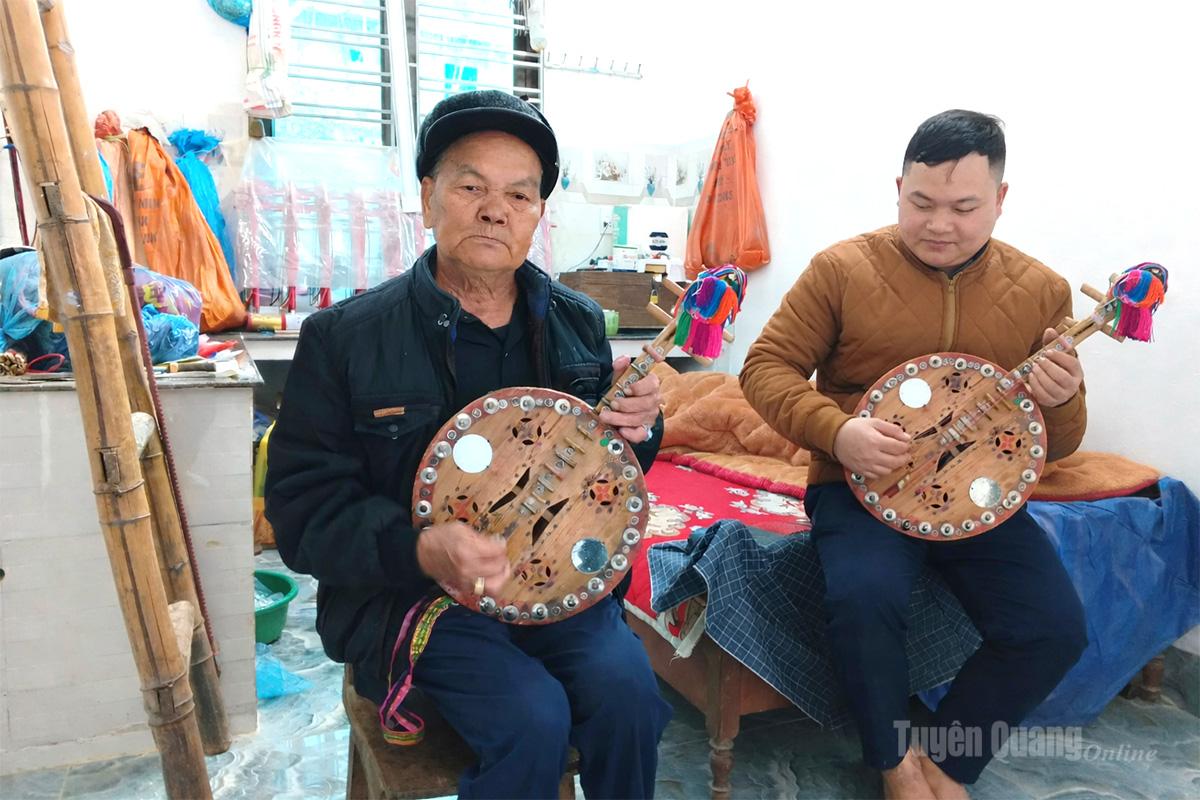 |
| Artisan Váng Vần Séng (on the left) teaches the Lìn Xìn instrument to the younger generation. |
Artisan Váng Vần Séng recounts that he became fascinated with the Lìn Xìn instrument in his childhood. On winter nights before electricity, by the warm fire, he was introduced to the Lìn Xìn through songs performed by his father and other artisans in the village. “Back then, the sound of the instrument in the night was like the sound of a stream flowing through the vast mountains and forests. It just seeped into me without me even realizing it,” Séng recalls. From that passion, he taught himself, practiced, and gradually became a skilled player in the region.
The Lin Xin instrument is an ancient musical instrument of the Nung ethnic group in Pa Vay Su. The instrument has a simple structure, resembling the Nguyet lute. The entire body is made of wood, approximately 70cm long, with a neck about 30cm long and four evenly spaced frets. The head of the instrument has holes for threading strings and is decorated with Nung ethnic brocade threads. The soundbox is a flattened, cylindrical shape, about 40cm in diameter and 6cm thick, with many small holes and one hole about 5cm in diameter on the back for sound escape. It is decorated with small pieces of stainless steel, aluminum, or silver around the soundbox. The Lin Xin has four strings made from horsehair, nylon, or thin steel wire; however, to produce a full, resonant sound, the player must understand the rhythm of folk songs and feel the spirit of each melody. For Mr. Séng, each piece of music tells a story about his village, about love between couples, about hopes for a bountiful harvest, and a song dedicated to the Party...
Comrade Duong Van Phu, Head of the Culture Department of Pa Vay Su commune, said: “Currently, artisan Vang Van Seng is one of the most skilled practitioners of Lin Xin in the area. He not only performs but also actively teaches the younger generation. This is an important factor in preserving the local intangible cultural heritage and simultaneously creating a foundation for building a mass cultural and artistic movement linked to community tourism development.”
According to the Head of the Culture Department of Pà Vầy Sủ commune, in the context of many traditional values facing the risk of disappearing, the role of folk artisans becomes even more special. They are the "living archives," the bridge between tradition and modernity, helping to prevent cultural disconnection across generations.
Passing it on to future generations.
The modern pace of life has opened up many opportunities for people in the highlands, but it also presents numerous challenges. Young people are going away to study and work, accessing modern forms of entertainment, causing traditional melodies to gradually become less known. Concerned about this reality, Mr. Séng proactively teaches the younger generation how to play the instrument anytime, anywhere. Every week in the evening, after school, the children gather on his porch. The artisan patiently holds each child's hand, adjusts their posture, and guides them on how to tune and keep the rhythm. "Teaching the children isn't just about teaching technique, but also about teaching them why their ancestors cherished the sound of the instrument so much," Mr. Séng shared.
 |
| The Lin Xin instrument is an ancient musical instrument of the Nung ethnic group in Pa Vay Su. |
Besides teaching the instrument, he also tells the younger generation about the origins of the melodies, the customs, and traditions of the Nung people. For him, learning to play the instrument is also about learning how to behave and learning to love the village. Artisan Chang Thi Ve, who has participated in folk culture activities in Pa Vay Su for many years, commented: “The Lin Xin instrument is not simply a musical instrument, but the soul of many rituals and community activities of the Nung ethnic group. Artisan Vang Van Seng is a person with great dedication, always striving to pass on the sound of Lin Xin to future generations. However, to effectively preserve it, in addition to individual efforts, the attention of the government and the cultural sector is very much needed in organizing training courses, opening classes to teach, and inspiring passion in the younger generation. Only when the heritage is ‘alive’ in the community will it have lasting sustainability.”
Besides performing and teaching, Mr. Séng also crafts musical instruments himself. From familiar materials like pieces of wood, water pipes, and milk cans, his skillful hands transform them into Lin Xin and Nhi instruments, each with its own unique sound. Each completed instrument is another bridge connecting the past and the present. During national unity festivals and spring festivals, Mr. Séng's music is always a highlight, attracting large crowds. This simple sound not only evokes national pride but also contributes to enriching the spiritual life of the community.
Amidst the changes in this border region, the sound of the Lin Xin instrument in Pa Vay Su still resonates, a reminder of our roots. As long as there are dedicated artisans like Vang Van Seng, the passion for traditional musical instruments will continue to be ignited in the younger generation, and the cultural heritage of the Nung people will continue to be preserved and spread, enduring like an underground stream flowing through generations.
Van Long
Source: https://baotuyenquang.com.vn/van-hoa/202603/giu-hon-lin-xin-noi-dai-ngan-e5f4e3e/
![[Photo] Prime Minister Pham Minh Chinh presides over the meeting of the Steering Committee for key projects in the transport sector.](https://vphoto.vietnam.vn/thumb/1200x675/vietnam/resource/IMAGE/2026/03/05/1772697311077_ndo_br_dsc-0043-jpg.webp)








































Comment (0)