

Mr. Ngo Hoang Son is the fourth generation in his family to practice blacksmithing. He recounts that the craft dates back to his great-grandfather's time. Through generations, from his maternal grandfather to his two uncles and then to himself, the forge's fire has burned continuously. "A sharp knife depends on using the right steel, a well-hardened cleaver… that's how you get a sharp knife that sells for a good price," Mr. Son says with a smile, his eyes shining with pride. This seemingly simple statement is an art form that only those in the trade truly understand, because a traditional forged knife is not just a tool, but the culmination of technique, time, fire, sweat, and… a love for the craft.
Mr. Son recounted that his family was poor when he was young, and he had to drop out of school after the 9th grade because they couldn't afford a bicycle to continue his studies in Rach Soi. From the age of 10, he followed his uncle to the forge, hammering with small hammers and then larger ones, learning each step from shaping, carving, and sharpening to polishing. It wasn't until he was 18 that he forged his first complete knife. "This job is very hard, but my uncle told me that since I had no other profession, I had to stick with blacksmithing so I could support my wife and children later," Mr. Son recalled.
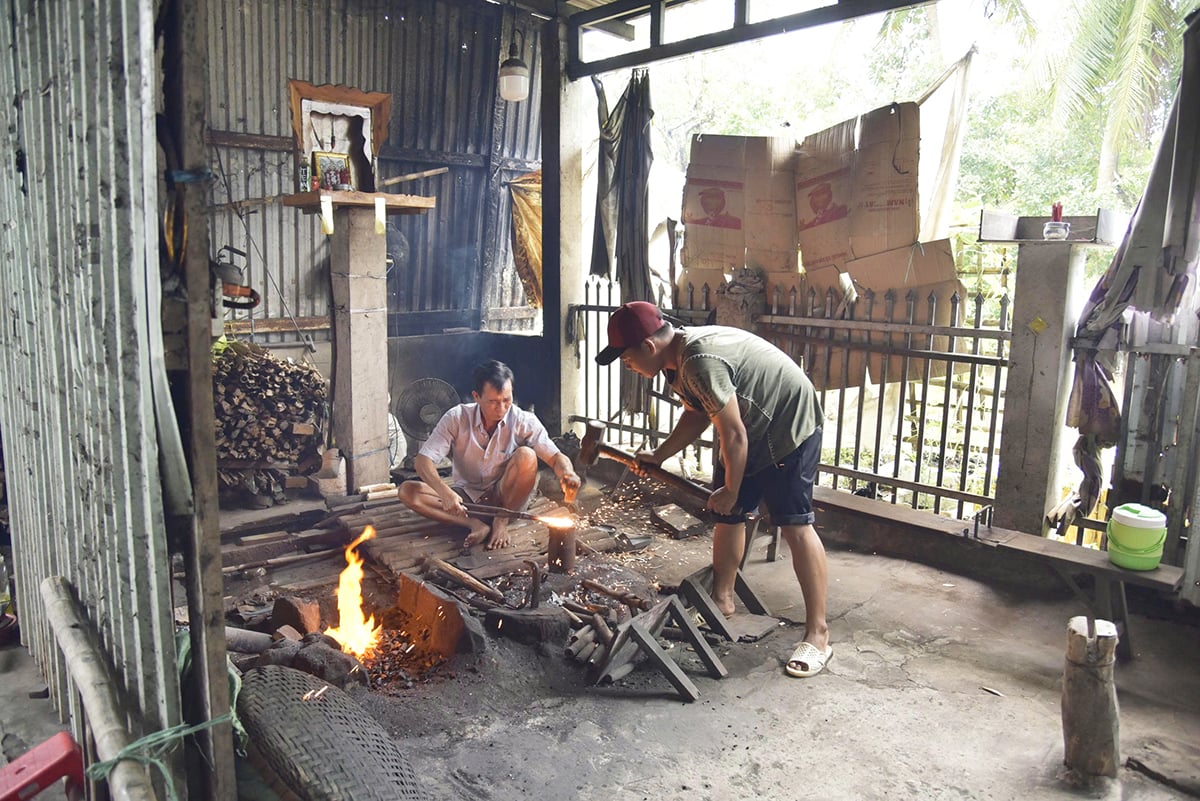
Mr. Ngo Hoang Son and his son forge knives for customers.
Mr. Son's blacksmith shop was recognized as a traditional craft in 2019, but for him, that title is less important than the steady stream of orders, with people using the tools and then returning for more. Each day, Mr. Son and his son forge 4-6 products, including various agricultural tools such as pineapple cutting knives, betel nut harvesting knives, leaf-picking knives, hammers, hoes, and scissors. Each product takes nearly half a day to complete, with knives priced from 200,000 VND to over 1 million VND. "I can't keep up with the demand. During Tet (Lunar New Year), people in Phu Quoc order many fish-cutting knives. The knives I make are different from those sold in the market; you can tell the difference immediately," Mr. Son said.
Like many other crafts, knife forging requires meticulousness, strength, and experience. From selecting the steel from imported bullet casings from Saigon to cutting the iron, measuring the blank, splitting, heating it over a red-hot fire made of acacia wood, then hammering, shaping, attaching the handle to a mulberry wood, sharpening, filing… each step is a link in the chain. Finally, sharpening is the step that determines the quality of the blade.
Mr. Son has only one son, Ngo Hoang Ha, who also followed in his father's footsteps. Although he worked as a hired hand for a while, Ha quickly returned to the blacksmith's shop because he missed home and the craft. Ha said, "I'll probably stick with this profession and won't change jobs. I'm so used to this work, it's like breathing." Thanks to his son's help and a few apprentices, Mr. Son's blacksmith shop earns an average of 1-2 million dong per day, with a profit of 500,000-800,000 dong after deducting expenses. Mr. Son said, "This profession doesn't make you rich, but it provides a living, and importantly, it preserves the craft of our ancestors."
Not only has Mr. Son preserved the craft, but he has also been the Party Secretary of Go Dat hamlet since 2000. Exemplary in his work, he has contributed to keeping alive a craft that is gradually fading away. Many people in the area and neighboring provinces have become loyal customers of the Go Dat blacksmith shop. Mr. Lam Thien Duc, residing in Dinh An commune, said: “I have used knives and hammers forged by Mr. Son for many years; they are very durable, only needing reforging every 5-10 years. Knives from the market used for chopping chicken sometimes get bent, but Mr. Son's knives are made of steel with an iron coating, they are sharp and stay sharp for a long time.”
Without flashy advertising or the need for social media, the Go Dat blacksmith shop endures through its quality and reputation. People seek out Mr. Son because they trust him, and others return because they remember him fondly. And the sharp blades from this workshop are not only used for splitting betel nuts and cutting pineapples, but also keep the flame of the ancient craft burning brightly...
Source: https://baoangiang.com.vn/giu-lua-nghe-truyen-thong-lo-ren-go-dat-a424230.html


























































































Comment (0)