

Every year-end, traditional sugarcane molasses distilleries along the Ho Chi Minh Highway in Nghia Hanh commune (Nghe An province) are busy with their fires burning day and night to produce a line of sweet, smooth, amber-colored sugarcane molasses to serve the Tet market.
For generations, the people of this mountainous commune have been closely associated with sugarcane cultivation for making molasses. The sugarcane harvest season coincides with the molasses pressing season, lasting from the tenth lunar month to the third month of the following year.
In particular, in the period more than a month before Tet, in order to supply a large quantity of sugarcane molasses to the market, the molasses distilleries continuously operate in batches, burning brightly day and night.
Constantly working on broken mattresses, bustling with activity like a blazing fire.
For decades, the communes of Tan Huong, Phu Son, and Nghia Hanh (formerly Tan Ky district), now Nghia Hanh commune, Nghe An province, have been famous for their traditional sugarcane molasses production. Currently, there are dozens of molasses production facilities in this "capital" of sugarcane molasses.
In the days leading up to the Lunar New Year of the Horse 2026, the molasses factories here are always busy as the owners take advantage of every hour to produce batches of molasses that are dark amber in color, smooth, clear, without bubbles, with a natural aroma and a mild, sweet taste.
In the early morning in the mountainous region, the sound of sugarcane presses echoes throughout the villages and hills. The molasses-making furnaces emit plumes of smoke, mingling with the sweet aroma of molasses, seemingly "awakening" the rural communities and mountain towns.
To convert sugarcane juice into molasses, business owners must use a continuous furnace system with 3-5 burners. The metal pans used for cooking the molasses are round, with a diameter of 1.2-2 meters, and each pan has a capacity of 170-200 liters. The average cost of construction, installation, and setup is 30-40 million VND per furnace, not including the cost of purchasing sugarcane presses and other auxiliary equipment.
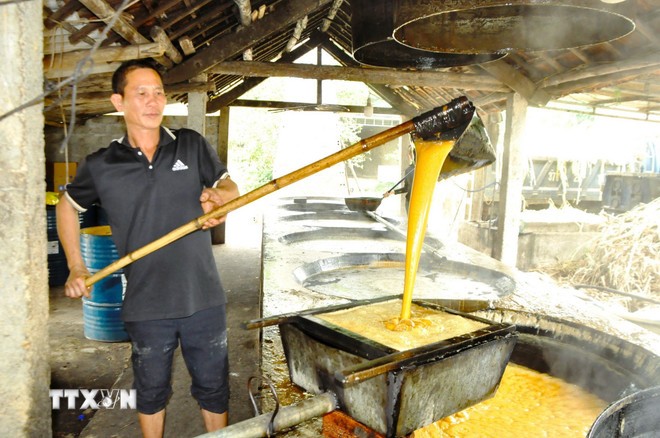
To operate a sugarcane syrup production facility and ensure smooth processes, approximately 3-4 workers are needed for each operation. During the syrup-making process, one person regularly adds firewood to the stove to maintain a stable heat supply, while using sieves with mesh made of cloth to skim off foam and impurities floating in the cooking pans. The others continuously press the sugarcane to extract the syrup, transport the sugarcane pulp for drying, and measure the cooled syrup into containers of various shapes and sizes.
While the process of gathering sugarcane, pressing it to extract the juice, and then boiling it in a pan requires labor and hard work, the stage of skimming off the foam and removing impurities from the boiling molasses demands skill and experience from the worker. If the impurities floating on top of the foam are not completely removed, the molasses will be lumpy, not smooth and creamy, the color will be dark, and the quality will be reduced. The quality of molasses depends heavily on the quality of the raw materials. The larger and sweeter the sugarcane, the more molasses is harvested.
A batch of sugarcane molasses takes about 3 to 4 hours to cook. For more than half of that time, the molasses is still bubbling and boiling. When boiling, the pots of molasses look like towering, golden-yellow waterspouts, emitting thick plumes of steam.
Ms. Nguyen Thi Phap, owner of the Truong Phap sugarcane syrup production facility in Nghia Hanh commune, said that the last three months of the year are the main season for making sugarcane syrup. Every day, she and her husband have to work from early morning until late afternoon.
To ensure a sufficient supply of raw materials for making molasses to meet market demand, her family purchased tens of tons of sugarcane from local residents.
This year, the price of raw materials has increased, leading to a slightly higher price for sugarcane molasses. Market demand is high this year, so all the molasses producers in the village are busy during the season. All the molasses they produce is bought up by customers, so the molasses producers are very happy.
Mr. Nguyen Van Duc, owner of the Duc Hien sugarcane molasses production facility in Nghia Hanh commune, shared that his family has been making sugarcane molasses for over 10 years. For more than two months now, his family has been making three batches of molasses daily, producing about 800 liters per day. The operation of the molasses production facility starts at 4 am and doesn't finish until nearly 10 pm.
Busy scooping sugarcane molasses into containers, Ms. Nguyen Thi Hien said that many years ago, the process of making sugarcane molasses had to be done manually and by hand, which was very hard work. Now, with the help of machinery, the labor has been freed up, making the molasses making process much easier.
From harvesting and cleaning the sugarcane to cooking and skimming off the foam, the process is streamlined, increasing work efficiency and productivity. To produce enough sugarcane syrup to meet customer orders during Tet (Lunar New Year), the family had to hire two additional workers.
According to Mr. Nguyen Van Duc, owner of a sugarcane molasses production facility, on average during Tet (Lunar New Year), each facility produces 8,000-10,000 liters of molasses, selling it locally to traders and consumers at a stable price of 28,000-30,000 VND/liter. At times of scarcity, the price of sugarcane molasses can reach 40,000 VND/liter.
On average, each ton of fresh sugarcane yields about 140 kg of concentrated molasses. At the end of the molasses production season, after deducting all expenses, households producing molasses can earn between 70 and 100 million VND.
Taking the brand further
According to owners of molasses production facilities in Nghia Hanh commune, sugarcane molasses is an indispensable ingredient and additive for making traditional dishes and treats in Vietnamese culinary culture during Tet (Lunar New Year) such as braised fish, braised meat, braised ribs, sweet soups, molasses cakes, sticky rice cakes, and peanut brittle... Therefore, at the end of the year, Nghia Hanh sugarcane molasses products always have the opportunity to reach markets throughout the country.
Mr. Hoang Van Nhung, from Dien Chau commune, Nghe An province, shared that in the minds of people in coastal villages, braised sea fish with molasses is an indispensable dish on the ancestral altar during Tet (Lunar New Year). People in coastal areas often braise various types of sea fish with molasses and spices such as galangal, ginger, and chili peppers in earthenware pots.
Whenever offerings are made to ancestors, fish is placed on a plate and arranged in the center of the offering tray. This beautiful cultural tradition has existed for nearly 100 years, preserved, maintained, and passed down through many generations by the people of this coastal region.
According to Mr. Nguyen Xuan Nam, Chairman of the People's Committee of Nghia Hanh commune, in recent years, Nghia Hanh sugarcane molasses has established its brand and is favored and trusted by customers near and far. The sugarcane molasses making profession has provided livelihoods, helped local people increase their income, and created jobs for thousands of local workers. In particular, many families have become wealthy from making sugarcane molasses right on the land they have lived on.
In recent years, owners of sugarcane syrup production facilities in Nghia Hanh commune have embraced digital technology, utilizing social media platforms like Facebook, TikTok, and Zalo to showcase their syrup-making methods and processes, and promote their products.
As a result, molasses producers gain access to a wider and more diverse market, increasing the value of sugarcane molasses and eliminating dependence on traders who come to purchase it on-site as before. Sugarcane molasses producers also play an active role in guaranteeing the purchase of sugarcane from local farmers and those in neighboring communes.
With the goal of improving quality, establishing brand recognition, and expanding the market for their products, families involved in the trade have formed a sugarcane molasses production cooperative; gradually improving the cooking process, investing in standardized containers for raw materials, changing product designs, and expanding the market; adhering to the correct production process for sugarcane molasses, ensuring food safety and hygiene.
Mr. Nguyen Xuan Nam, Chairman of the People's Committee of Nghia Hanh commune, said that in recent years, local people have maintained and expanded the planting area to create a raw material source for the sugarcane molasses making industry.
Currently, the entire commune has 30 establishments specializing in producing sugarcane molasses, with an output of approximately 250,000-300,000 liters per year. During the end of the year, market demand increases significantly, resulting in strong sales of sugarcane molasses.
Many traders also buy sugarcane molasses from Nghia Hanh to export to the Laotian market. Currently, the local sugarcane molasses product has been recognized as a 3-star OCOP product.
Working alongside the people, in the coming years, the local government will continue to support the promotion and introduction of products, expand consumption markets; design labels, register trademarks, and ensure traceability so that the sugarcane molasses product line can reach even further.
Source: https://baolaocai.vn/lang-nghe-mat-mia-vao-vu-tet-post892672.html































































































Comment (0)